
AP Biology Practice Quiz: Enzymes
Written by AP Content Team, Verified for 2026 AP Exams, Last updated: August 2026
Test your understanding with short quizzes. This quiz has 9 questions to check your progress.
Question 1 of 9
All Questions (9)
A) To increase the activation energy of reactions.
B) To act as the primary energy source for reactions.
C) To speed up the rate of chemical reactions.
D) To become a permanent part of the reaction's product.
Correct Answer: C
The text explicitly states that enzymes are 'biological catalysts that speed up chemical reactions in cells'.
A) By increasing the overall energy of the products.
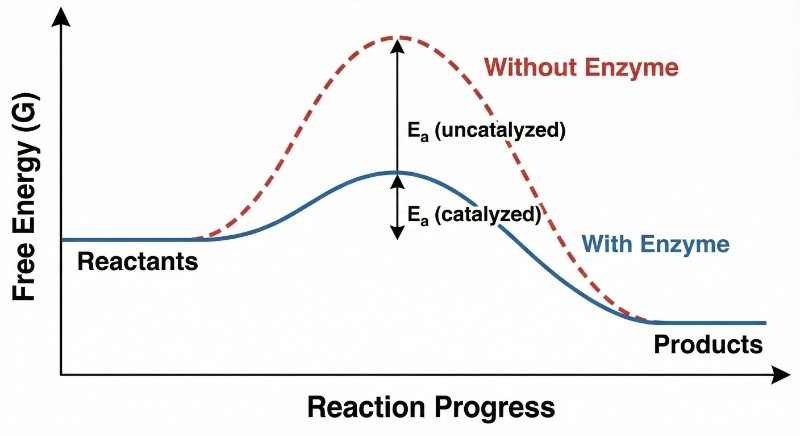
B) By lowering the activation energy required for the reaction.
C) By permanently binding to the substrate molecule.
D) By increasing the temperature within the cell.
Correct Answer: B
The content specifies that enzymes 'speed up chemical reactions in cells by lowering the activation energy required'.
A) Carbohydrates
B) Lipids
C) Nucleic Acids
D) Proteins
Correct Answer: D
The text begins a sentence with 'Enzymes, which are proteins...', directly identifying their molecular nature.
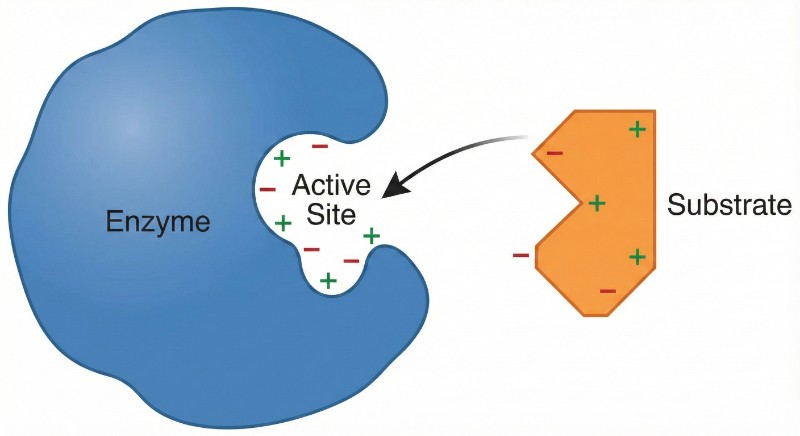
A) The substrate must be larger than the enzyme.
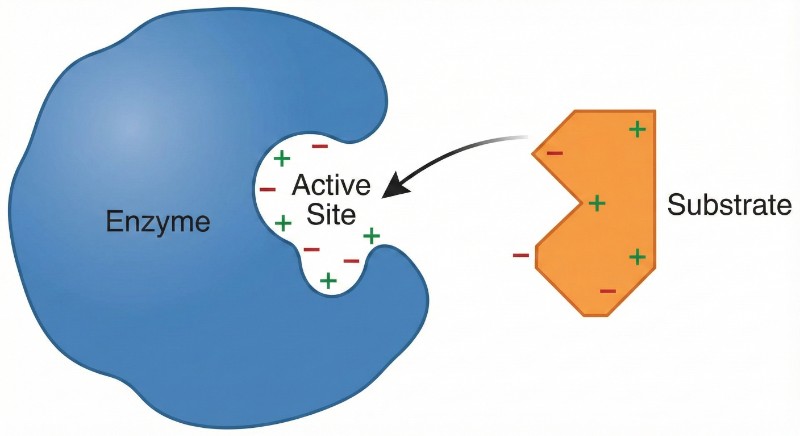
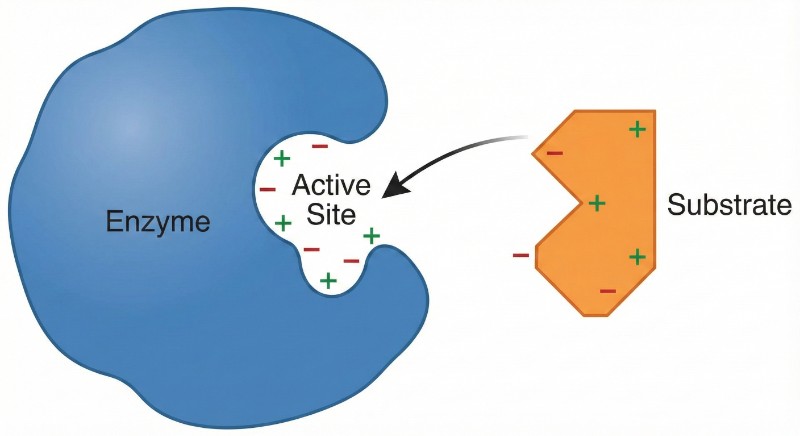
B) The substrate's shape and charge must be compatible with the enzyme's active site.
C) The enzyme must be present in a higher concentration than the substrate.
D) The reaction must occur in the absence of water.
Correct Answer: B
The text states that 'the substrate's shape and charge must be compatible with the enzyme's active site' for a reaction to occur.
A) Activation energy model
B) Biological catalyst model
C) Enzyme-substrate complex model
D) Protein reaction model
Correct Answer: C
The text directly references the 'enzyme-substrate complex model' when describing the compatibility between a substrate and an enzyme's active site.
A) The reaction rate would increase to compensate for the change.
B) The enzyme would lower the activation energy even further.
C) The compatibility with the enzyme's active site would be disrupted, slowing or stopping the reaction.
D) The enzyme would denature and become non-functional.
Correct Answer: C
Based on the text, both shape and charge must be compatible. An alteration in charge would likely disrupt the necessary compatibility for the enzyme-substrate complex to form, thus inhibiting the reaction.
A) Is consumed during the reaction.
B) Only functions inside a living organism.
C) Increases the speed of a reaction.
D) Provides energy for a reaction.
Correct Answer: C
The text defines enzymes as 'biological catalysts that speed up chemical reactions', directly linking the term 'catalyst' to the function of increasing reaction speed.
A) Enzymes are proteins that bind to any substrate to form a complex, which increases activation energy.
B) As protein catalysts, enzymes accelerate reactions by lowering activation energy, a process dependent on the specific charge and shape compatibility between the substrate and the active site.
C) The enzyme-substrate complex model explains how enzymes slow down reactions by changing the shape of the substrate.
D) Enzymes lower the activation energy of reactions by permanently altering their own protein structure to match the substrate.
Correct Answer: B
This option correctly synthesizes all the key points: enzymes are proteins, they act as catalysts, they speed up reactions by lowering activation energy, and this function relies on the specific compatibility described by the enzyme-substrate complex model.
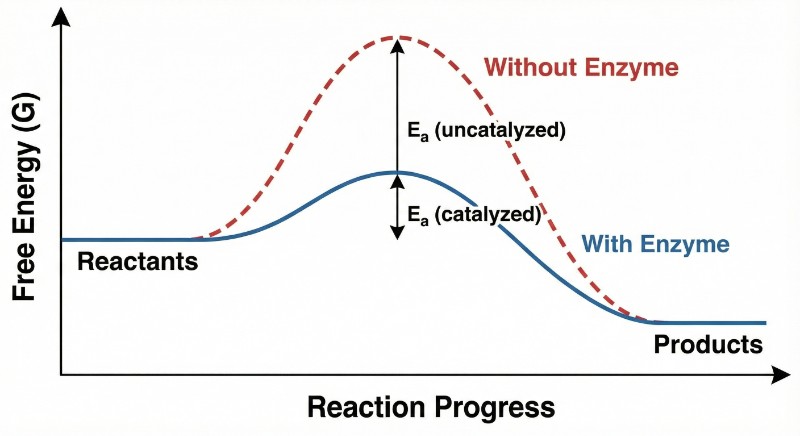
A) The enzyme would make the reaction require more energy to start.
B) The enzyme would change the final products of the reaction.
C) The enzyme would increase the reaction rate by reducing the energy barrier.
D) The enzyme would be used up, and the reaction would stop.
Correct Answer: C
The text states enzymes speed up reactions by 'lowering the activation energy'. This 'activation energy' is the energy barrier for the reaction. Therefore, the enzyme increases the rate by reducing this barrier.