
Getting Started
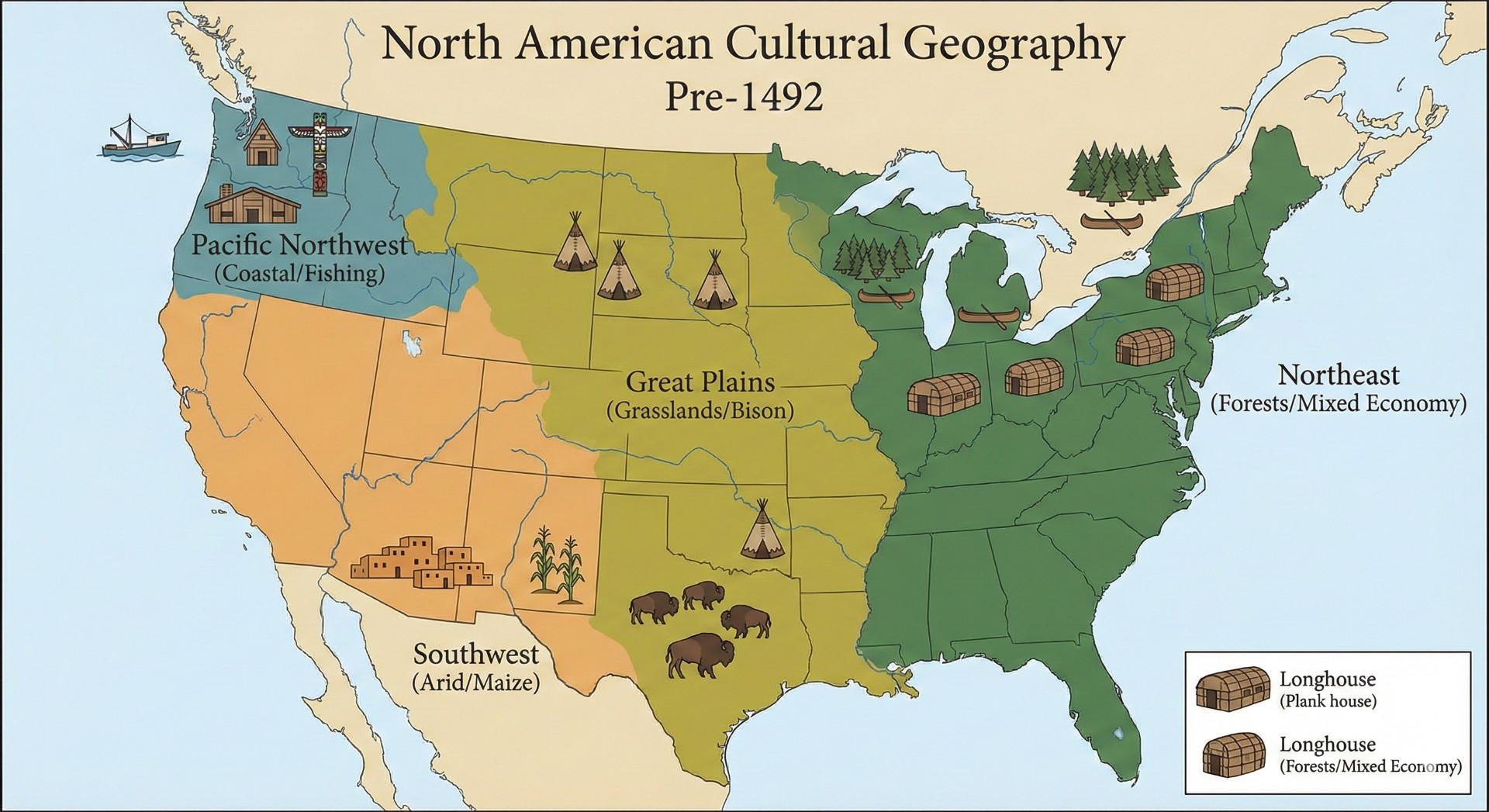
Before the arrival of Europeans, North America was home to millions of people living in a vast array of distinct societies. Over thousands of years, these groups developed unique cultures and lifestyles profoundly shaped by the continent's diverse natural environments. This chapter explores how and why different Native American societies adapted to, and interacted with, their specific geographic regions before 1492.
What You Should Be Able to Do
After studying this topic, you should be able to:
Explain how the spread of maize cultivation transformed societies in the American Southwest and East.
Analyze the relationship between a region's environment and the development of either mobile or permanent settlements.
Compare the economic and social structures of societies from four major regions: the Southwest, the Great Plains, the Northeast, and the Northwest.
Explain how different societies supported themselves through agriculture, hunting-gathering, or a combination of both.
Key Developments & Analysis
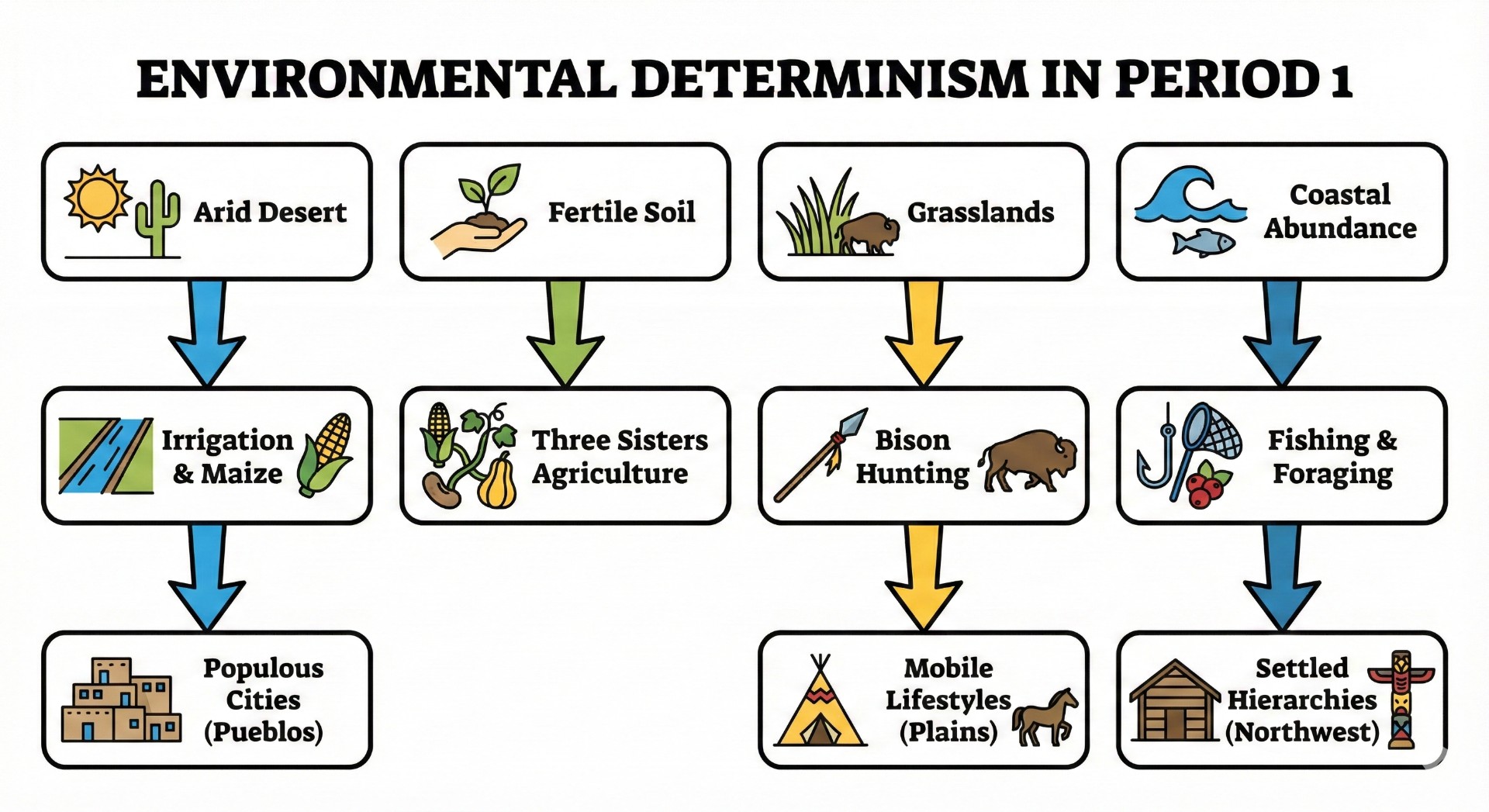
The primary cause for the vast diversity among Native American societies was their adaptation to different natural environments. The availability of resources, the climate, and the geography of a region directly influenced whether a society developed a mobile or settled lifestyle, how it obtained food, and how complex its social structure became.
Cause: The Spread of Maize Cultivation
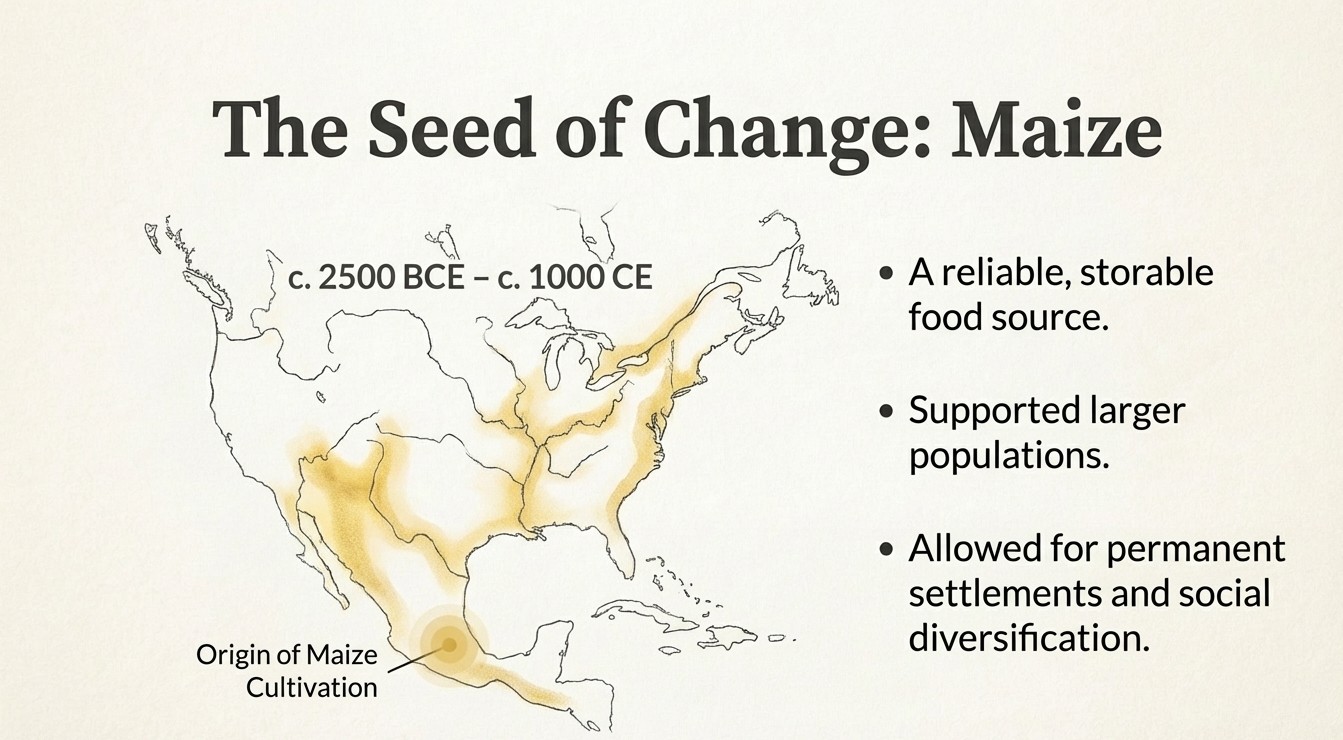
The development and spread of agriculture, particularly maize cultivation, was a powerful agent of change that transformed societies that adopted it.
- Maize Cultivation: The agricultural practice of growing corn. Originating in Mexico, its cultivation slowly spread northward into the American Southwest and then eastward, providing a reliable and storable food source.
Effects & Impacts of Environmental Adaptation
1. The Rise of Settled, Agricultural Societies
In regions where agriculture took hold, societies experienced profound changes that led to larger, more complex communities.
Immediate Effects:
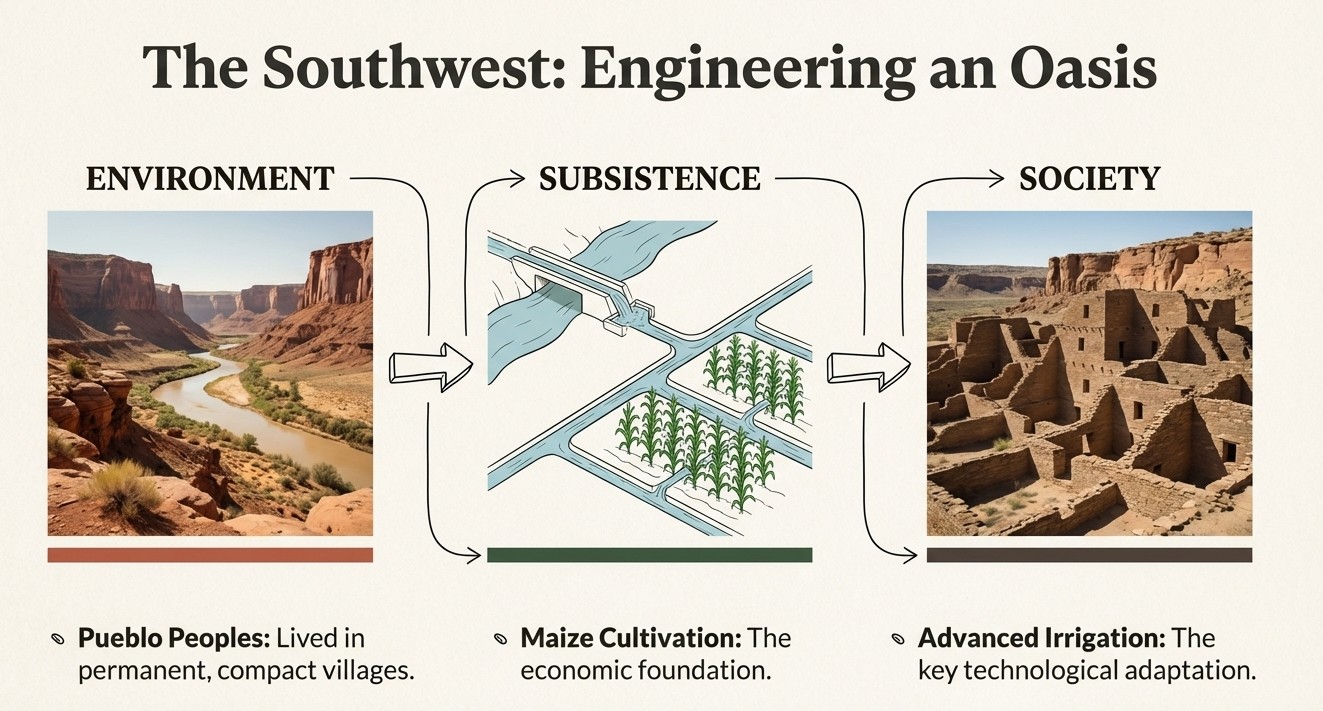
The reliable food surplus from maize supported larger populations.
Societies in the Southwest developed advanced irrigation systems to water crops in arid conditions.
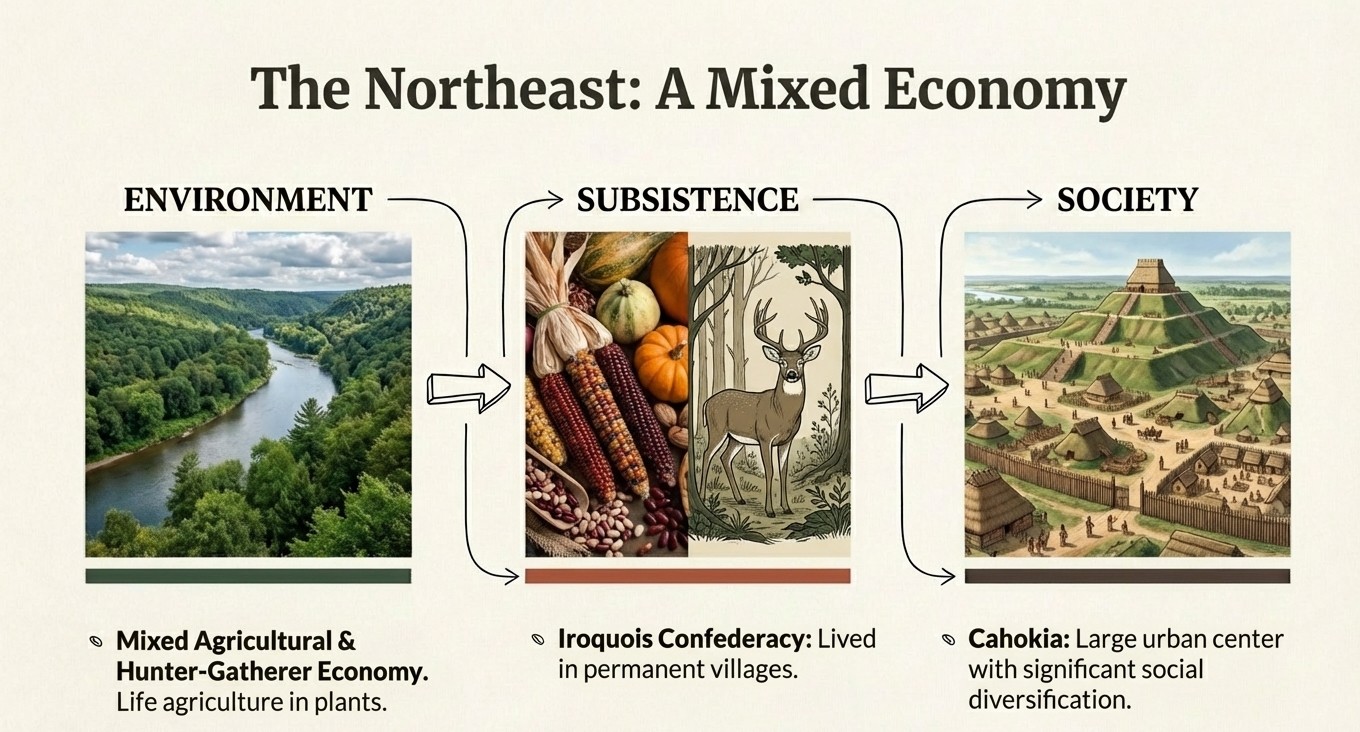
Groups in the Northeast, Mississippi River Valley, and along the Atlantic seaboard developed mixed agricultural and hunter-gatherer economies, cultivating crops while also hunting and gathering to supplement their diets.
Long-Term Impacts:
Food surpluses allowed for social diversification, where some members of the community could specialize in non-agricultural tasks such as craftwork, religious leadership, or governance.
Permanent villages and even large urban centers, like Cahokia in the Mississippi River Valley, emerged.
Economic development was spurred by the ability to store and trade surplus crops.
2. The Development of Mobile Lifestyles
In environments that could not support large-scale agriculture, societies adapted by remaining mobile.
Immediate Effects:
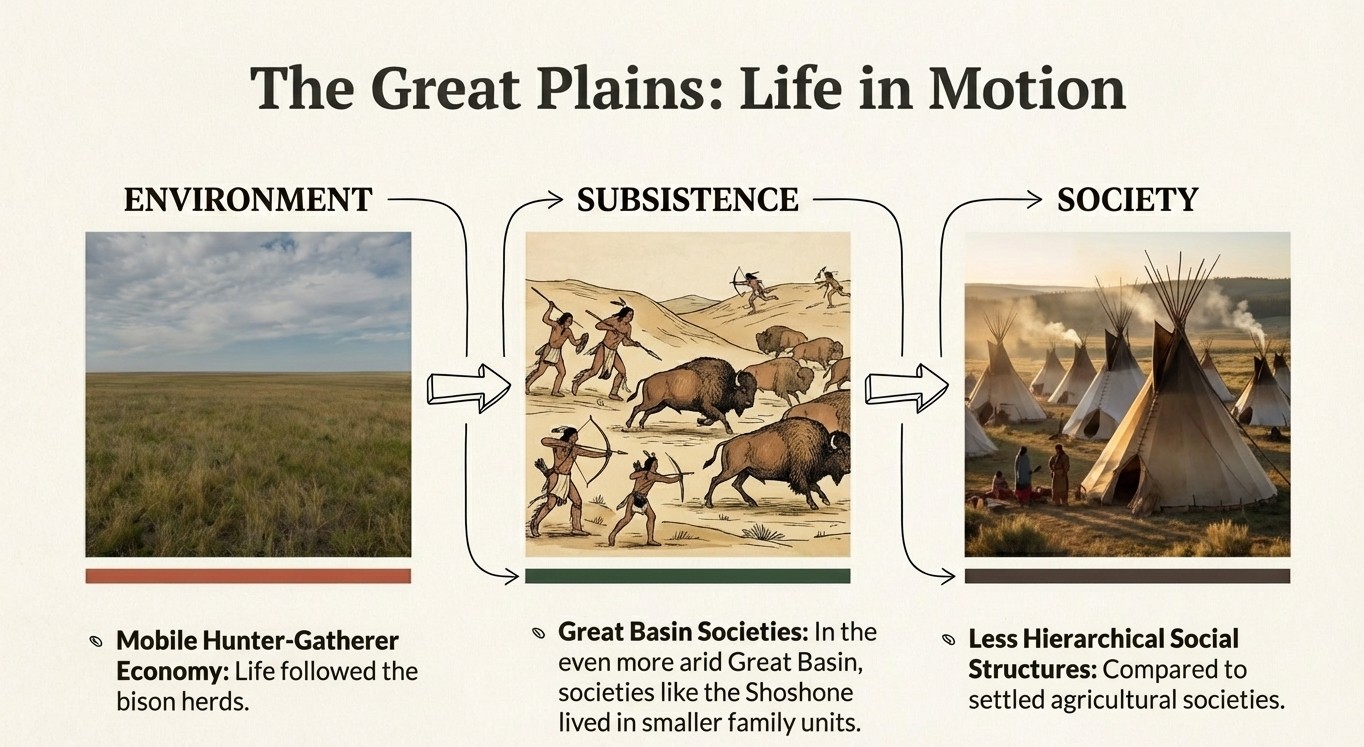
In the arid Great Basin, resources were too scarce to support permanent villages, leading societies to live in small, mobile family groups.
On the vast grasslands of the western Great Plains, societies were largely mobile, following the great bison herds that provided their primary source of food, clothing, and tools.
Long-Term Impacts:
Social structures remained less hierarchical than in settled agricultural societies.
Deep knowledge of the environment, animal migration patterns, and seasonal plant life was essential for survival.
3. The Emergence of Settled Foraging Communities
In some regions, the natural environment was so rich that it could support large, settled communities without the need for agriculture.
Immediate Effects:
Societies in the Northwest and parts of California relied on hunting, gathering, and especially fishing in the resource-rich ocean and rivers.
The abundance of food, such as salmon runs in the Northwest, allowed people to live in one place year-round.
Long-Term Impacts:
These societies developed permanent villages with large, sturdy houses.
They built complex social and political structures, often with clear hierarchies and powerful leaders, despite not being agricultural.
Data & Organization Tools
This table organizes Native American societies by region, highlighting the connection between environment, subsistence, and settlement.
| Region | Key Environmental Feature | Primary Subsistence Strategy | Typical Settlement Pattern |
|---|---|---|---|
| Southwest | Arid climate, river valleys | Maize cultivation with advanced irrigation | Permanent, compact villages (pueblos) |
| Great Basin / Great Plains | Arid, sparse vegetation / Grasslands | Mobile hunting and gathering | Mobile, non-permanent camps |
| Northeast / Miss. Valley | Temperate forests, fertile river valleys | Mixed agriculture and hunting-gathering | Permanent villages, some large cities |
| Northwest / California | Abundant forests, rivers, ocean | Hunting, gathering, and fishing | Permanent villages, supported by ocean resources |
Evidence Bank
- Maize: The primary grain crop for many agricultural Native American societies. Its cultivation allowed for food surpluses, population growth, and the development of settled communities.
Pueblo Peoples: Societies in the American Southwest who cultivated maize and lived in permanent, multi-story buildings made of adobe or stone. They developed complex irrigation systems to farm in an arid climate.
Cahokia: The largest urban center of the Mississippian culture, located near modern-day St. Louis. At its peak, it was a city of thousands, featuring enormous earthen mounds and demonstrating significant social diversification.
Iroquois Confederacy: A political and linguistic group in the Northeast that lived in permanent villages. They practiced a mixed economy, cultivating maize, beans, and squash while also hunting and gathering.
Great Basin Societies: Groups such as the Shoshone and Paiute who adapted to the dry, resource-scarce Great Basin. They lived as mobile hunter-gatherers in small family units.
Chinook Peoples: Societies of the Pacific Northwest who lived in settled, non-agricultural communities. They built a complex society based on the abundant fish, game, and plant life of the region.
Hunter-Gatherer Economy: A system in which food is obtained by foraging for wild plants and hunting wild animals, rather than by agriculture. This was the sole strategy in some regions and part of a mixed strategy in others.
Skill Snapshots
Causation:
The spread of maize cultivation from Mexico caused the development of permanent villages and social diversification in the American Southwest and East.
The arid environment of the Great Basin caused societies there to adopt largely mobile lifestyles.
The vast resources of the Pacific Ocean caused the development of settled communities in the Northwest, even without agriculture.
Comparison:
Societies in the Northeast developed permanent villages based on mixed agriculture, whereas societies in the Great Plains developed mobile lifestyles based on hunting bison.
Both Northwest and Great Basin societies were hunter-gatherers, but the resource-rich Northwest supported permanent villages while the arid Great Basin required constant mobility.
Pueblo societies in the Southwest and Mississippian societies both practiced maize agriculture, but the Pueblo developed unique irrigation systems to cope with their arid environment.
Continuity and Change Over Time:
Baseline: Before the adoption of agriculture, most societies in North America relied on hunting and gathering.
Change: The introduction of maize led to a dramatic shift toward permanent settlements and more complex social structures in certain regions.
Change: In the Great Plains, the eventual introduction of the horse by Europeans would later transform mobile hunting societies.
Continuity: In regions unsuited for agriculture, such as the Great Basin, mobile hunter-gatherer lifestyles continued for centuries.
Common Misconceptions & Clarifications
Myth: All Native Americans were nomadic.
Clarification: Many societies, particularly those that practiced agriculture (Northeast, Southwest) or had access to abundant natural resources (Northwest), lived in permanent, settled villages and cities.
Myth: North America was an untouched wilderness before Europeans arrived.
Clarification: Native peoples actively shaped their environments through practices like controlled burning to manage forests for hunting, building irrigation canals, and clearing land for agriculture.
Myth: Native American societies were all the same.
Clarification: As this topic shows, societies were incredibly diverse, with lifestyles, economies, and social structures that varied dramatically from one geographic region to another.
Myth: Hunter-gatherer societies were inherently simple.
Clarification: Hunter-gatherer societies, such as those in the Northwest, could be highly complex, with permanent settlements, dense populations, and stratified social hierarchies, provided the environment was rich enough.
One-Paragraph Summary
Prior to European contact, North America was populated by a wide array of societies whose ways of life were fundamentally linked to their natural environments. The spread of maize cultivation from Mexico enabled the growth of populous, settled societies with complex social structures in the Southwest, Mississippi River Valley, and the Northeast. In contrast, societies in the arid Great Basin and the vast Great Plains adapted by developing mobile, hunter-gatherer lifestyles. In the resource-abundant Pacific Northwest, societies were able to build permanent, complex communities based on hunting and gathering alone. This demonstrates that there was no single "Native American" experience; rather, diverse peoples developed distinct economic and social systems in direct response to the opportunities and limitations of their unique homelands.