
AP U.S. History Flashcards: Native American Societies Before European Contact
Written by AP Content Team, Verified for 2026 AP Exams, Last updated: August 2026
Review key ideas with interactive flashcards. This set includes 11 cards to help you master important concepts.
Explain the relationship between the environment and the lifestyles of societies in the Great Basin.
The arid environment of the Great Basin offered limited resources, which prompted the native societies there to adopt mobile, hunter-gatherer lifestyles.
Card 1 of 11
All Flashcards (11)
Explain the relationship between the environment and the lifestyles of societies in the Great Basin.
The arid environment of the Great Basin offered limited resources, which prompted the native societies there to adopt mobile, hunter-gatherer lifestyles.
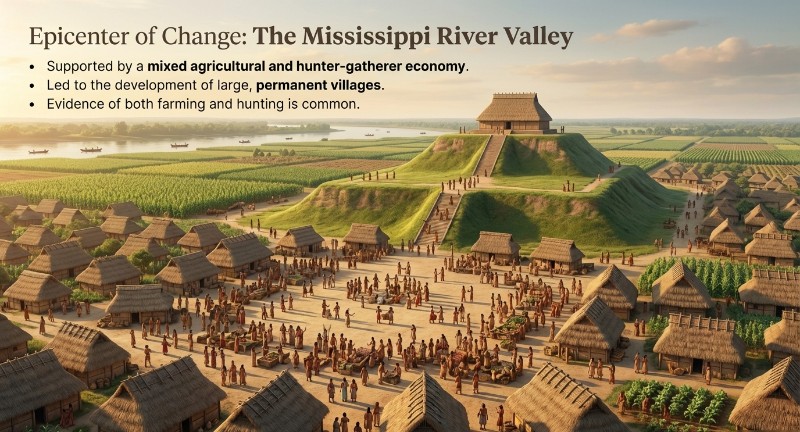
Term: Mixed agricultural and hunter-gatherer economy
This was an economic system used by societies in the Northeast and Mississippi River Valley where communities relied on both farming and hunting/gathering for subsistence.
How did the spread of maize cultivation from Mexico affect North American societies?
The spread of maize cultivation supported economic development, the growth of permanent settlements, the use of advanced irrigation, and greater social diversification.
What kind of economies led to the development of permanent villages in the Northeast and along the Atlantic seaboard?
In these regions, societies developed mixed agricultural and hunter-gatherer economies, which provided a stable enough resource base to support permanent villages.
Contrast the settlement patterns of the Great Plains with those of the Mississippi River Valley.
Societies in the Great Plains were largely mobile due to the arid grasslands, while societies in the Mississippi River Valley developed permanent villages supported by mixed economies.
What type of lifestyle was developed by societies in the arid Great Basin and the western Great Plains?
Societies in these regions responded to the arid environment by developing largely mobile lifestyles, often based on hunting and gathering.
An archaeological site in the Mississippi River Valley reveals evidence of both farming and hunting. What type of settlement pattern would you expect to find?
You would expect to find evidence of a permanent village, as the mixed agricultural and hunter-gatherer economy of this region supported such settlements.
What is the central theme regarding the interaction between native populations and their environments before European contact?
The central theme is that diverse native populations adapted to and transformed their specific natural environments, leading to a wide variety of economic and social structures.
If a society primarily cultivated maize, what societal characteristics would likely be present?
The society would likely feature permanent settlements, a degree of economic development and social diversification, and possibly advanced irrigation systems.
How did societies in the Northwest develop settled communities without large-scale agriculture?
Unlike other regions, the vast and reliable resources of the ocean allowed some hunter-gatherer societies in the Northwest to establish settled, permanent communities.
How did societies in the Northwest and present-day California subsist?
These societies primarily supported themselves by hunting and gathering, with some developing settled communities supported by the vast resources of the ocean.