
Getting Started
This unit explores the world of the Americas, Europe, and Africa just before and immediately after their first sustained interactions in the late 15th and 16th centuries. Before 1492, the Western Hemisphere was home to millions of people in diverse and complex societies, completely isolated from the Eastern Hemisphere. The period from 1491 to 1607 covers the context and consequences of the initial European encounters in the Americas, a process that transformed the social, political, and environmental landscape of the entire world.
What You Should Be Able to Do
Explain the diversity and complexity of Native American societies before European contact.
Explain the social, economic, and political motivations that drove European exploration.
Analyze the causes and widespread effects of the Columbian Exchange on both hemispheres.
Compare the divergent worldviews of Native Americans and Europeans regarding society and the environment.
Key Developments & Analysis
This section is organized by Causation to explain the conditions that led to European encounters in the Americas and the effects that followed.
Causes of European Encounters in the Americas
Preconditions in the Americas (The World Before Columbus)
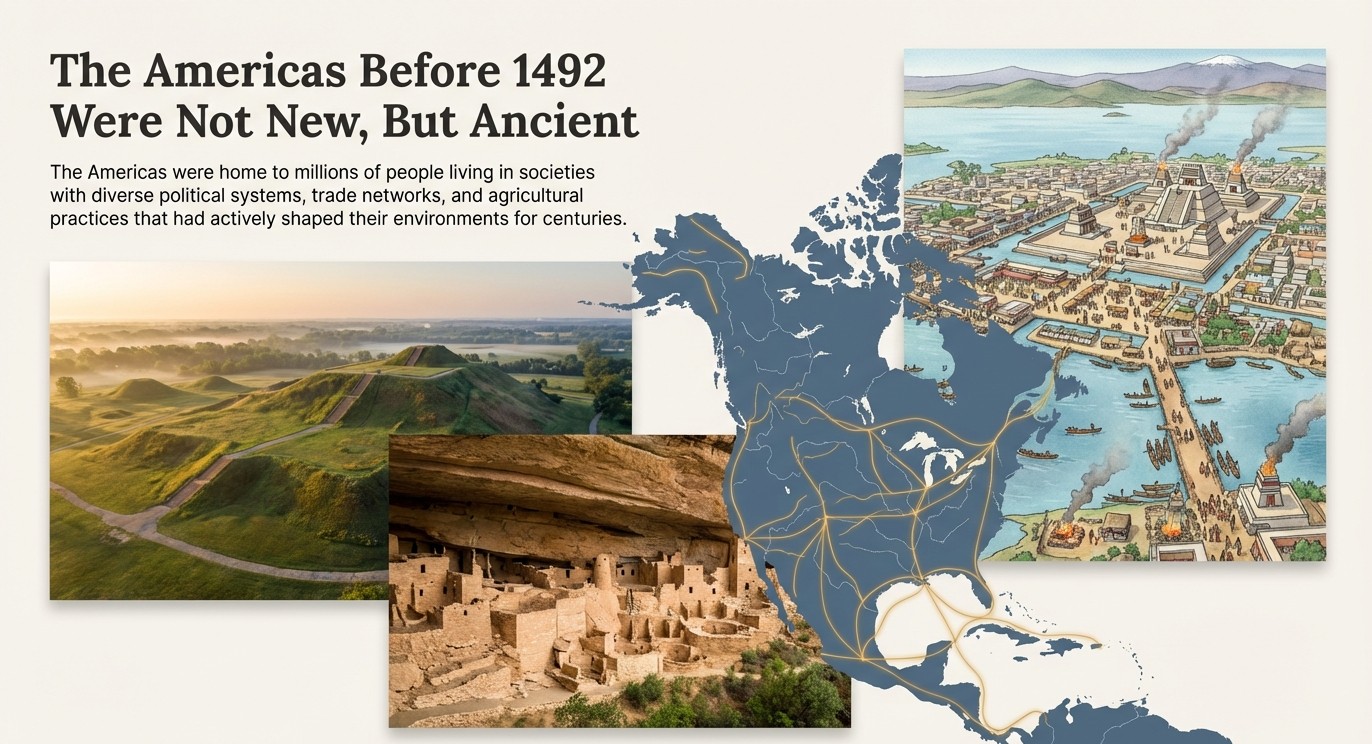
The societies that Europeans encountered were not new, but ancient and highly developed.
Migration and Settlement: As native populations migrated and settled across the vast continent of North America over millennia, they developed distinct and often complex societies.
Adaptation to Environment: Native societies creatively adapted to and transformed their diverse environments. This led to remarkable innovations in agriculture, unique methods of resource use, and varied social structures. For example, societies in the arid Southwest developed intricate irrigation systems, while those in the forested Northeast relied on a mix of agriculture and hunting.
Triggers in Europe (The Drive to Explore)
A confluence of factors within European societies propelled explorers across the Atlantic.
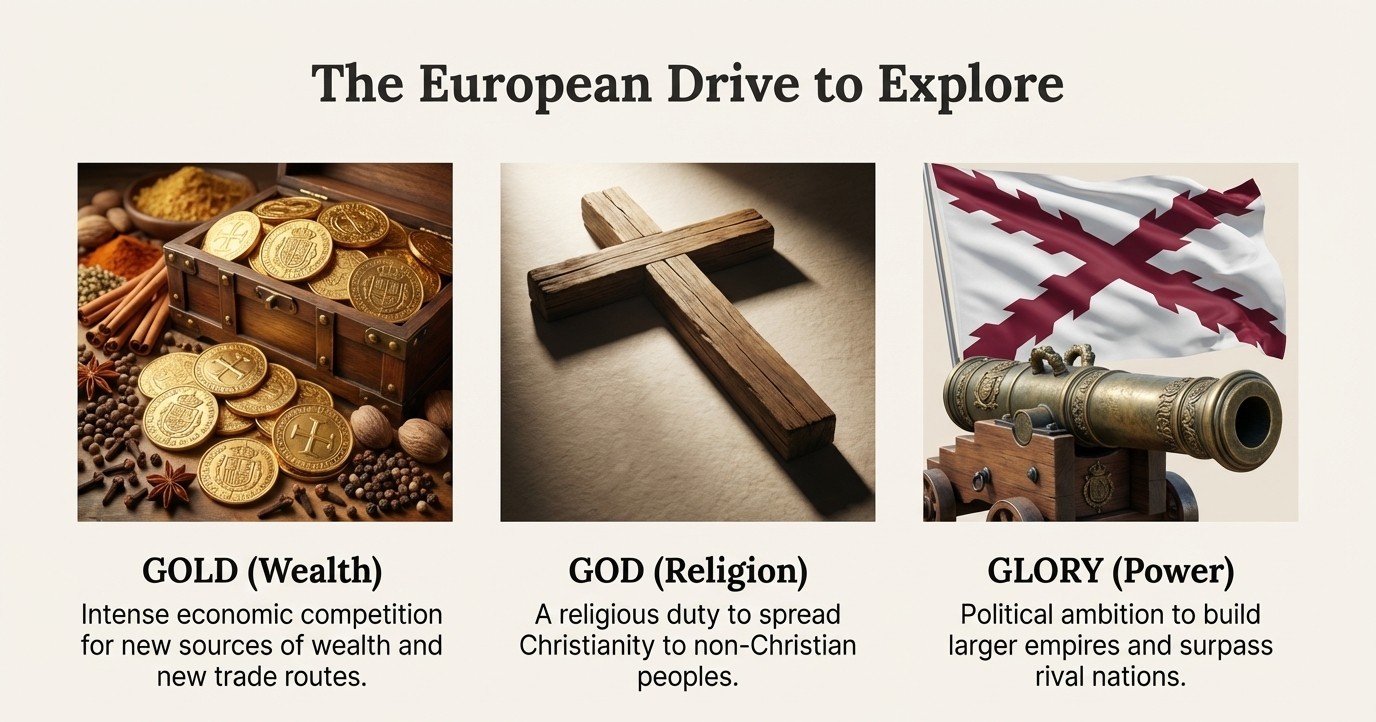
Economic Competition: European nations sought new sources of wealth, such as gold, silver, and agricultural products. This desire generated intense economic and military competition to find and control new trade routes and territories.
Political and Religious Competition: The expansion into the Western Hemisphere was also driven by political ambitions to build larger empires than rival nations. Additionally, many Europeans felt a religious duty to spread Christianity to non-Christian peoples around the globe.
Effects of the Encounter
Immediate Effects
The initial contact between the hemispheres set off a chain reaction of dramatic changes.
- The Columbian Exchange: This term refers to the widespread transfer of plants, animals, culture, human populations, technology, diseases, and ideas between the Americas, West Africa, and the Old World following Columbus's voyages. It was one of the most significant events in global history.
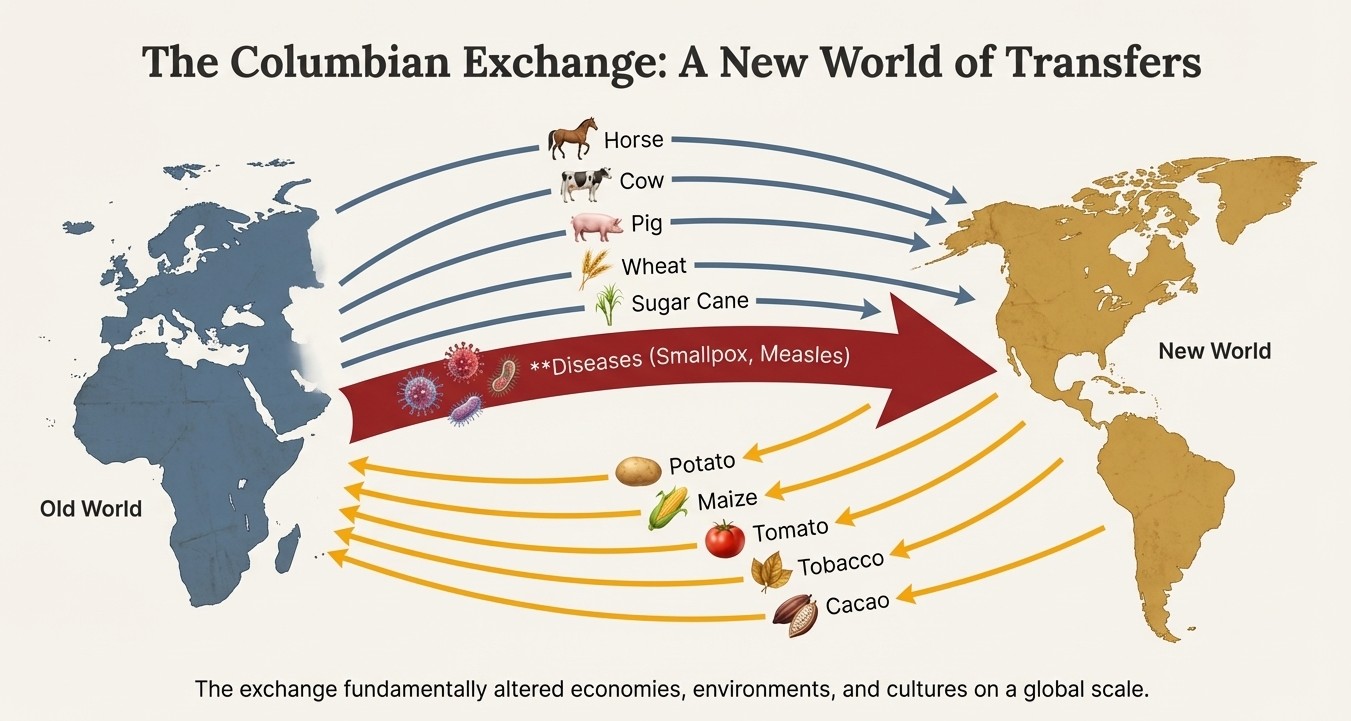
Demographic Catastrophe: The most devastating immediate effect was the introduction of European diseases (like smallpox and measles) to the Americas. Lacking any immunity, Native American populations suffered a catastrophic decline, with some estimates as high as a 90% mortality rate in certain areas.
Introduction of New Species: The Americas received new livestock from Europe, such as cattle, pigs, and horses, which transformed Native American life, particularly on the Great Plains. In return, Europe was introduced to American crops like maize (corn), potatoes, and tomatoes, which helped fuel significant population growth.
Long-Term Impacts
The consequences of this encounter reshaped societies on both sides of the Atlantic for centuries.
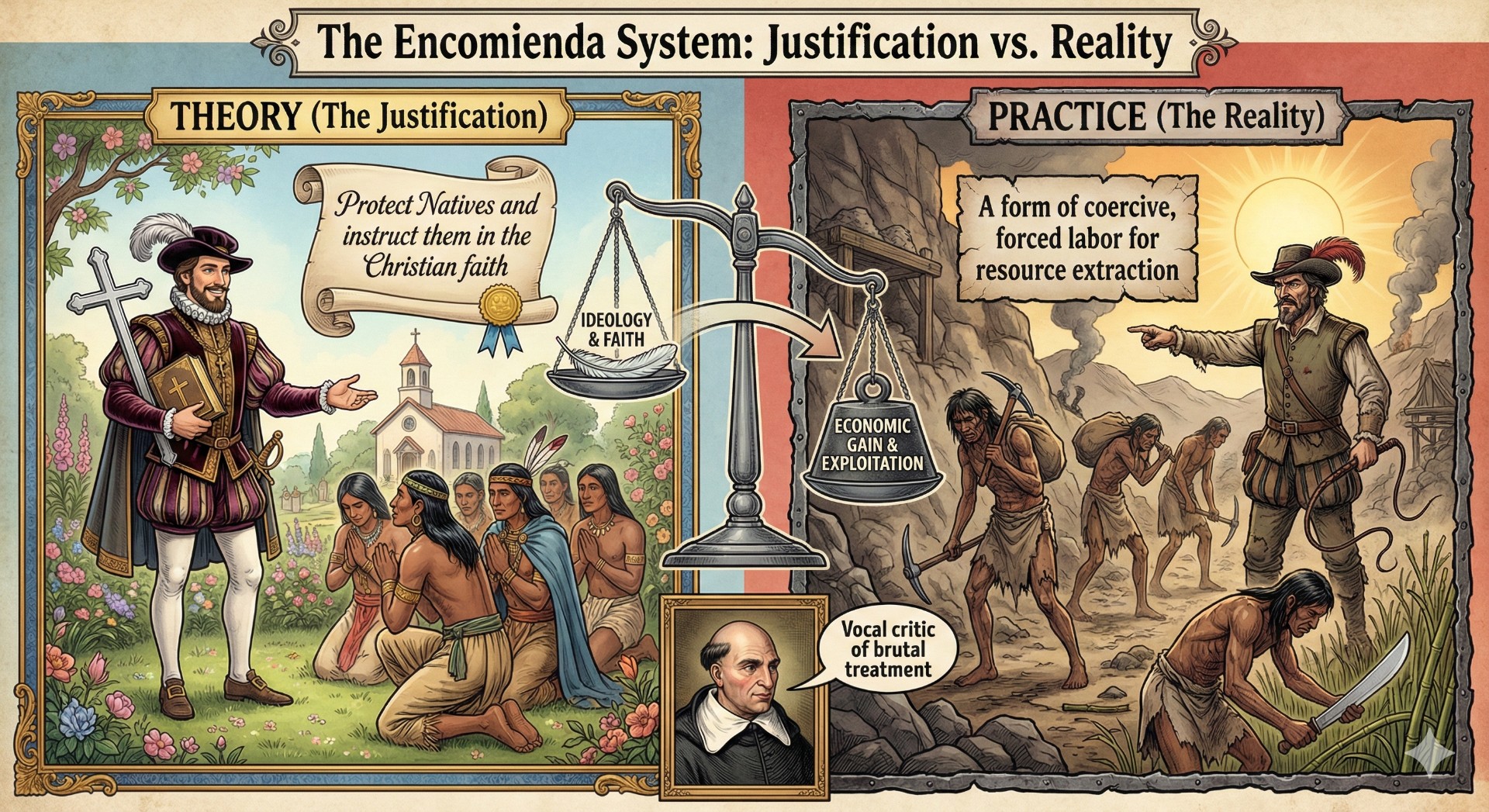
Development of the Spanish Empire: Spain developed a vast and wealthy empire in the Western Hemisphere. This empire was built on the extraction of resources and the exploitation of native labor through systems like the encomienda system, a Spanish labor system that granted conquerors the labor of specific groups of conquered peoples.
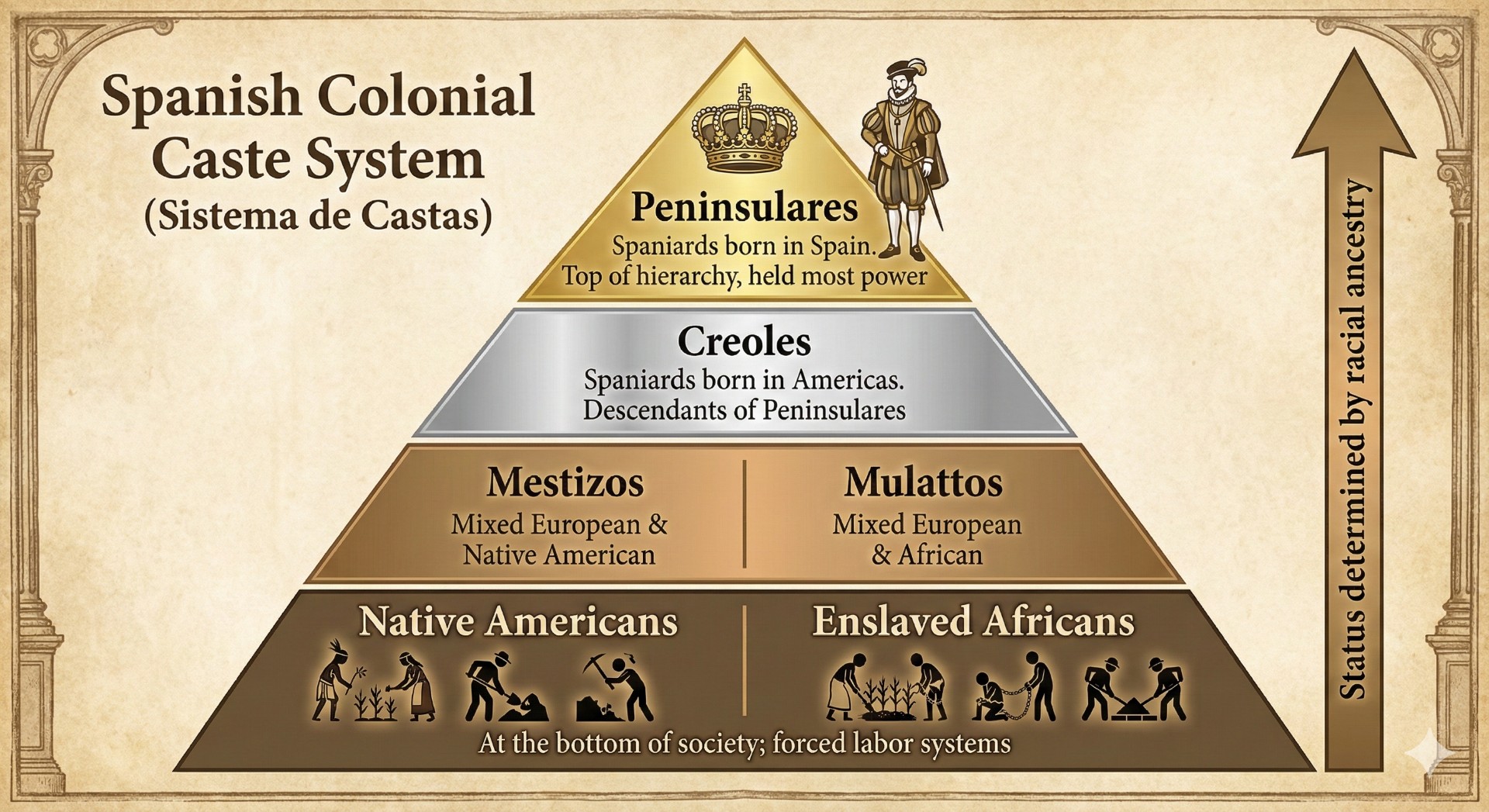
New Social and Racial Hierarchies: The Spanish Empire's development led to extensive social changes, including the emergence of a racially mixed population of Mestizos (mixed European and Native American) and Mulattos (mixed European and African). This led to the creation of a complex caste system that organized society based on racial ancestry.
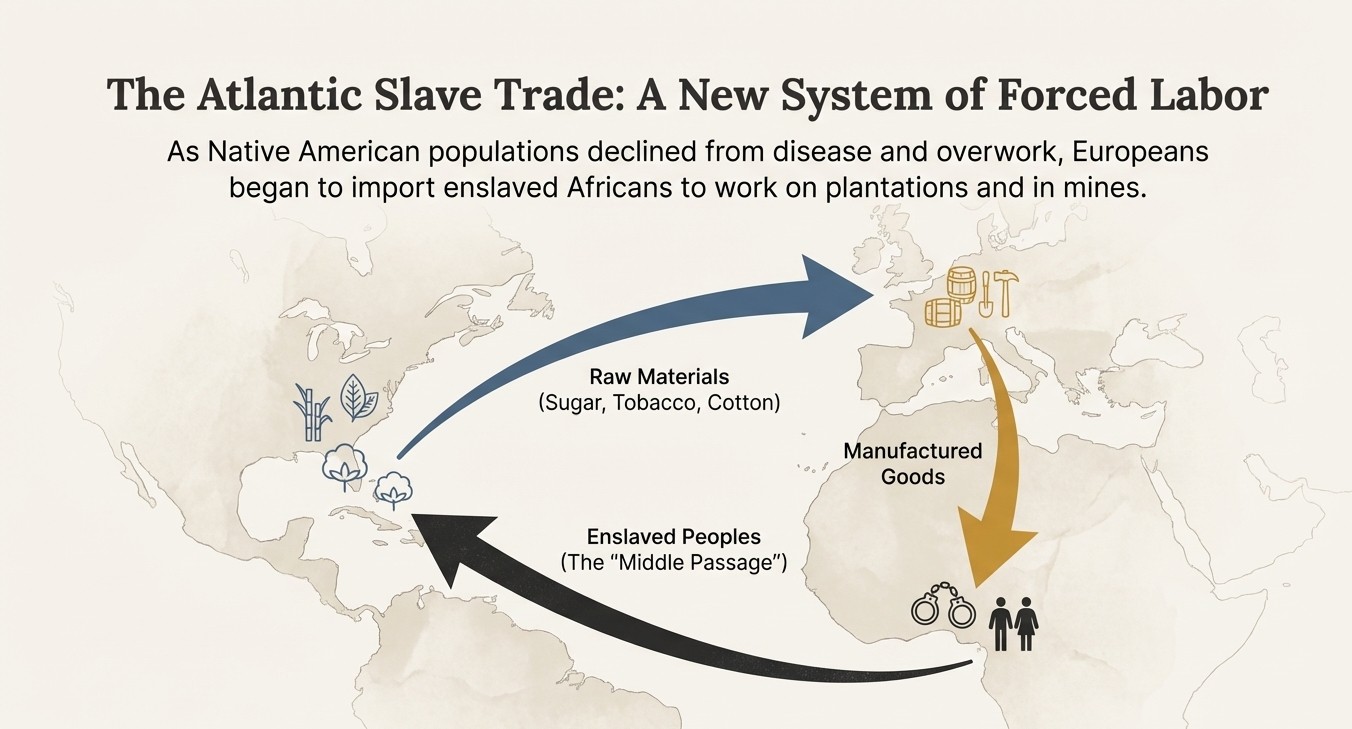
The Atlantic Slave Trade: As Native American populations declined from disease and overwork, Europeans, particularly the Spanish and Portuguese, began to import enslaved Africans to work on plantations and in mines, creating a new system of forced labor and a tragic chapter in world history.
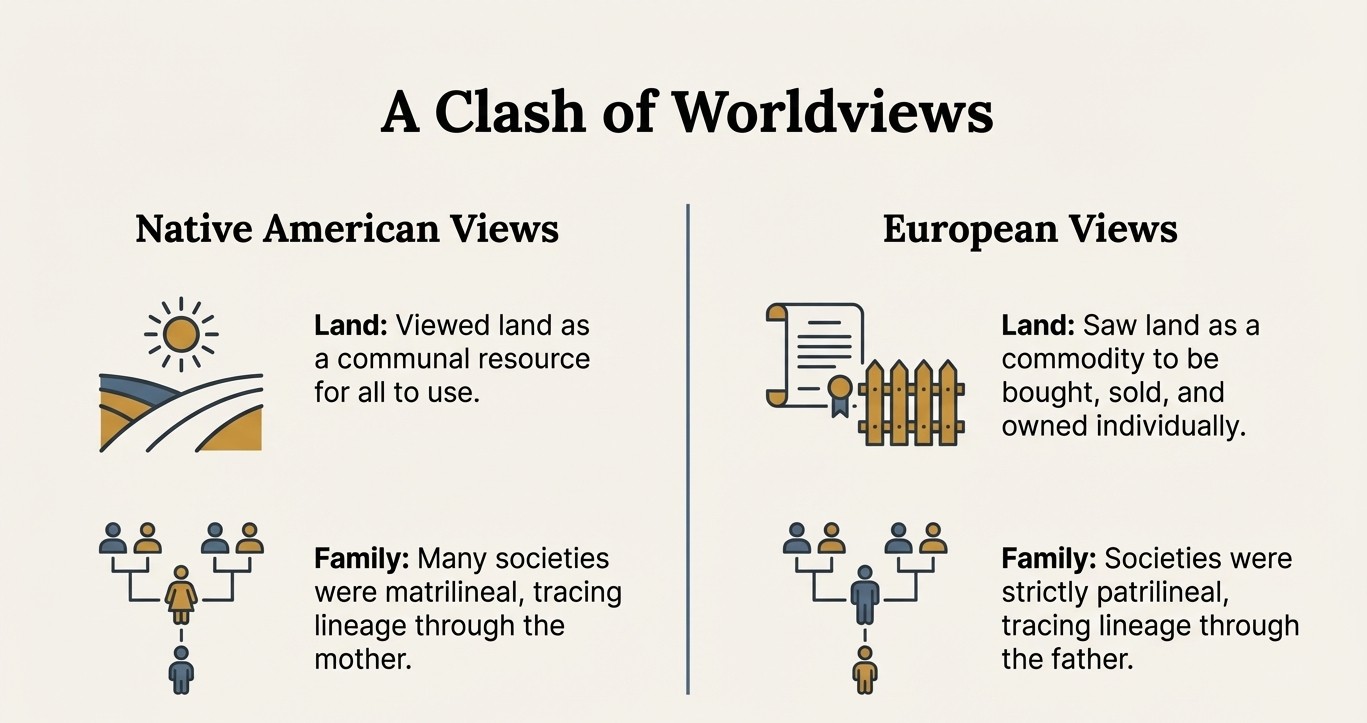
- Clash of Worldviews: Europeans and Native Americans asserted divergent worldviews, which led to persistent conflict. They held fundamentally different beliefs about religion, gender roles, family structures, land use (communal resource vs. private property), and the nature of political power.
Data & Organization Tools
Timeline of Key Events
| Year(s) | Event | Significance |
|---|---|---|
| c. 1491 | Pre-Columbian Era | Diverse Native American societies, numbering in the millions, thrive across the Americas, isolated from the rest of the world. |
| 1492 | Columbus's First Voyage | Initiates sustained contact between the Eastern and Western Hemispheres, sparking the Columbian Exchange. |
| c. 1500s | Spanish Conquest | Spain establishes a vast empire in the Americas, leading to massive demographic and social changes. |
| 1512 | Laws of Burgos | Spain formally establishes the encomienda system, attempting to regulate (while solidifying) the use of native labor. |
| c. 1520s-1550s | Disease Epidemics | Smallpox and other European diseases devastate Native American populations throughout the Americas. |
| 1607 | Founding of Jamestown | The first permanent English colony is established, marking the beginning of a new phase of European colonization. |
Evidence Bank
Maize Cultivation: The growing of corn, a staple crop first domesticated in Mesoamerica. Its spread northward supported economic development, the settlement of permanent villages, and social diversification among Native American societies in places like the American Southwest and the Eastern Woodlands.
Great Plains Societies: Native American groups who inhabited the vast interior of the continent. Before the introduction of the horse by Europeans, many were more sedentary, but they later developed highly mobile, hunter-gatherer lifestyles in response to the environment.
Atlantic Seaboard Societies: The diverse groups, such as the Iroquois and Algonquian peoples, who lived in the Northeast and along the Atlantic coast. They developed mixed agricultural and hunter-gatherer economies that created permanent villages.
Columbian Exchange: The transatlantic exchange of plants, animals, diseases, technologies, and ideas that began after 1492. It fundamentally altered economies, environments, and cultures on a global scale.
Encomienda System: A Spanish colonial labor system in which the Spanish crown granted a person a specified number of natives for whom they were to take responsibility. In theory, the receiver was to protect the natives from warring tribes and instruct them in the Spanish language and in the Catholic faith; in practice, it was a form of forced labor.
- Caste System (Sistema de Castas): A social hierarchy developed in the Spanish American colonies that categorized individuals based on their racial ancestry. At the top were pure-blooded Spaniards (peninsulares), followed by those of mixed heritage, with enslaved Africans and Native Americans at the bottom.
- Divergent Worldviews: The conflicting perspectives between Native Americans and Europeans. Key differences included the Native American belief in the communal ownership of land versus the European concept of private property, and differing views on gender roles, with many native societies being matrilineal while European societies were patrilineal.
Skill Snapshots
Causation:
European desire for new sources of wealth → The financing of transatlantic voyages.
The introduction of European diseases to the Americas → A catastrophic decline in Native American populations.
The transfer of American crops like potatoes and maize to Europe → A significant increase in European population and wealth.
Comparison:
Native Americans generally viewed land as a communal resource for all to use, while Europeans saw it as a commodity to be bought, sold, and owned individually.
Many Native American societies were matrilineal (tracing lineage through the mother), whereas European societies were strictly patrilineal (tracing lineage through the father).
Spanish colonizers were primarily motivated by the extraction of mineral wealth (gold and silver), while later English colonizers would be more focused on establishing agricultural settlements.
Continuity and Change Over Time:
Baseline (c. 1491): The Americas were populated by a wide array of self-sufficient and complex societies with no sustained contact with Afro-Eurasia.
Change: The arrival of Europeans and the Columbian Exchange radically altered the demographics, economy, and environment of the Americas.
Continuity: Despite the devastation caused by disease and conquest, Native American peoples survived, resisted European control, and adapted their cultures over time, preserving core elements of their worldviews.
Common Misconceptions & Clarifications
Myth: The Americas were a sparsely populated, untamed wilderness before 1492.
Clarification: The Americas were home to millions of people living in societies with diverse political systems, trade networks, and agricultural practices that had actively shaped their environments for centuries.
Myth: Native Americans were a single, monolithic group.
Clarification: The term "Native American" or "Indian" masks the reality of hundreds of distinct cultures, languages, and societies, each with its own unique history and traditions.
Myth: Christopher Columbus "discovered" America.
Clarification: Columbus did not "discover" a land that was already inhabited. His voyages initiated the first sustained and large-scale contact between the Eastern and Western Hemispheres, with profound consequences for all involved.
Myth: Europeans easily conquered Native Americans because they were culturally or technologically superior.
Clarification: The single most important factor in the European conquest was the devastating impact of Old World diseases, to which Native Americans had no immunity. This demographic collapse crippled their ability to resist European expansion.
One-Paragraph Summary
The period before 1607 was defined by the collision of three worlds—the Americas, Europe, and Africa—that had previously developed in isolation. In 1491, the Americas were home to a rich tapestry of complex societies that had adapted to diverse environments. Driven by intense economic, political, and religious competition, European nations launched voyages of exploration that initiated the Columbian Exchange. This process resulted in catastrophic demographic changes for Native Americans, primarily through disease, while new crops from the Americas fueled population growth in Europe. The ensuing interactions were shaped by profoundly divergent worldviews on land, religion, and social order, laying the groundwork for the development of a new Atlantic world characterized by conquest, coercion, and cultural exchange.