
Unit Big Picture
Spanning from 1844 to 1877, this period chronicles the nation's dramatic territorial expansion to the Pacific, the subsequent breakdown of political compromise over slavery, and the brutal Civil War that followed. The era concludes with the contested and ultimately unfinished process of Reconstruction, which aimed to rebuild the nation and define the status of formerly enslaved people. The United States was fundamentally transformed, preserving the Union and abolishing slavery but failing to secure lasting civil and political rights for African Americans.
Core Threads
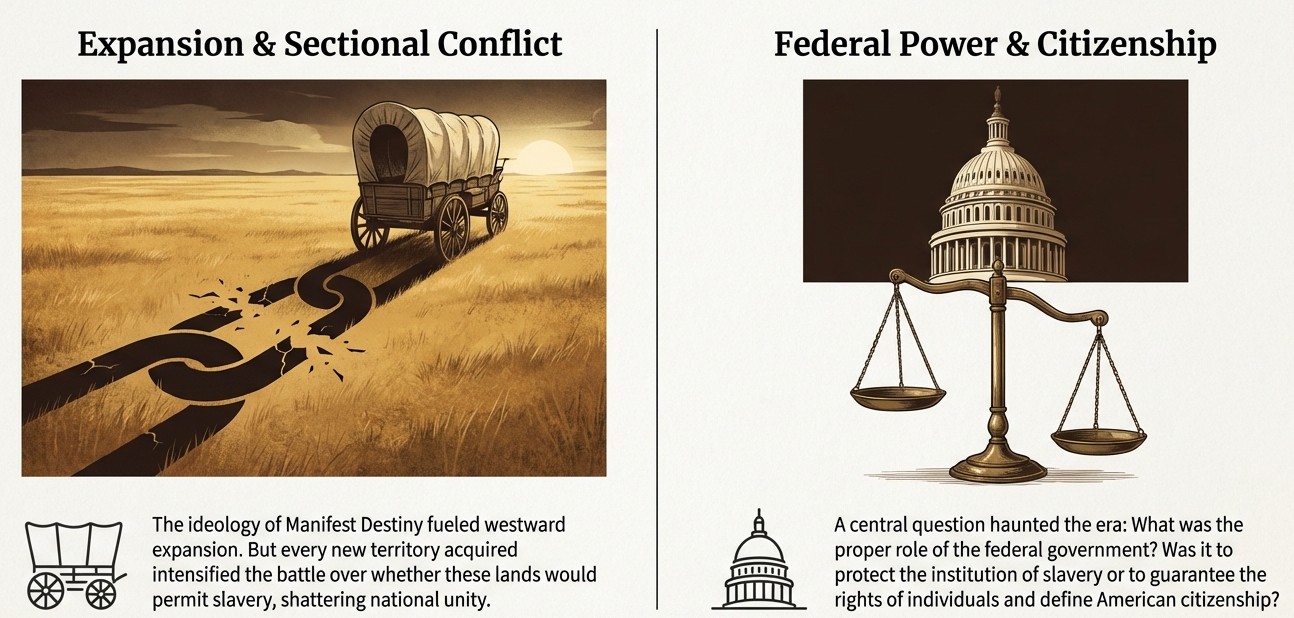
Thread 1: Expansion and Sectional Conflict
The ideology of Manifest Destiny—the belief in a divinely ordained right to expand U.S. dominion—fueled westward migration and territorial acquisition, most notably through the Mexican-American War.
Each new territory acquired intensified the sectional conflict, as the North and South battled over whether these lands would permit slavery, shattering national unity and leading to war.
Thread 2: Federal Power and Citizenship
The Civil War and Reconstruction dramatically expanded federal power, as the government mobilized for war, issued the Emancipation Proclamation, and passed transformative constitutional amendments.
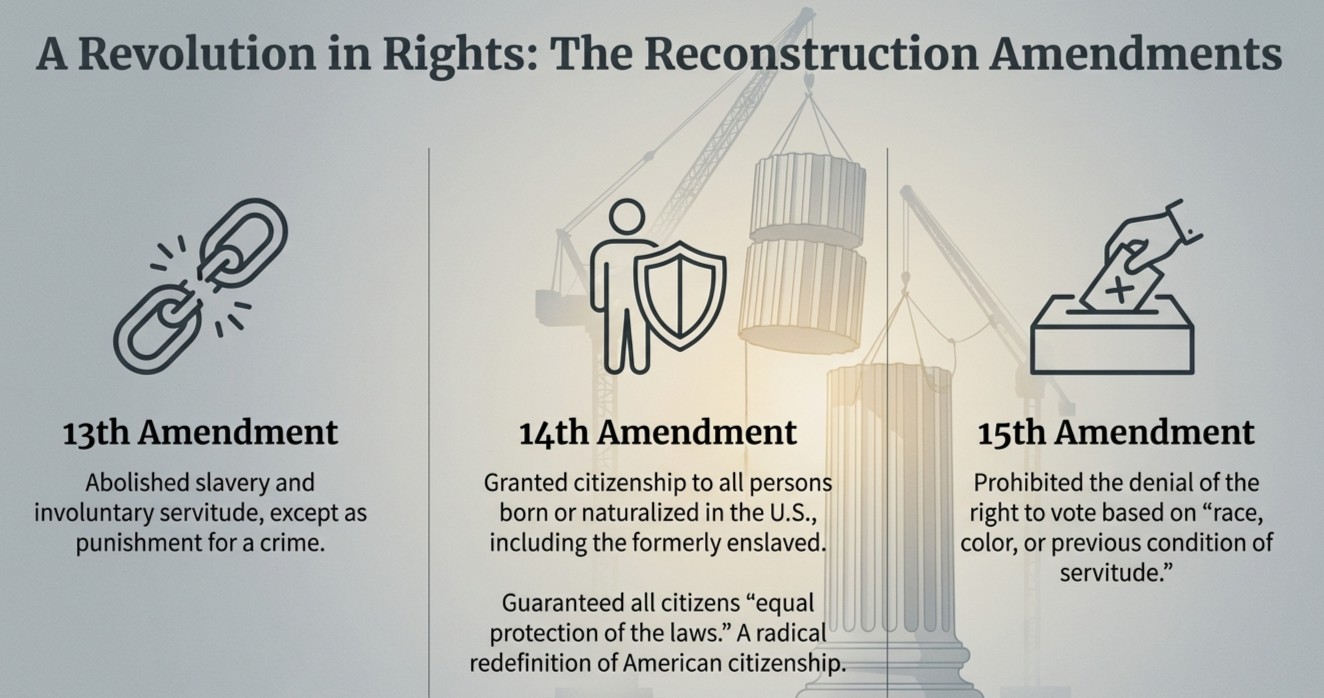
The 13th, 14th, and 15th Amendments represented a radical, albeit temporary, redefinition of American citizenship and civil rights, extending them to African American men and establishing the federal government as a protector of rights.
Timeline (Compact)
| Year | Event |
|---|---|
| 1846 | Mexican-American War begins |
| 1848 | Treaty of Guadalupe Hidalgo cedes vast territory to the U.S. |
| 1850 | Compromise of 1850, including the Fugitive Slave Act |
| 1854 | Kansas-Nebraska Act passed |
| 1857 | Dred Scott v. Sandford Supreme Court decision |
| 1860 | Abraham Lincoln elected president; South Carolina secedes |
| 1863 | Emancipation Proclamation takes effect |
| 1877 | Compromise of 1877 effectively ends Reconstruction |
Turning Points
| Trigger (Precondition) | Event (Year) | Why It Mattered |
|---|---|---|
| U.S. victory in the Mexican-American War | The Compromise of 1850 | It was the last major political compromise to hold the Union together, but its controversial Fugitive Slave Act radicalized many Northerners. |
| Decades of failed compromises over slavery | Election of Abraham Lincoln (1860) | It was the immediate catalyst for secession, as Southern states believed his victory signaled the end of their power to protect slavery. |
| Union victory and the abolition of slavery | Radical Reconstruction (began c. 1867) | It was the federal government's most direct effort to enforce equal rights for African Americans, leading to the 14th and 15th Amendments. |
Unit Evidence Bank
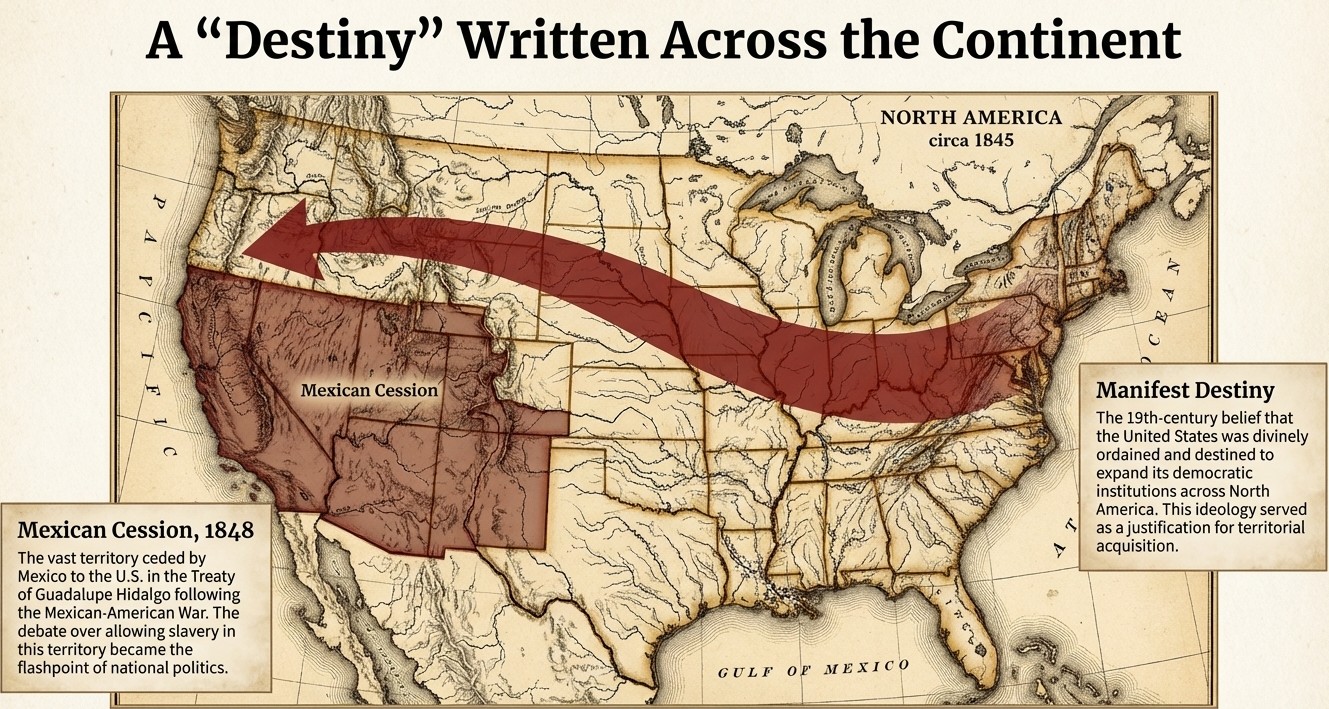
Manifest Destiny: The 19th-century belief that the United States was destined to expand its democratic institutions across North America. This ideology served as a justification for territorial acquisition and westward migration.
Mexican Cession: The vast territory ceded by Mexico to the United States in 1848 following the Mexican-American War. The debate over allowing slavery in this territory became a major point of contention.
Popular Sovereignty: The principle that the authority of a state and its government are created and sustained by the consent of its people. In this era, it was applied to the idea that settlers in a territory could vote to decide whether to allow slavery.
Kansas-Nebraska Act (1854): A law that allowed voters in Kansas and Nebraska to choose whether to allow slavery in their territories through popular sovereignty. It effectively repealed the Missouri Compromise and led to violent conflict in "Bleeding Kansas."
Dred Scott decision (1857): A landmark Supreme Court ruling that African Americans were not citizens and could not sue in federal court. It also declared the Missouri Compromise unconstitutional, further inflaming sectional tensions.
Emancipation Proclamation (1863): An executive order issued by Abraham Lincoln that declared all enslaved people in Confederate-held territory to be free. It shifted the purpose of the Civil War from preserving the Union to also ending slavery.
14th Amendment (1868): A constitutional amendment that granted citizenship to all persons born or naturalized in the U.S., including formerly enslaved people, and guaranteed all citizens "equal protection of the laws."
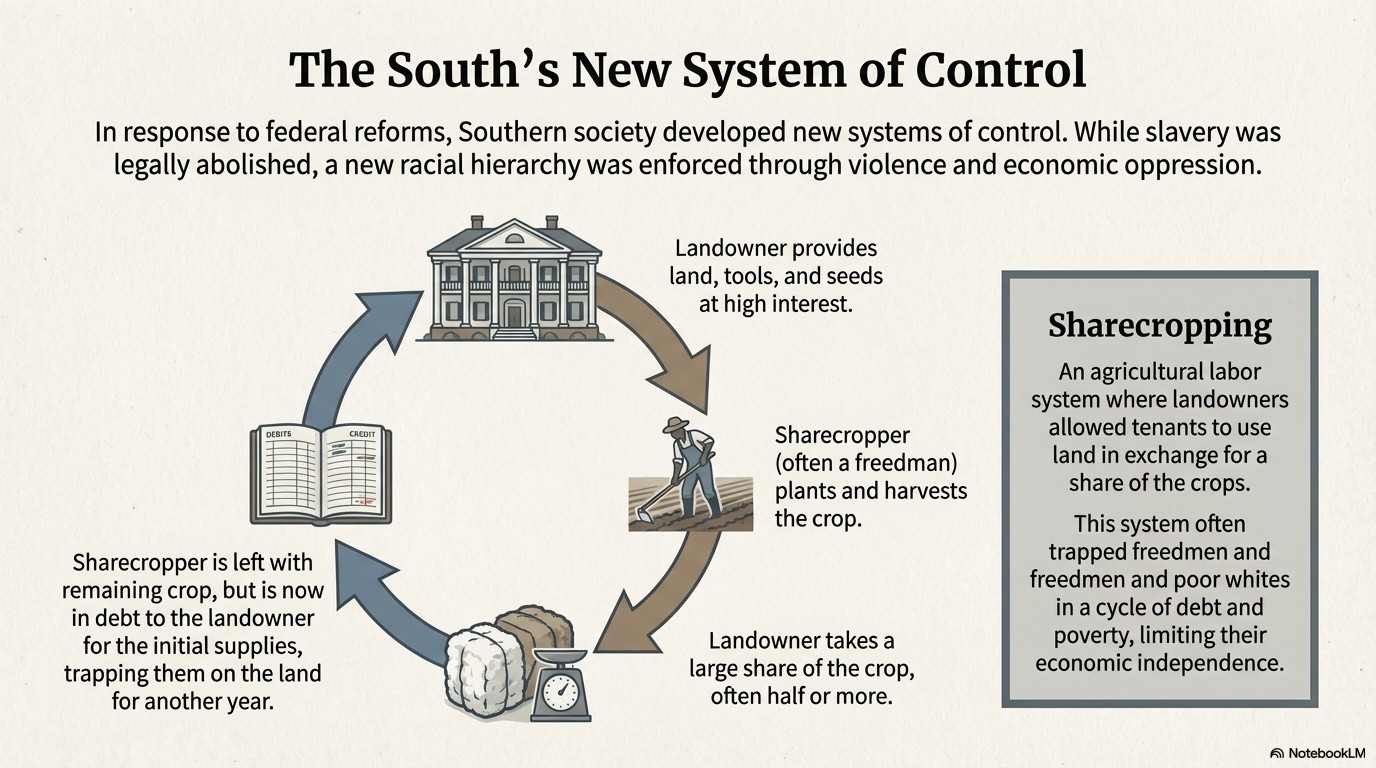
Sharecropping: An agricultural labor system that emerged in the South after the Civil War. Landowners allowed tenants to use land in exchange for a share of the crops, often trapping freedmen and poor whites in a cycle of debt and poverty.
Topic Navigator
| Topic Title | What This Adds (≤10 words) |
|---|---|
| 5.1: Contextualizing Period 5 | Setting the stage for expansion and conflict. |
| 5.2: Manifest Destiny | The ideology driving westward expansion. |
| 5.3: The Mexican-American War | The war that acquired vast new western lands. |
| 5.4: The Compromise of 1850 | A major, temporary political fix for the slavery debate. |
| 5.5: Sectional Conflict: Regional Differences | Growing economic and cultural North-South divides. |
| 5.6: Failure of Compromise | Why political compromises over slavery ultimately broke down. |
| 5.7: Election of 1860 and Secession | The final political trigger for Southern secession. |
| 5.8: Military Conflict in the Civil War | The course, strategies, and turning points of the war. |
| 5.9: Government Policies During the Civil War | How the Union government mobilized for total war. |
| 5.10: Reconstruction | The effort to rebuild the nation and integrate freedpeople. |
| 5.11: Failure of Reconstruction | Why Reconstruction's goals were largely abandoned by 1877. |
| 5.12: Comparison in Period 5 | Synthesizing the era's causes, effects, and changes. |
Exam Skills Focus
Causation: Westward expansion intensified sectional tensions over slavery, leading directly to the Civil War.
Comparison: Compare the industrializing, free-labor economy of the North with the agrarian, slave-labor economy of the South.
CCOT: While the Union was preserved and slavery was legally abolished, Southern society retained a racial hierarchy through new systems of political and economic control.
Common Misconceptions & Clarifications
Misconception: The Civil War was fought over states' rights, not slavery. → Clarification: The primary "states' right" that Southern states seceded to protect was the right to own and perpetuate the institution of slavery.
Misconception: The Emancipation Proclamation freed all enslaved people. → Clarification: It was a military order that applied only to states in rebellion and did not affect slavery in the border states that remained loyal to the Union.
Misconception: With the end of Reconstruction, life for African Americans returned to the way it was under slavery. → Clarification: While Reconstruction's protections were withdrawn, the 13th, 14th, and 15th Amendments remained, providing a constitutional basis for future civil rights movements.
One-Paragraph Summary
Driven by a belief in Manifest Destiny, the United States expanded to the Pacific Ocean, but this success reignited the explosive debate over slavery's extension into new territories. A series of political compromises failed to resolve deep-seated economic and ideological differences between the North and South, culminating in the election of Abraham Lincoln and the secession of Southern states. The ensuing Civil War devastated the nation but ultimately preserved the Union and ended slavery. The subsequent era of Reconstruction attempted to redefine American society and secure rights for newly freed African Americans, but its goals were largely abandoned by 1877, leaving a complex legacy of both progress and enduring racial inequality.