
Getting Started
Period 5 (1844–1877) was a time of dramatic transformation for the United States, marked by rapid territorial expansion and a deepening crisis over the institution of slavery. These twin forces intensified economic, cultural, and political divisions between the North and the South, ultimately leading to a devastating civil war. The conflict and its aftermath reshaped American society, settling the questions of union and slavery while raising new, profound debates about federal power, citizenship, and the nation's core values.
What You Should Be Able to Do
After studying this topic, you should be able to:
Compare the economic systems and political ideologies of the North and the South before the Civil War.
Explain how westward expansion intensified sectional conflicts over slavery.
Compare the goals and resources of the Union and the Confederacy during the Civil War.
Explain how the Civil War and Reconstruction altered the relationship between the states and the federal government.
Compare debates over citizenship and rights for different groups, particularly African Americans and women, before and after the war.
Key Developments & Analysis
The Civil War was the culmination of decades of growing division. Comparing the North and South reveals two societies with fundamentally different values, economies, and visions for the nation's future. The Union victory did not resolve these differences overnight but instead transformed the terms of the debate, shifting from the existence of slavery to the meaning of freedom.
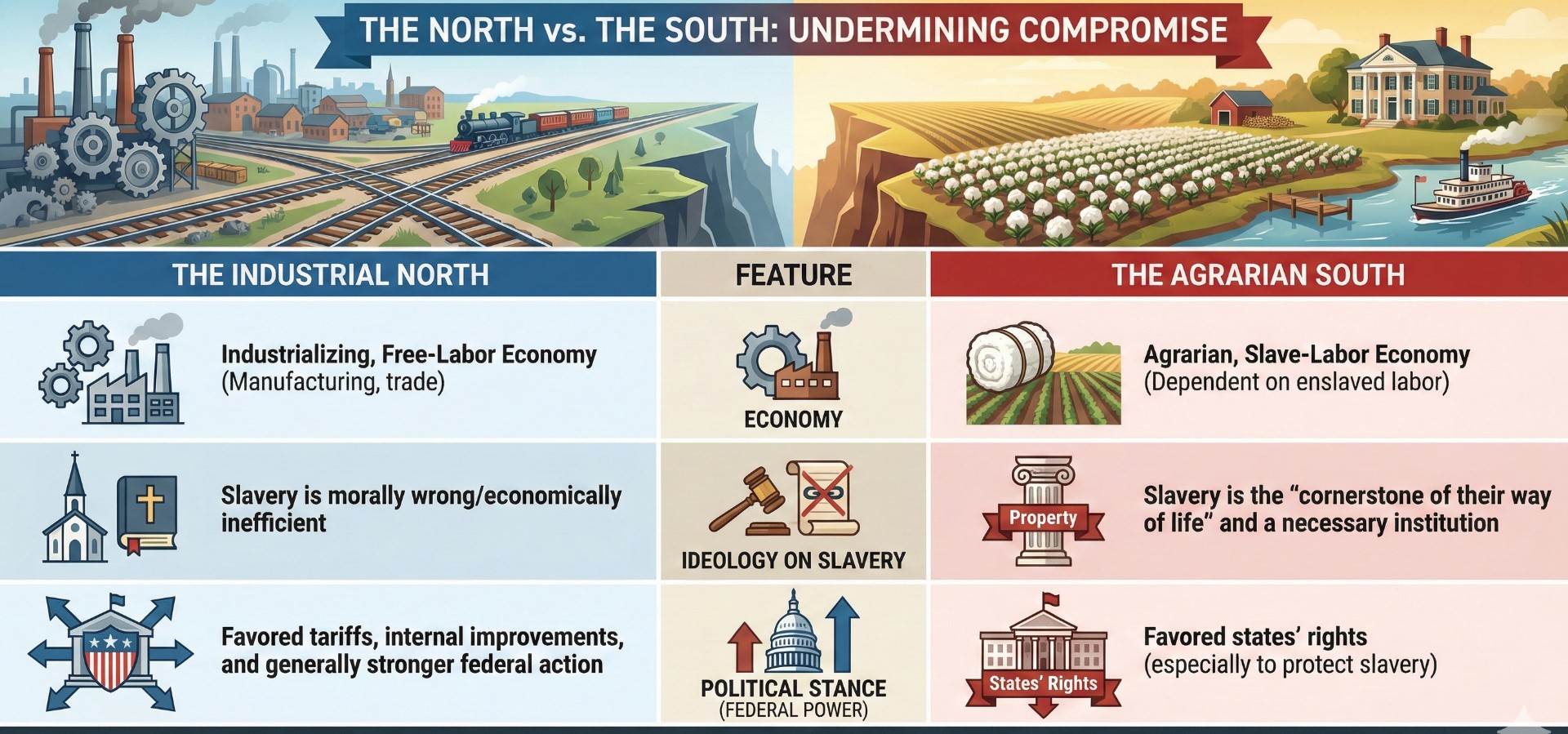
| Theme of Comparison | The North (Union) | The South (Confederacy) | Why This Difference Matters |
|---|---|---|---|
| Economic Foundation & Ideology | An industrializing economy with factories, a diverse immigrant workforce, and a belief in "free labor"—the idea that workers could achieve economic mobility. | An agrarian economy dominated by large plantations and reliant on the forced labor of enslaved people. Valued states' rights primarily as a means to protect the institution of slavery. | These opposing economic systems created different social structures and political priorities, making national compromise on issues like tariffs and slavery increasingly difficult. |
| Vision for Westward Expansion | Supported expansion to create new markets and opportunities for free farmers and workers. Feared the extension of slavery would limit opportunities for white settlers. | Demanded that new territories acquired through an expansionist foreign policy be open to slavery to maintain its economic viability and political power in Congress. | The debate over whether new territories would be "free" or "slave" was the central, irreconcilable political issue of the 1850s, directly leading to the nation's fracture. |
| Goals & Resources in the Civil War | Fought initially to preserve the Union. The decision to emancipate enslaved people later added the abolition of slavery as a core war aim. Benefited from greater manpower and superior industrial resources. | Fought to secure independence and preserve a society founded on slavery. Its primary goal was to defend its territory and outlast the Union's political will to fight. | The Union's superior resources and Abraham Lincoln's leadership were critical to its victory, while the goal of emancipation transformed the war into a moral and revolutionary struggle. |
| Post-War Transformation & Values | Emerged with a vastly strengthened federal government and a booming industrial economy. Debates shifted to defining the terms of reunion and the rights of newly freed African Americans. | The economy and social structure were devastated. During Reconstruction, the South resisted federal authority and sought to re-establish a system of racial hierarchy short of slavery. | The war decisively answered the questions of slavery and secession, but it created new, unresolved conflicts over the meaning of citizenship and the federal government's role in protecting individual rights. |
Data & Organization Tools
This matrix compares the status of key national issues before the Civil War with their status after the war and Reconstruction, highlighting the period's transformative impact.
| Issue | Status Before the Civil War (c. 1844–1860) | Status After the Civil War & Reconstruction (c. 1877) |
|---|---|---|
| Slavery | A legal institution in Southern states; the central point of political, economic, and cultural division. | Abolished nationwide by the 13th Amendment, but its legacy persisted in new systems of racial control. |
| Federal vs. State Power | Dominated by debates over states' rights, particularly the right of states to nullify federal laws or secede from the Union. | The supremacy of the federal government was decisively asserted; secession was established as illegal. |
| Citizenship & Rights | Citizenship was ill-defined at the federal level; rights for African Americans, women, and other minorities were severely limited or non-existent. | New constitutional amendments defined citizenship and protected rights on paper, but these protections were contested and often unenforced. |
| National Identity | A divided nation with competing regional identities and values (a "house divided"). | A single, legally indivisible nation was preserved, but deep regional, political, and racial divisions remained unresolved. |
Evidence Bank
Expansionist Foreign Policy: A national policy of territorial or economic expansion. In the 1840s, this was driven by popular enthusiasm and economic interests, leading to the acquisition of territories like Texas, California, and Oregon.
Westward Migration: The large-scale movement of settlers to western territories, which created constant political pressure to determine whether these new lands would permit or prohibit slavery.
Secession: The formal withdrawal of a state from the Union. Following the election of Abraham Lincoln in 1860, Southern states seceded, arguing that the federal government no longer protected their right to own enslaved people.
Abraham Lincoln: The 16th U.S. President, whose leadership was crucial in preserving the Union. His decision to issue the Emancipation Proclamation redefined the purpose of the war.
Emancipate: To set free from legal, social, or political restrictions. The Civil War ultimately led to the emancipation of nearly four million enslaved African Americans.
Union: The term for the United States government and the states that remained loyal to it during the Civil War. Its victory affirmed national unity and ended slavery.
Confederacy: The government formed by the 11 Southern states that seceded from the Union. Its defeat meant the end of both secession as a political option and the institution of slavery.
Reconstruction: The period after the Civil War (1865–1877) when the federal government attempted to rebuild the South, readmit the former Confederate states, and define the rights of formerly enslaved people.
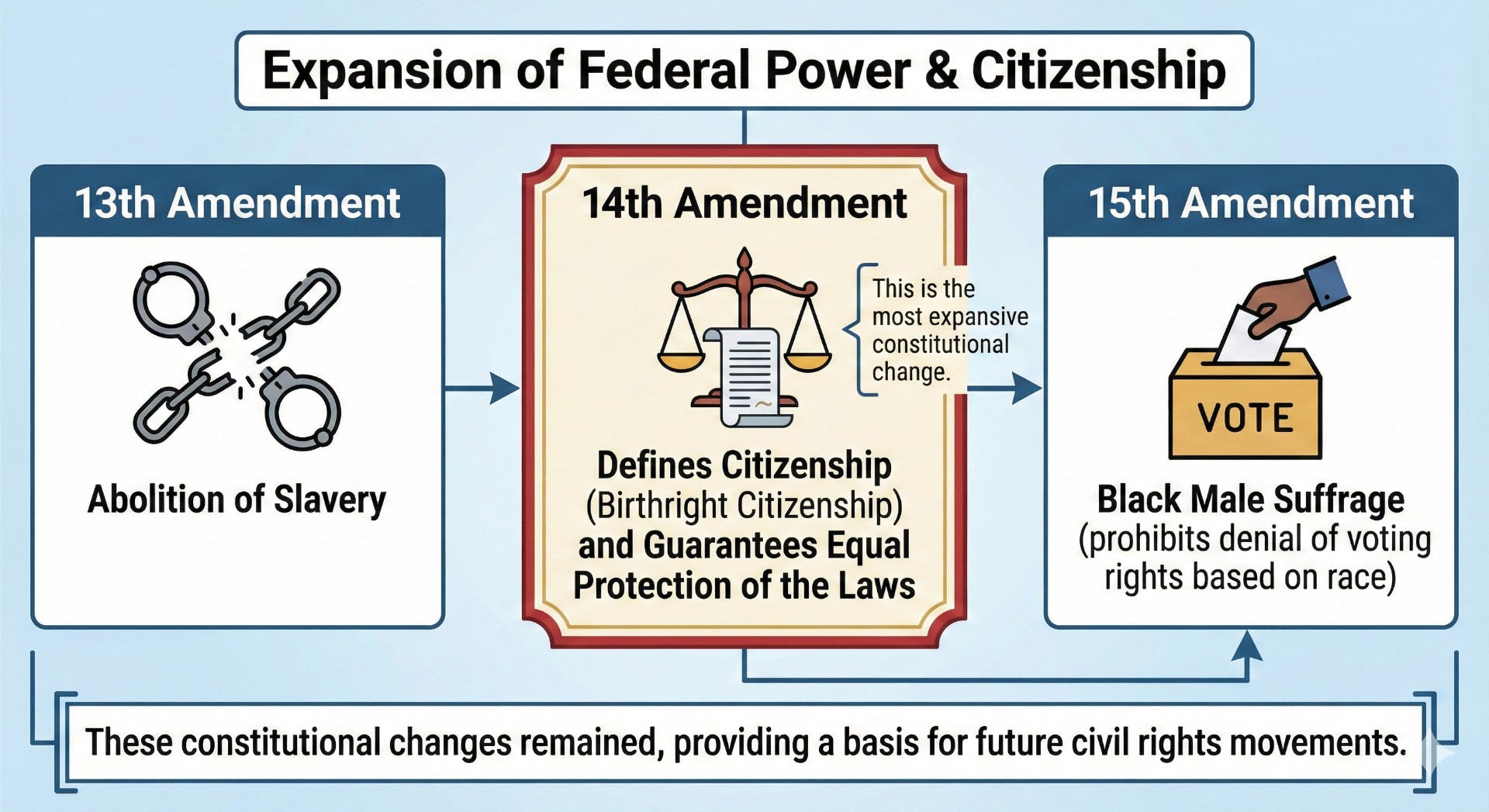
13th, 14th, and 15th Amendments: Three constitutional amendments passed during and after the Civil War that abolished slavery, defined national citizenship, and prohibited voting discrimination based on race, respectively. They fundamentally altered the Constitution.
Skill Snapshots
Causation: The acquisition of new territories from an expansionist foreign policy caused intense political debates over the future of slavery, which in turn caused the secession of Southern states.
Comparison: The North's industrial economy, based on free labor, contrasted sharply with the South's agrarian economy, which was dependent on enslaved labor.
Continuity and Change Over Time: The Civil War changed the nation by abolishing slavery and strengthening the federal government. However, deep-seated racial discrimination and debates over the rights of minority groups continued long after the war ended.
Common Misconceptions & Clarifications
Misconception: The Civil War was fought over "states' rights," not slavery.
Clarification: The primary "right" Southern states sought to protect through secession was the right to own and perpetuate the institution of slavery.
Misconception: The North was united in its desire to abolish slavery from the start of the war.
Clarification: The initial and primary goal of the Union was to preserve the nation. The decision to emancipate enslaved people was a crucial turning point that evolved as the war progressed.
Misconception: The Emancipation Proclamation freed all enslaved people.
Clarification: It was a military and political strategy that freed enslaved people only in the Confederate-held territories. Slavery was not abolished nationwide until the ratification of the 13th Amendment.
Misconception: Reconstruction successfully integrated formerly enslaved people into society as equal citizens.
Clarification: While Reconstruction established important constitutional principles of citizenship and voting rights, it ultimately failed to overcome Southern resistance and protect those rights in the long term.
One-Paragraph Summary
Period 5 fundamentally reshaped the United States. Driven by popular enthusiasm for expansion, the nation acquired vast new territories, which intensified the ideological and economic conflict over slavery. This conflict culminated in the Civil War, a struggle that tested the nation's survival. The Union's victory, aided by its industrial and demographic advantages, settled the questions of secession and slavery. The subsequent era of Reconstruction altered the relationship between the federal government and the states and established new constitutional definitions of citizenship. However, it left unresolved the deep-seated challenge of securing equal rights for all Americans, a debate that would continue for generations.