
Getting Started
The American Civil War (1861–1865) was a brutal and transformative conflict that pitted the industrializing Union against the agrarian Confederacy. While the Confederacy achieved notable early military successes, the war's trajectory ultimately shifted. This chapter examines the complex interplay of factors—from industrial might and strategic evolution to home front struggles—that culminated in a Union victory.
What You Should Be Able to Do
Explain how both the Union and the Confederacy mobilized their societies and economies for war.
Analyze the reasons for the Confederacy's early military initiative.
Explain the various factors that ultimately contributed to the Union victory in the Civil War.
Evaluate the significance of leadership, strategy, and resources in determining the war's outcome.
Key Developments & Analysis
The central question of the Civil War's military history is why the Union ultimately prevailed. The answer lies in a set of causal factors that allowed the North to overcome the South's early advantages and fierce resistance.
Factor 1: Resources and Mobilization
A primary cause of the Union victory was its significant advantage in material resources and its ability to effectively mobilize them. Mobilization refers to the process of assembling and preparing national resources—including soldiers, supplies, and industrial production—for war.
Union Advantages: The Union possessed a vastly larger population, a robust industrial economy capable of mass-producing weapons and supplies, an extensive railroad network for transporting troops and goods, and a more established financial system. This allowed the Union to sustain a long war of attrition.
Confederate Efforts: The Confederacy, by contrast, had a smaller population and an economy based on agriculture, primarily cotton. It struggled to finance the war and create an industrial base from scratch. Despite these limitations, the Confederacy showed remarkable resolve in mobilizing its society, dedicating a huge proportion of its population and economy to the war effort.
Home Front Opposition: Both sides faced considerable opposition on the home front, the civilian sphere where the population supports the war effort. In the Union, the military draft sparked riots, and political opposition to the war was significant. In the Confederacy, food shortages, inflation, and growing class resentment led to protests and undermined morale, weakening its ability to sustain the conflict.
Factor 2: Leadership and Strategy
While resources provided a foundation for victory, they had to be leveraged by effective leadership and military strategy, which is the overall plan for using military forces to achieve political objectives.
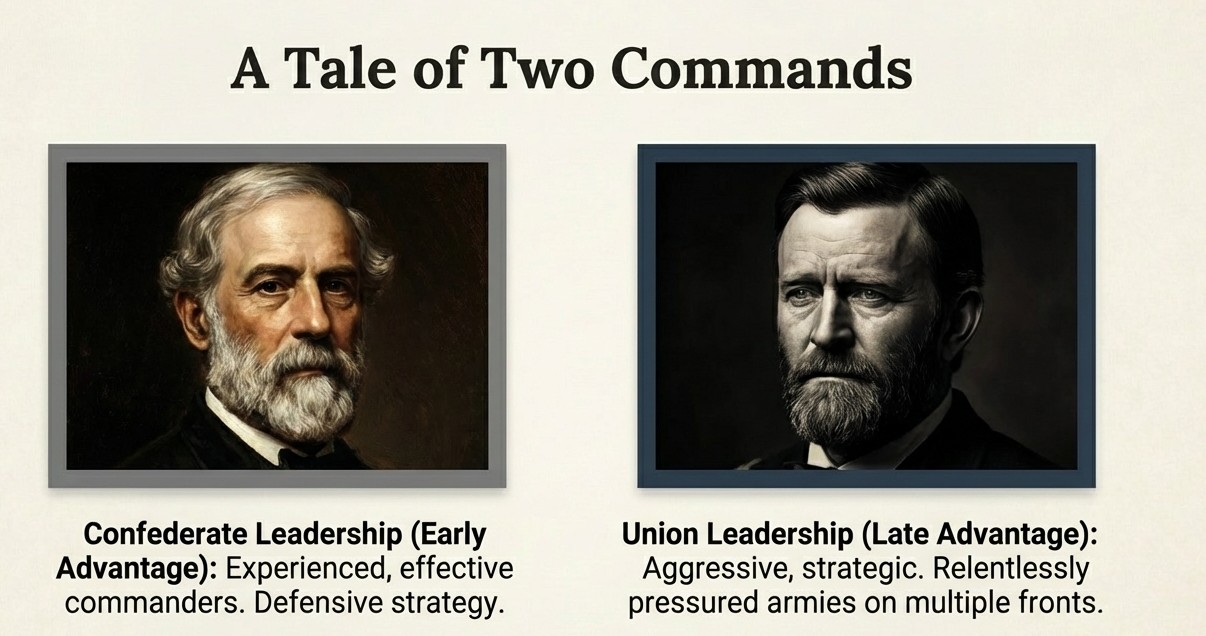
Confederate Early Initiative: In the war's initial years, the Confederacy benefited from more experienced military leadership (such as Robert E. Lee) and a clear defensive strategy. Fighting on their home territory, Confederate forces often outmaneuvered larger Union armies, leading to a series of early victories that shocked the North and prolonged the war.
Union's Strategic Evolution: The Union's path to victory was marked by a crucial improvement in its military leadership and a shift in strategy. President Abraham Lincoln eventually found aggressive commanders like Ulysses S. Grant and William T. Sherman, who understood that winning required more than just capturing the Confederate capital. The Union's strategy evolved from limited engagements to a "total war" approach aimed at destroying the Confederacy's ability and will to fight.
Factor 3: Key Victories and Infrastructure Destruction
The Union's improved strategy and leadership produced key turning-point victories and a systematic campaign to dismantle the Southern war machine.
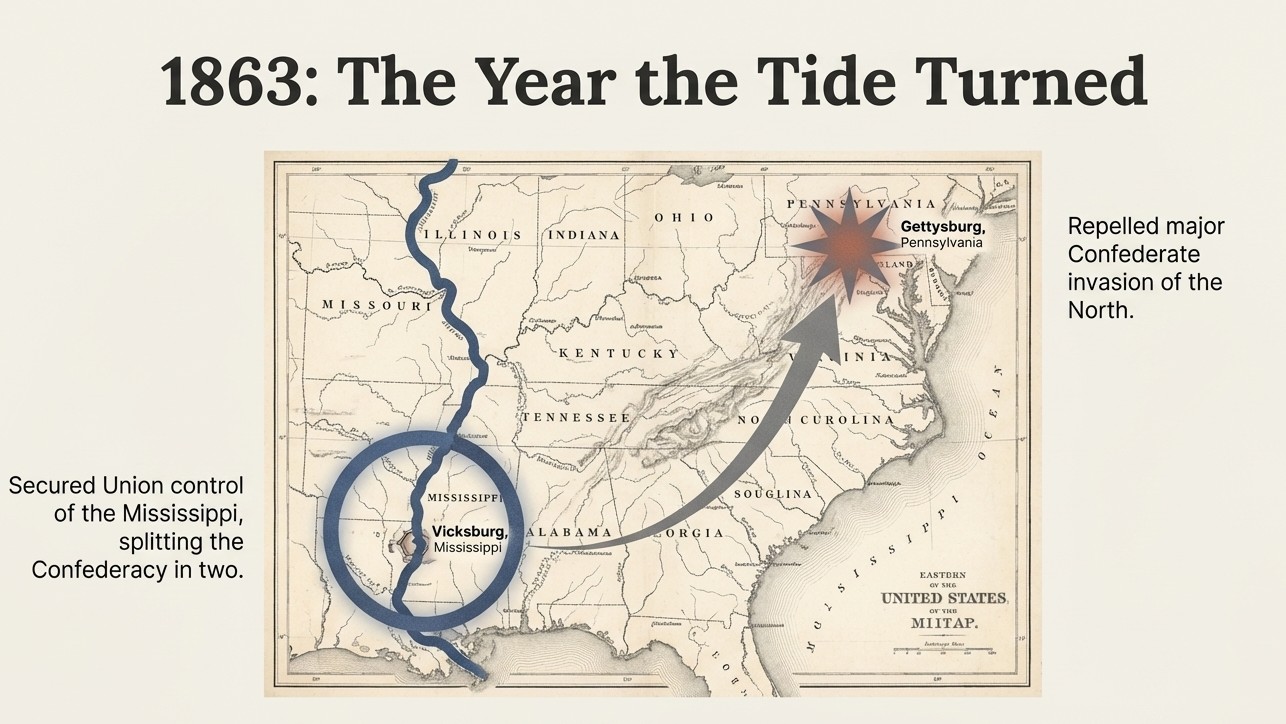
Pivotal Battles: Mid-war victories, such as at Gettysburg and Vicksburg in 1863, were critical. They halted Confederate momentum, secured Union control of the Mississippi River (splitting the Confederacy in two), and boosted Northern morale.
Destroying the Southern War Effort: The final phase of Union strategy focused on destroying the South's infrastructure—the physical and organizational structures, such as railroads, bridges, and industrial centers, needed for a society to function. Campaigns like Sherman's March to the Sea deliberately targeted these resources, crippling the Confederacy's ability to supply its armies and feed its population, thereby hastening its collapse.
Data & Organization Tools
Comparative Advantages: Union vs. Confederacy
| Factor | Union (USA) | Confederacy (CSA) |
|---|---|---|
| Population | ~22 million | |
| Economy | Industrial, with 90% of factory output | Agrarian, reliant on cotton exports |
| Transportation | Extensive railroad network | Limited and fragmented rail lines |
| Military Goal | Offensive: Conquer the South, preserve the Union | Defensive: Survive, win independence |
| Leadership (Early) | Inconsistent, cautious generals | Experienced, effective commanders |
| Leadership (Late) | Aggressive, strategic (Grant, Sherman) | Strained by attrition and losses |
Evidence Bank
Union Mobilization: The Union's established factories in the Northeast rapidly converted to produce rifles, cannons, and uniforms, while its vast railroad network allowed for the efficient movement of troops and supplies to different fronts.
Confederate Mobilization: The Confederacy established government-run armories and attempted to build factories, but it largely relied on European imports and captured Union weapons to equip its armies.
Home Front Opposition (Union): The New York City Draft Riots of 1863 were a violent protest against the military conscription law, revealing deep social, ethnic, and class-based tensions in the North.
Home Front Opposition (Confederacy): Bread riots, led primarily by women in cities like Richmond, erupted due to severe food shortages and hyperinflation, demonstrating the internal strains on the Confederate government.
Ulysses S. Grant: As commanding general of the U.S. Army from 1864, Grant implemented a coordinated strategy of total war, relentlessly pressuring Confederate armies on multiple fronts and accepting high casualties to grind down the South's ability to fight.
William T. Sherman's March to the Sea: This 1864 military campaign from Atlanta to Savannah, Georgia, exemplified the Union's strategy of destroying infrastructure and civilian property to break the Confederate will to continue the war.
Battle of Gettysburg (1863): A key Union victory in Pennsylvania that repelled a major Confederate invasion of the North, often considered a major turning point in the war.
Siege of Vicksburg (1863): A decisive Union victory that gave it control of the entire Mississippi River, effectively splitting the Confederacy in two and cutting off vital supply lines.
Skill Snapshots
Causation:
The Union's larger population and industrial base (cause) → allowed it to sustain a long war of attrition and replace losses more effectively than the Confederacy (effect).
The appointment of Grant and Sherman to high command (cause) → led to the implementation of a more aggressive "total war" strategy targeting the South's infrastructure (effect).
The destruction of Southern railroads (cause) → crippled the Confederacy's ability to supply its armies and transport resources, accelerating its collapse (effect).
Comparison:
The Union fought an offensive war to conquer and restore the nation, while the Confederacy fought a defensive war to secure its independence.
While the Union's economy was diversified and industrial, the Confederacy's was primarily agrarian and dependent on enslaved labor.
Early in the war, Confederate military leadership was generally considered superior, whereas the Union struggled to find effective commanders until later in the conflict.
Continuity and Change Over Time:
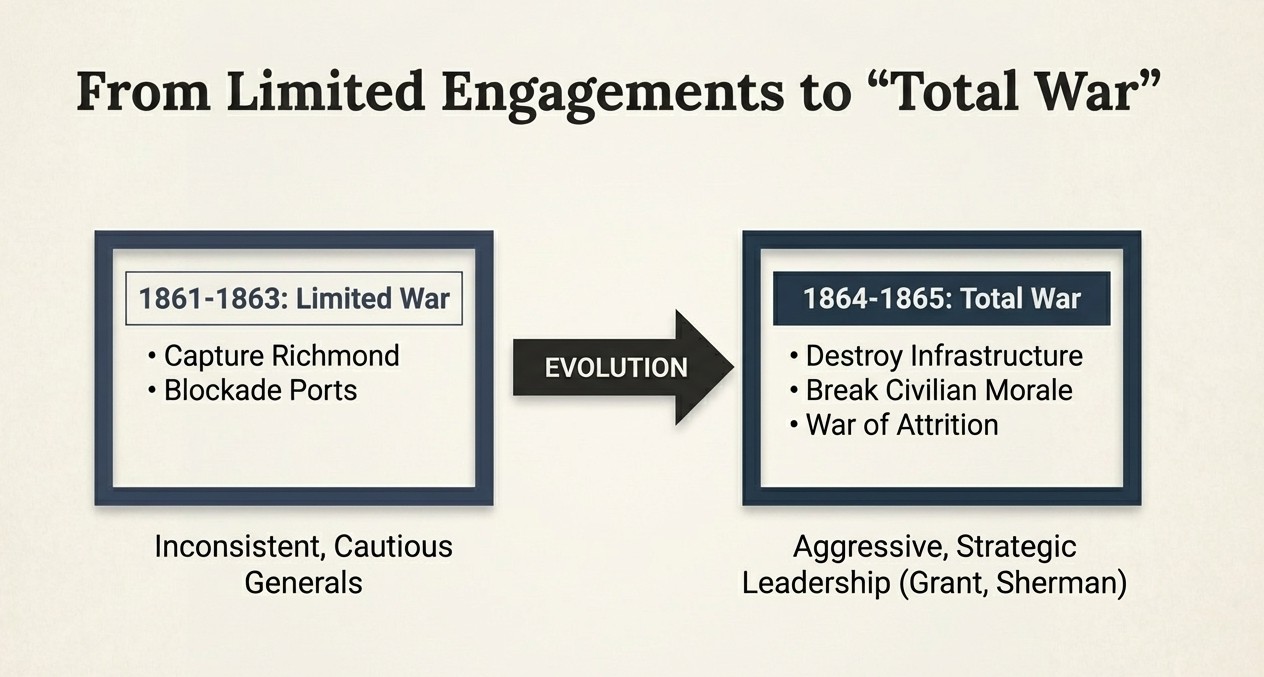
Baseline: At the start of the war, the Confederacy held a key advantage in military leadership and defensive strategy.
Change: The Union's military strategy evolved from limited warfare to a "total war" approach focused on destroying the enemy's capacity to fight.
Change: Union military leadership improved dramatically with the rise of generals like Grant and Sherman.
Continuity: The Union's fundamental advantages in population, industry, and financial resources remained a constant factor throughout the entire war.
Common Misconceptions & Clarifications
Misconception: The Union won simply because it had more men and materials.
Clarification: While resources were a decisive factor, the Union also had to develop effective leadership and a strategy to leverage those advantages. The Confederacy's skill and determination made the outcome uncertain for several years.
Misconception: The Confederacy was a united society fighting for a single cause.
Clarification: The Confederacy faced significant internal dissent. Issues like states' rights, class conflict, and the hardships of war created considerable home front opposition that weakened the war effort.
Misconception: The Union's victory was inevitable from the start.
Clarification: The Confederacy showed significant military initiative early in the war, winning major battles and posing a serious threat to the Union. It took years of strategic adaptation, key victories, and relentless pressure for the Union to succeed.
One-Paragraph Summary
The Union's ultimate victory in the Civil War was the result of a complex convergence of factors. Although the Confederacy demonstrated considerable military initiative and resilience in the early years of the conflict, it could not overcome the Union's overwhelming advantages in population, industrial capacity, and financial resources. Both sides mobilized their societies to an unprecedented degree and faced significant opposition on the home front. However, the Union's success was ultimately secured through critical improvements in military leadership with generals like Grant and Sherman, the adoption of a "total war" strategy that targeted the South's infrastructure, and a series of key battlefield victories that broke the Confederacy's ability to wage war.