
Getting Started
The 1850s marked a period of intense political breakdown in the United States. While the nation had previously managed to contain the explosive issue of slavery through a series of compromises, attempts to resolve its expansion into western territories during this decade failed spectacularly. This chapter examines the key political events and shifts that shattered national unity, destroyed the existing party system, and set the nation on an irreversible path to civil war.
What You Should Be Able to Do
After reviewing this chapter, you should be able to:
Explain how the Kansas-Nebraska Act intensified sectional tensions over slavery.
Analyze the ways in which the Dred Scott decision undermined attempts at compromise.
Explain the causes for the collapse of the Second Party System.
Describe the formation and core principles of the Republican Party.
Connect the political failures of the 1850s to the outbreak of the Civil War.
Key Developments & Analysis
The Causes of Political Breakdown
The fragile peace maintained by earlier compromises collapsed in the 1850s due to a series of legislative, judicial, and political failures that directly addressed the issue of slavery in the territories.
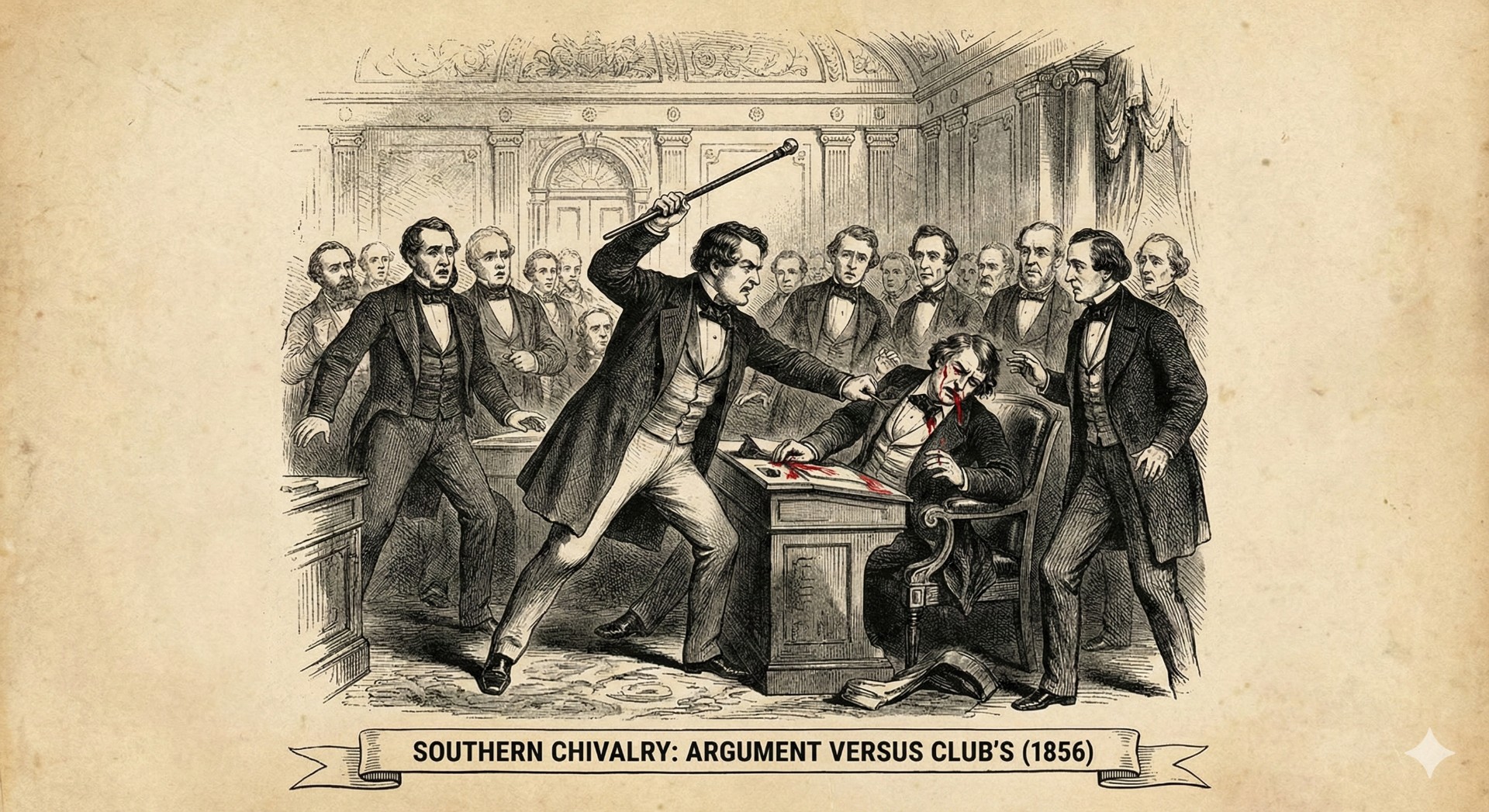
- The Kansas-Nebraska Act (1854): This act was a legislative attempt to organize the vast territory north of the Missouri Compromise line. To win Southern support, it proposed the use of popular sovereignty, a principle allowing settlers in a territory to decide for themselves whether to permit slavery. This law had two disastrous consequences: it explicitly repealed the Missouri Compromise of 1820, which had banned slavery in this region for over 30 years, and it ignited a violent proxy war in Kansas between pro-slavery and anti-slavery settlers. Instead of resolving the issue, the act turned the territory into a battleground known as "Bleeding Kansas."
The Dred Scott Decision (1857): The Supreme Court intervened in the slavery debate with its ruling in Dred Scott v. Sandford. The Court declared that Dred Scott, an enslaved man who had lived in free territory, was not a citizen and therefore could not sue in federal court. More broadly, the decision stated that Congress had no constitutional power to ban slavery in any federal territory, rendering past and future compromises unconstitutional. This judicial ruling infuriated the North, as it appeared to make slavery a national institution, and it emboldened the South, which now had the highest court's backing for its position.
The Collapse of the Second Party System: The intense sectional conflict over slavery proved fatal to the Second Party System, the political alignment of the Democratic and Whig Parties that had defined national politics since the 1830s.
The Whig Party, unable to forge a unified position on the Kansas-Nebraska Act, fractured and dissolved.
While nativism—a political movement characterized by hostility toward immigrants, particularly Irish and German Catholics—briefly fueled the rise of the American (or "Know-Nothing") Party, the issue of slavery quickly overshadowed it.
The Democratic Party survived but became increasingly dominated by its pro-slavery Southern wing.
The Effects of Failed Compromise
The failure of these attempts at resolution did not reduce conflict; instead, it created a new, more dangerously polarized political landscape.
Immediate Effect: The Rise of Sectional Parties: The collapse of the Whigs created a political vacuum in the North. This void was filled by the newly formed Republican Party. The Republican Party was the nation's first major sectional party, meaning its support was based almost exclusively in one region—the North. Its central platform was preventing the extension of slavery into the western territories. It was a coalition of former Northern Whigs, anti-slavery Democrats, and members of the Free-Soil Party.
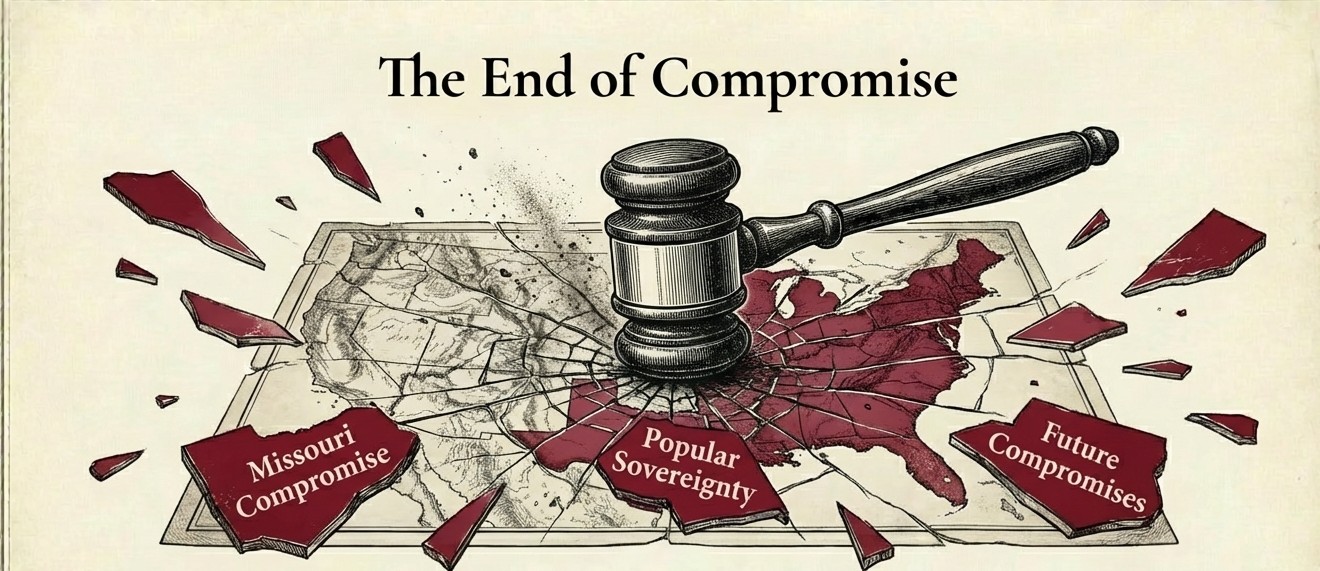
Long-Term Impact: The End of Political Compromise: By the late 1850s, the primary mechanisms for national compromise had been destroyed. The legislative branch produced a failed law (Kansas-Nebraska Act) that led to violence, the judicial branch issued a decision (Dred Scott) that invalidated the very idea of legislative compromise on slavery in the territories, and the national party system had been replaced by one that pitted the North against the South. With no viable political path to resolving the slavery issue, the stage was set for a military conflict.
Data & Organization Tools
A Causal Chain of Political Failure: 1854–1860
| Event/Development | Immediate Consequence |
|---|---|
| Kansas-Nebraska Act (1854) | Repeals the Missouri Compromise line, introducing popular sovereignty. |
| "Bleeding Kansas" | Pro- and anti-slavery forces clash violently in Kansas. |
| Collapse of the Whig Party | The party fractures over its inability to take a clear stance on slavery's expansion. |
| Formation of the Republican Party | A new, purely sectional party emerges in the North to oppose slavery's extension. |
| Dred Scott Decision (1857) | The Supreme Court declares that Congress cannot ban slavery in the territories. |
| Solidification of Sectionalism | The North and South are now represented by opposing political parties with irreconcilable views on slavery. |
Evidence Bank
Kansas-Nebraska Act (1854): A law that allowed voters in the Kansas and Nebraska territories to choose whether to allow slavery through popular sovereignty. It overturned the Missouri Compromise and led to violent conflict in Kansas.
Popular Sovereignty: The political principle that the authority of a state and its government are created and sustained by the consent of its people, who are the source of all political power. In the 1850s, it referred specifically to the idea that settlers in a territory could vote on whether to allow slavery.
Dred Scott v. Sandford (1857): A landmark Supreme Court decision that ruled African Americans were not citizens and had no rights in federal court. It also found the Missouri Compromise unconstitutional, arguing Congress could not prohibit slavery in the territories.
Republican Party: A sectional political party founded in the 1850s in response to the Kansas-Nebraska Act. Its primary platform was the non-extension of slavery into the western territories.
Second Party System: The political era in the United States from roughly 1828 to 1854, characterized by competition between the Democratic Party and the Whig Party. This system collapsed due to divisions over slavery.
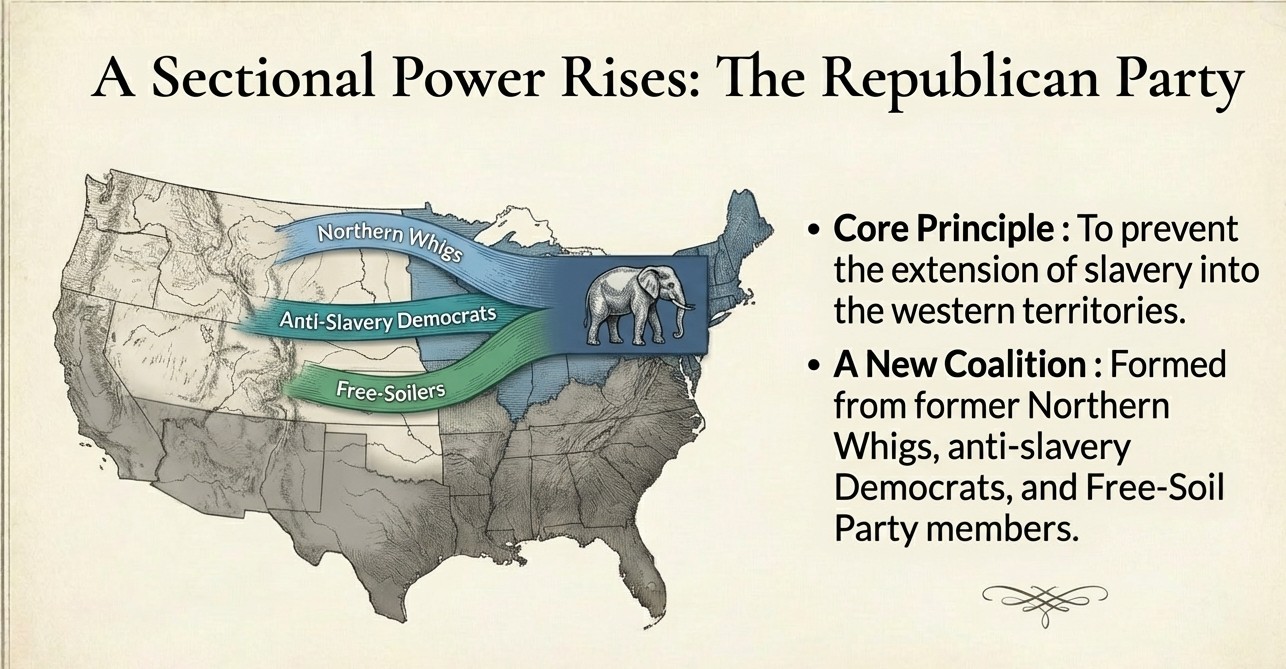
Sectional Parties: Political parties whose support base is concentrated in one region or section of the country. The Republican Party's emergence as a powerful Northern party, with virtually no support in the South, is a key example.
Nativism: A political policy of promoting the interests of native-born inhabitants over those of immigrants. In the 1850s, it was directed primarily at Catholic immigrants from Ireland and Germany and was the central issue of the short-lived American Party.
Skill Snapshots
Causation:
The Kansas-Nebraska Act caused the repeal of the Missouri Compromise, which in turn caused the outbreak of violence in "Bleeding Kansas."
The fracturing of the Whig Party over slavery caused a political vacuum that was filled by the new Republican Party.
The Dred Scott decision caused the invalidation of popular sovereignty as a viable compromise, further enraging Northerners.
Comparison:
The Whig Party was a national party with support in both North and South, whereas the Republican Party was a sectional party with support based almost exclusively in the North.
The Missouri Compromise of 1820 represented a legislative attempt to solve the slavery issue, whereas the Dred Scott decision represented a judicial attempt that ultimately blocked legislative solutions.
Northern political identity increasingly centered on "free labor" and opposition to slavery's expansion, whereas Southern political identity centered on protecting slavery as a constitutional right.
Continuity and Change over Time:
Baseline: In the early 1850s, the Second Party System, with two national parties (Whigs and Democrats), was the primary structure for political competition.
Change: By 1856, the Whig Party had collapsed, and the new Republican Party had emerged as the primary opposition to the Democrats in the North.
Continuity: The Democratic Party survived the collapse of the Second Party System, though it became increasingly dominated by its Southern, pro-slavery faction.
Common Misconceptions & Clarifications
Misconception: The Republican Party was founded to abolish slavery everywhere in the United States.
Clarification: The early Republican platform was focused on stopping the expansion of slavery into the western territories, not on abolishing it in the states where it already existed.
Misconception: The Dred Scott decision was just about one man's freedom.
Clarification: The decision had sweeping political consequences, declaring that African Americans were not citizens and that Congress had no power to regulate slavery in the territories, thereby nullifying decades of political compromise.
Misconception: The Kansas-Nebraska Act successfully settled the slavery issue in the territories.
Clarification: The act was a catastrophic failure that led directly to violence in Kansas ("Bleeding Kansas") and shattered the fragile peace over slavery's expansion.
Misconception: Nativism was as important as slavery in destroying the Second Party System.
Clarification: While nativism was a significant social and political force in the 1850s, the issue of slavery was the primary cause of the Whig Party's collapse and the rise of the sectional Republican Party.
One-Paragraph Summary
The 1850s witnessed the complete failure of political compromise over the issue of slavery, directly causing the Civil War. Legislative efforts like the Kansas-Nebraska Act backfired, sparking violence rather than settling disputes. The Supreme Court's Dred Scott decision further polarized the nation by declaring that Congress had no authority to limit slavery's expansion, making future compromises seem impossible. This intense sectional conflict destroyed the Second Party System, leading to the demise of the national Whig Party and the rise of the purely sectional Republican Party in the North. With political institutions broken and the nation divided into hostile regional factions, the path to a peaceful resolution was closed, making war nearly inevitable.