
Getting Started
The period from 1844 to 1877 was defined by a profound and often violent struggle over the future of the United States. Fueled by westward expansion and deep-seated economic and ideological differences, the nation fractured over the institution of slavery, leading to a devastating Civil War. The subsequent era of Reconstruction (1865–1877) was a contested effort to rebuild the nation, end slavery, and confront the unresolved questions of federal power and citizenship that the war left in its wake.
What You Should Be Able to Do
After studying this topic, you should be able to:
Explain how U.S. expansion in the 1840s and 1850s intensified sectional divisions.
Analyze the primary causes of the Civil War, focusing on debates over slavery.
Explain the key factors that led to the Union victory.
Evaluate how the Civil War and Reconstruction altered the relationship between the federal government and the states.
Analyze the debates over citizenship and the rights of African Americans that defined the Reconstruction era.
Key Developments & Analysis
This period is best understood through the lens of causation, as a chain of events where expansionist ambitions led directly to a national crisis over slavery, which in turn caused a war whose outcome created the complex challenges of Reconstruction.
Causes of Sectional Conflict and Civil War (c. 1844–1861)
The Civil War was not a sudden event but the culmination of decades of mounting tension. The primary drivers were the nation's expansion and the intractable disagreement over slavery.
Expansion and Territorial Acquisition: A popular enthusiasm for U.S. expansion, driven by economic interests and a sense of national destiny, resulted in the acquisition of vast new territories in the West. This expansionist foreign policy directly forced the question of whether these new lands would permit slavery, upsetting the delicate political balance between North and South.
Deepening Regional Divisions: Ideological and economic differences over slavery created starkly different societies in the North and the South. The North was developing an industrial economy, while the South remained a largely agrarian economy dependent on enslaved labor. These differences fueled diverging political and cultural responses to national issues.
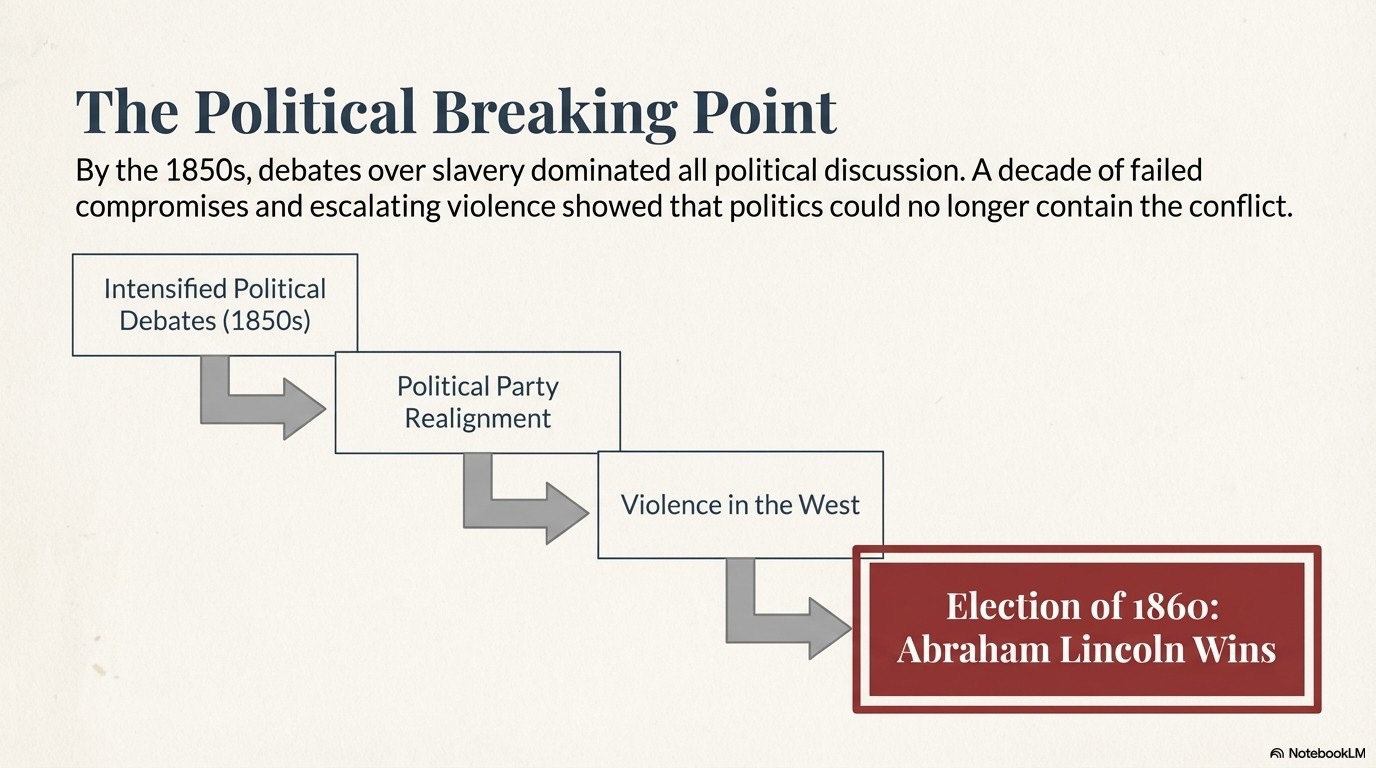
Dominance of the Slavery Debate: By the 1850s, debates over slavery came to dominate all political discussion. Questions about the rights and citizenship—the status of being a citizen, with its accompanying rights and responsibilities—for various groups, including enslaved people, free African Americans, and immigrants, became central to the national conflict.
Political Culmination: The bitter presidential election of 1860, won by Abraham Lincoln on a platform opposing the extension of slavery, served as the final trigger. Believing their way of life was under threat, Southern states began to enact secession, the formal withdrawal from the Union, leading directly to war.
Effects of the Civil War and the Era of Reconstruction (c. 1861–1877)
The Union victory settled the questions of slavery and secession but created a new set of challenges regarding the terms of reunion and the definition of freedom.
Immediate Effects
Union Victory: The North’s victory was the result of several key factors, including its greater manpower, superior industrial resources, and the effective leadership of President Abraham Lincoln.
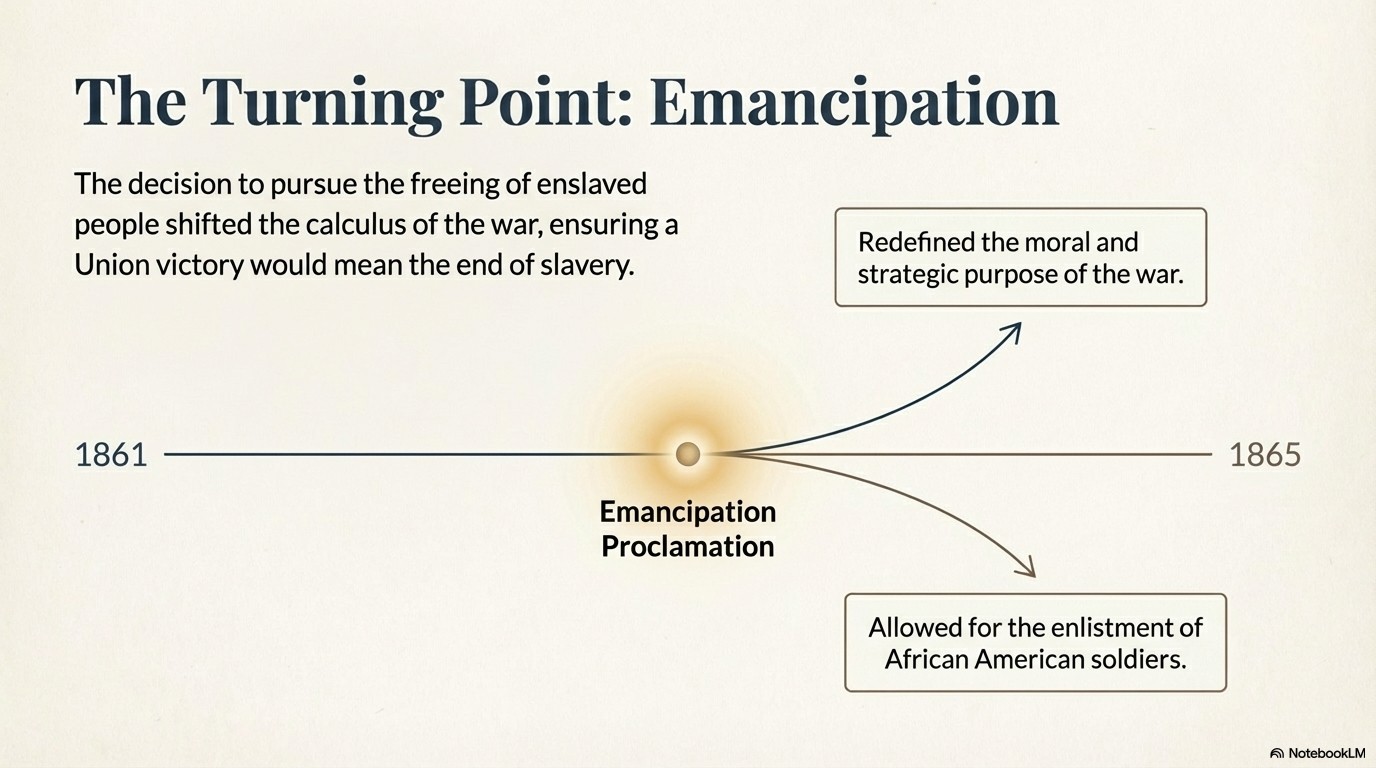
Emancipation: A critical turning point in the war was the decision to pursue emancipation—the freeing of enslaved people. This not only shifted the moral and strategic calculus of the war but also ensured that a Union victory would mean the end of slavery.
End of Slavery and Secession: The war definitively ended the institution of slavery and affirmed that states did not have the right to secede from the Union.
Long-Term Impacts and Contested Outcomes
Altered Federal-State Relations: The Civil War and Reconstruction dramatically increased the power of the federal government. Constitutional amendments and federal legislation asserted national authority over the states in unprecedented ways, particularly to protect citizens' rights.
New Definitions of Citizenship: The most significant and contested outcome was the debate over new definitions of citizenship. The abolition of slavery forced the nation to confront the status of nearly four million newly freed African Americans. This led to landmark constitutional amendments aimed at securing their rights.
Unresolved Questions: Despite these changes, Reconstruction left many questions unresolved. The extent of federal power to protect the rights of African Americans, women, and other minorities remained a subject of intense debate and conflict, and Southern resistance ultimately limited the era's transformative potential.
Data & Organization Tools
Timeline of Sectional Conflict and Reconstruction
| Date | Event | Significance |
|---|---|---|
| 1845-1848 | U.S. acquires Texas and the Mexican Cession | Sparks intense debate over whether slavery will be allowed in these vast new western territories. |
| 1850s | Intensified Political Debates | Political discussions become dominated by the issue of slavery, leading to violence and party realignment. |
| 1860 | Election of Abraham Lincoln | Southern states, fearing a federal government hostile to slavery, begin to secede from the Union. |
| 1861-1865 | The Civil War | The Union's military victory preserves the nation and leads to the abolition of slavery. |
| 1863 | Emancipation Proclamation | Lincoln's executive order begins the process of freeing enslaved people in Confederate territory. |
| 1865-1877 | Reconstruction Era | The federal government attempts to rebuild the South and define the rights of newly freed citizens. |
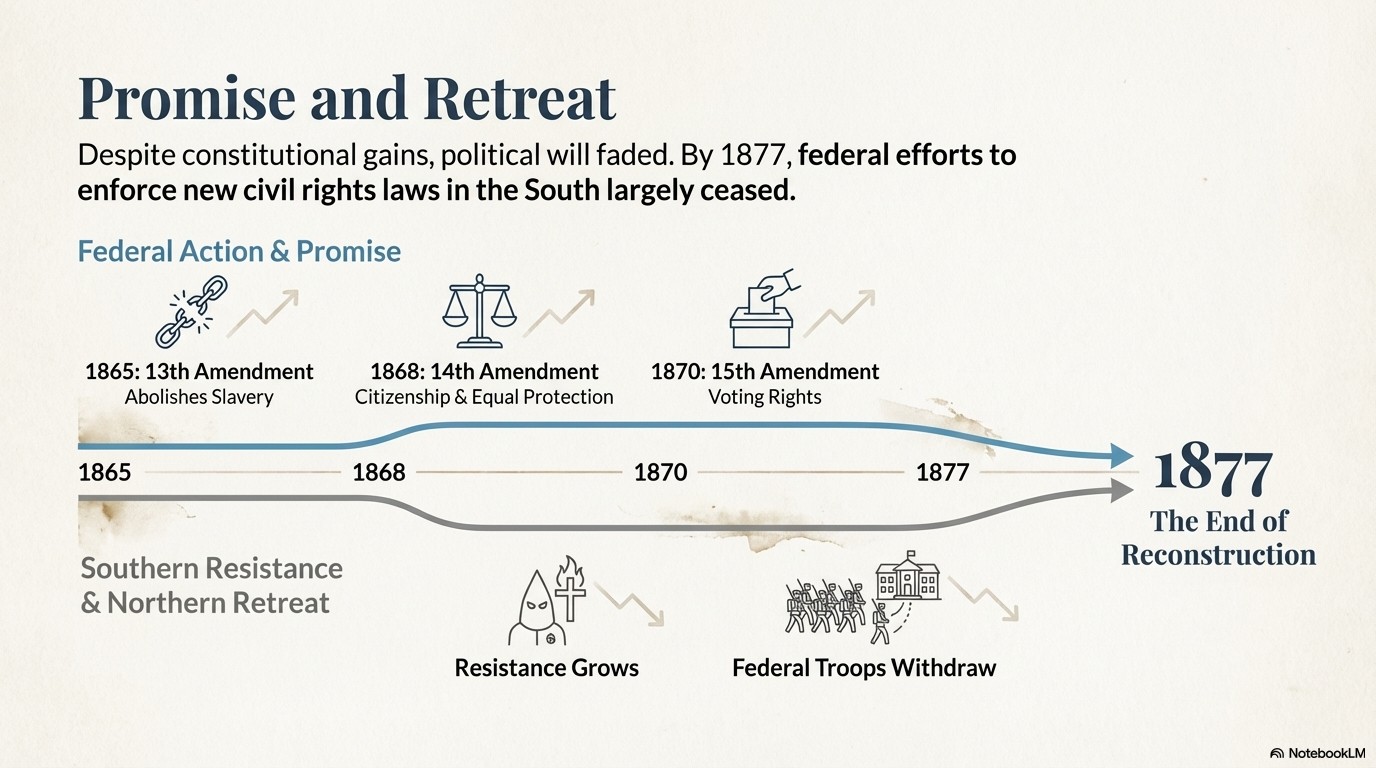
| 1865-1870 | Reconstruction Amendments | The 13th, 14th, and 15th Amendments are passed, ending slavery and granting citizenship and voting rights. |
| 1877 | End of Reconstruction | Federal efforts to enforce new civil rights laws in the South largely cease. |
Evidence Bank
Expansionist foreign policy: The 19th-century U.S. policy of acquiring new territory, particularly in the Western Hemisphere. This policy, exemplified by the annexation of Texas and the Mexican-American War, directly fueled the conflict over the extension of slavery.
Sectional conflict: The intense political, economic, and cultural disagreements between the North and the South that deepened from the 1840s onward. These conflicts centered on the issue of slavery and the balance of power in the federal government.
Secession: The act of a state formally withdrawing from the United States. The secession of 11 Southern states following the 1860 election was the immediate cause of the Civil War.
Abraham Lincoln: As the 16th U.S. President, his leadership was crucial to preserving the Union during the Civil War. His decision to issue the Emancipation Proclamation redefined the purpose of the war.
Emancipation: The process of freeing enslaved people, which became a central goal of the Union war effort. It culminated in the 13th Amendment, which permanently abolished slavery in the United States.
Reconstruction: The period following the Civil War (1865–1877) focused on rebuilding the former Confederate states and integrating newly freed African Americans into society as citizens. It was marked by intense debate over federal power and civil rights.
Citizenship rights: The fundamental rights, privileges, and protections guaranteed to a nation's citizens. During Reconstruction, the 14th and 15th Amendments were passed to grant citizenship and voting rights to African American men, though the enforcement of these rights was heavily contested.
Federal government: The national government of the United States. The Civil War and Reconstruction led to a significant expansion of its power and authority relative to the states.
Skill Snapshots
Causation: Popular enthusiasm for expansion → acquisition of new territories → intensified political debates over slavery → the Civil War.
Causation: The Union's military victory → the passage of the 13th, 14th, and 15th Amendments → new debates over the definition and protection of citizenship rights.
Comparison: The Northern economy was primarily industrial with free labor, while the Southern economy was agrarian and dependent on enslaved labor, leading to different political and social ideologies.
Comparison: Before the Civil War, debates often centered on states' rights versus federal power. After the war, the power of the federal government to define and protect citizenship was significantly strengthened, though still contested.
CCOT:
Baseline (c. 1844): A fragile political balance existed between free and slave states, with the power of the federal government to interfere with slavery being sharply limited.
Change: The Civil War and Reconstruction abolished slavery and constitutionally redefined citizenship to include African Americans, asserting federal power to protect individual rights.
Continuity: Despite constitutional changes, deep-seated debates over the rights of minority groups and the proper balance of power between the federal and state governments continued long after 1877.
Common Misconceptions & Clarifications
Misconception: The Civil War was fought over "states' rights," not slavery.
Clarification: The primary "right" Southern states sought to protect was the right to own enslaved people and extend the institution into new territories. Debates over slavery were the central cause of the war.
Misconception: Reconstruction was a complete failure.
Clarification: While Reconstruction failed to achieve long-term racial justice and equality, it was not a total failure. The constitutional amendments passed during this era (13th, 14th, and 15th) provided the legal foundation for the Civil Rights Movement of the 20th century.
Misconception: With the end of the Civil War, the nation's problems were solved.
Clarification: The end of the war settled the issues of union and slavery but opened up new, complex questions. The Reconstruction era was a period of intense conflict over how to rebuild the South, what freedom meant for former slaves, and what the role of the federal government should be.
One-Paragraph Summary
The period from 1844 to 1877 witnessed the escalation and culmination of the nation's deepest sectional conflicts. Driven by an expansionist foreign policy, the United States acquired new territories that ignited fierce debates over the future of slavery. These ideological and economic divisions ultimately led to the secession of Southern states and the Civil War. The Union's victory, secured through its industrial and manpower advantages, settled the questions of slavery and national unity. However, the subsequent era of Reconstruction introduced a new, contested chapter in American history, marked by profound debates over the meaning of citizenship, the rights of African Americans, and the expanded power of the federal government to shape the nation's future.