
Getting Started
By 1860, the United States was a nation fractured along sectional lines, primarily over the issue of slavery's expansion into western territories. Decades of failed compromises had intensified distrust between the North and South. The presidential election of that year was not just a political contest; it was a critical turning point that would determine whether the Union would endure or dissolve into civil war.
What You Should Be Able to Do
Explain the core principles of the Republican Party's platform in the 1860 election.
Describe how the results of the election demonstrated a deep national division.
Explain the direct causal relationship between Abraham Lincoln's victory and the secession of Southern states.
Analyze why the election of 1860 served as the immediate trigger for the Civil War.
Key Developments & Analysis
This topic is best understood through the lens of Causation, as the election of 1860 served as a direct trigger for a series of momentous effects, culminating in war.
Causes (The Trigger Event)
The victory of Abraham Lincoln in the 1860 presidential election was the immediate cause that led to secession. Two key aspects of his victory were particularly alarming to the slaveholding South:
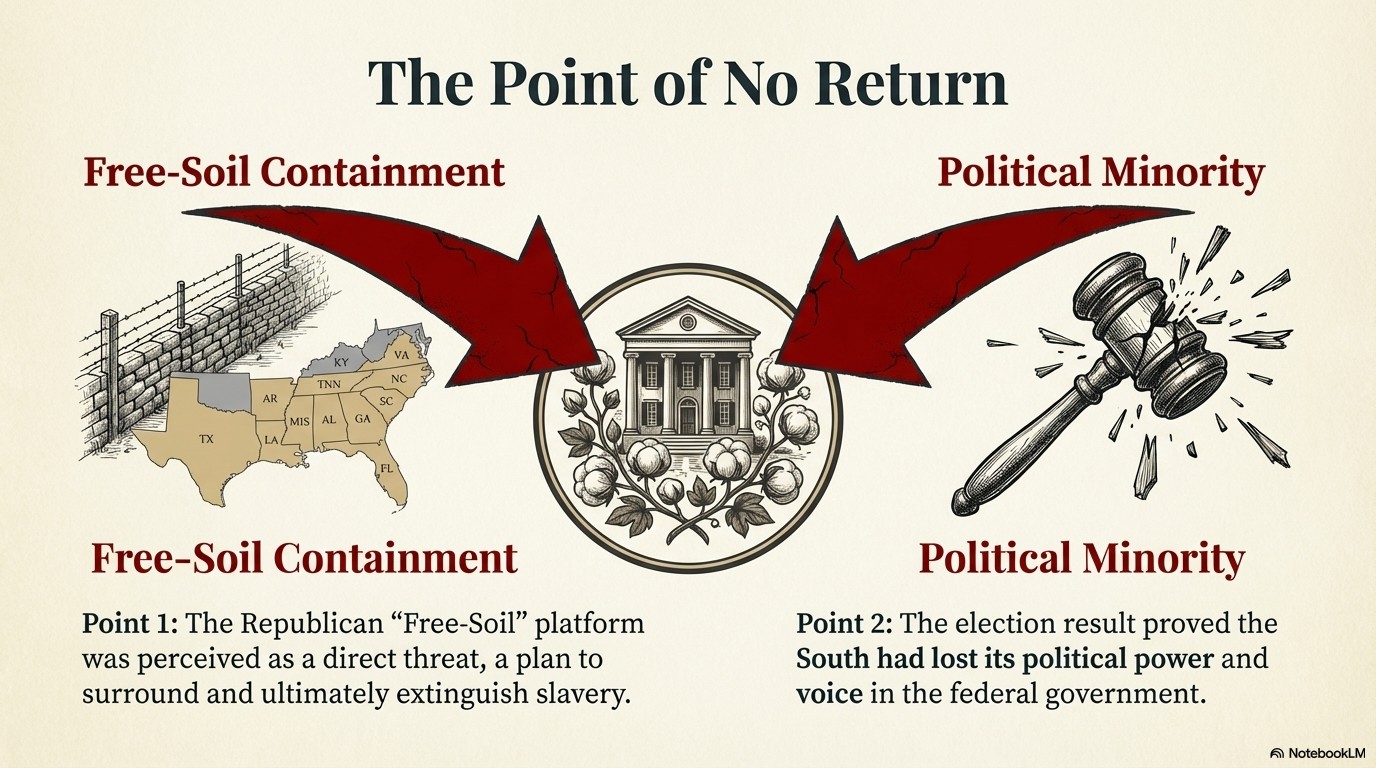
The Republican Free-Soil Platform: The Republican Party was a relatively new political party whose central ideology was built on preventing the expansion of slavery into new U.S. territories. This was known as a free-soil platform. While this platform did not call for abolishing slavery where it already existed, Southern leaders viewed it as a direct threat to the long-term survival of their slave-based economy and social structure. They believed that if slavery could not expand, it would eventually be surrounded and extinguished.
Victory Without Southern Support: Abraham Lincoln won the presidency with a clear majority in the Electoral College but did so without winning a single electoral vote from a Southern state. This starkly demonstrated to the South that they had lost their political influence on the national stage. They were now a political minority, unable to block the election of a president they viewed as hostile to their interests.
Effects & Impacts
Lincoln's victory set in motion a rapid and decisive chain of events that led the nation to war.
Immediate Effect: Secession: Believing their way of life was under imminent threat and that they no longer had a voice in the national government, most slave states chose to secede, or formally withdraw, from the United States. They argued that the Union—the federal compact between the states—had been broken by the election of a purely sectional president. South Carolina was the first to secede in December 1860, and several other Deep South states quickly followed, even before Lincoln was inaugurated.
Long-Term Impact: Civil War: The act of secession was not accepted by the federal government. President Lincoln and leaders in the North viewed secession as an illegal rebellion. The fundamental disagreement over whether a state had the right to leave the Union, combined with the underlying conflict over slavery, directly precipitated the Civil War. When Confederate forces fired on the federal Fort Sumter in April 1861, the political crisis became a military one.
Data & Organization Tools
The Election of 1860: A Nation Divided
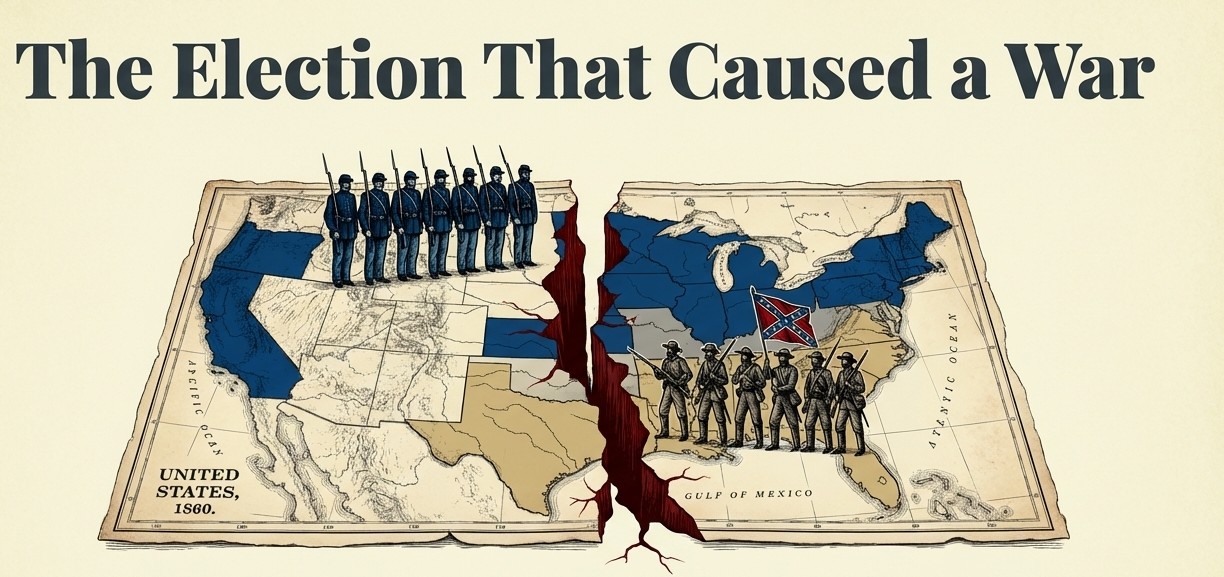
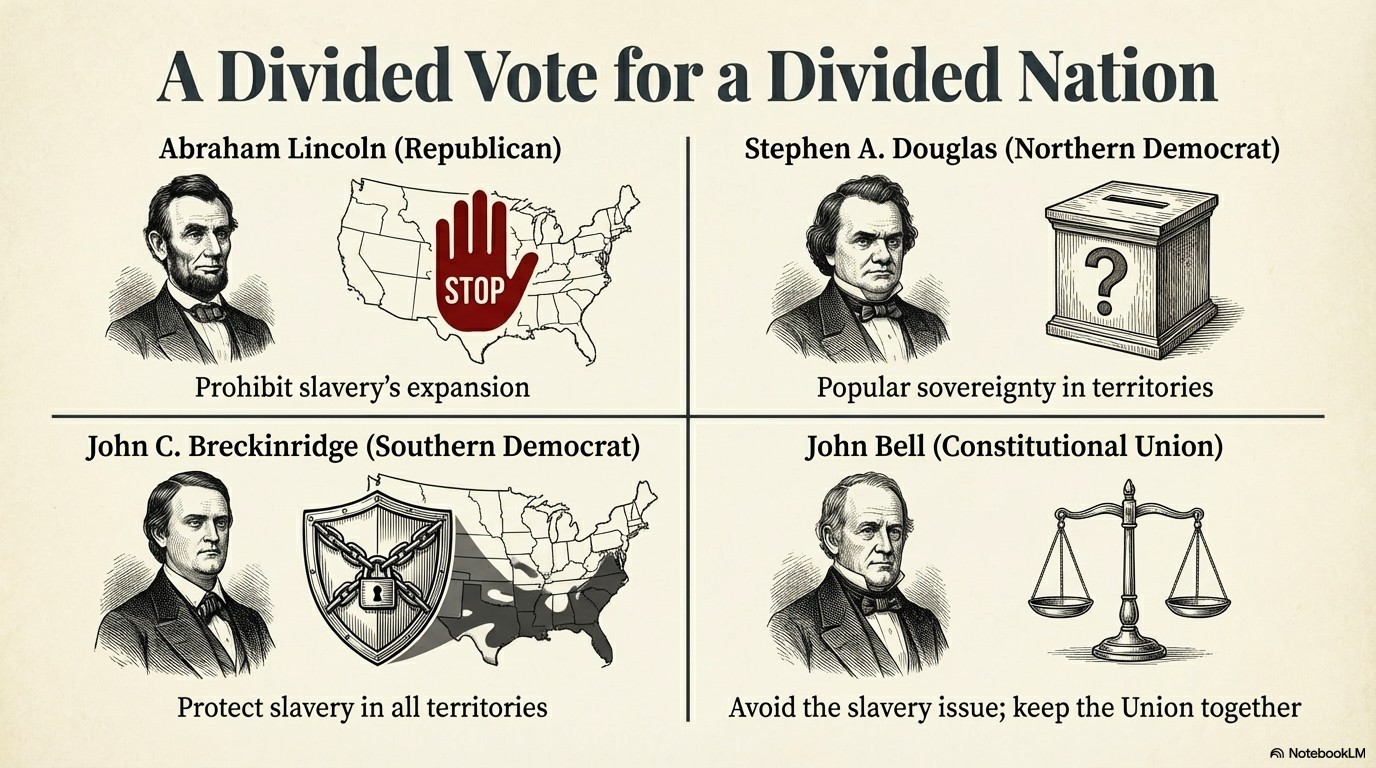
The 1860 election results clearly illustrate the deep sectional divisions that led to the crisis. The Democratic Party split into Northern and Southern factions, which, along with a fourth-party candidate, divided the vote and allowed Lincoln to win.
| Candidate | Party | Platform on Slavery | Primary Region of Support |
|---|---|---|---|
| Abraham Lincoln | Republican | Prohibit slavery's expansion (Free-Soil) | The North |
| Stephen A. Douglas | Northern Democrat | Popular sovereignty in territories | North, Midwest |
| John C. Breckinridge | Southern Democrat | Protect slavery in all territories | The South |
| John Bell | Constitutional Union | Avoid the slavery issue; keep the Union together | Border States |
Evidence Bank
Abraham Lincoln: The Republican candidate whose victory in the 1860 presidential election on a free-soil platform triggered the secession of Southern states.
Republican Party: A political party founded in the 1850s, its primary goal was to stop the expansion of slavery into the western territories, which Southerners saw as a direct threat to their interests.
Free-Soil Platform: The political position that slavery should not be allowed to spread to any new U.S. territories. This was the central plank of the Republican platform in 1860.
Election of 1860: The pivotal U.S. presidential election where Abraham Lincoln was elected without any Southern electoral votes, demonstrating the nation's profound sectional divide.
Secession: The formal act of a state withdrawing from the Union. Following Lincoln's election, 11 Southern states seceded, arguing the federal government no longer represented their interests.
The Union: A term for the United States as a national entity. The conflict over whether states had the right to leave the Union was a central cause of the Civil War.
Southern Electoral Votes: A key feature of the 1860 election results; Lincoln won the presidency despite receiving zero electoral votes from the slaveholding South, confirming their status as a political minority.
Skill Snapshots
Causation:
The Republican Party's free-soil platform caused Southern leaders to fear for the future of slavery.
Lincoln’s victory without any Southern electoral votes caused most slave states to conclude they had lost all federal power.
The secession of Southern states caused a constitutional crisis that precipitated the Civil War.
Comparison:
The Republican platform sought to contain slavery's expansion, whereas the Southern Democratic platform sought to protect slavery's expansion.
Lincoln's political support was entirely sectional, concentrated in the North, in contrast to the other candidates, whose support was either Southern or spread across different regions.
The North viewed Lincoln's election as a legitimate democratic outcome, while the seceding South interpreted it as a hostile act that justified leaving the Union.
Continuity and Change Over Time:
Baseline: Before 1860, national political parties and compromises had managed to hold the Union together despite sectional tensions over slavery.
Change: The election of 1860 marked the first time a president was elected on a platform openly opposed to the expansion of slavery, breaking the tradition of compromise.
Change: The secession of the Southern states was a radical departure from previous political disputes, representing a complete rejection of the national political system.
Continuity: The fundamental conflict over the institution of slavery and its role in American society remained the central, unresolved issue driving national politics.
Common Misconceptions & Clarifications
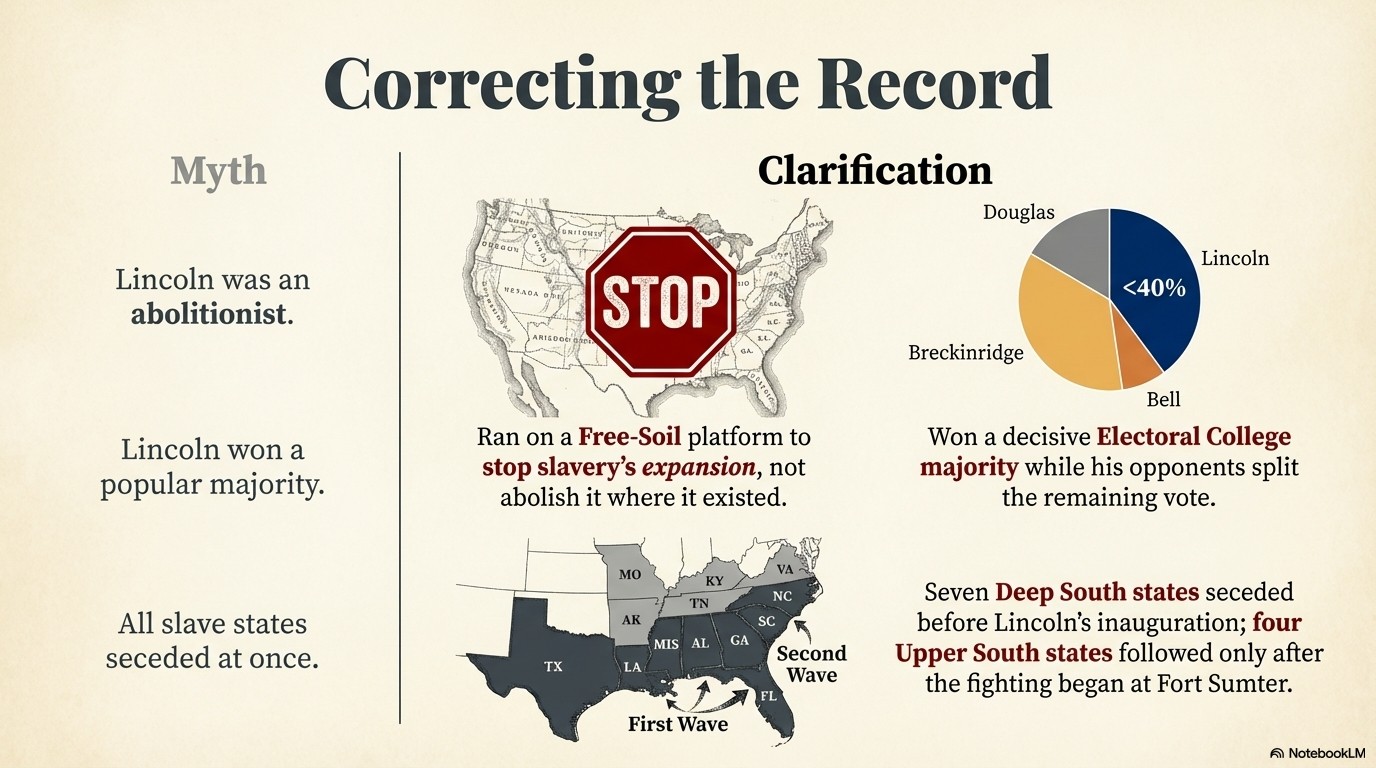
Misconception: Abraham Lincoln ran for president in 1860 as an abolitionist.
- Clarification: Lincoln and the Republican Party ran on a free-soil platform, which aimed to stop the expansion of slavery, not to abolish it where it already existed. Many Southerners, however, believed this was the first step toward total abolition.
Misconception: The South seceded solely because of Abraham Lincoln the man.
- Clarification: The secession was a reaction to what Lincoln's victory represented: the triumph of a political party whose core principle threatened the institution of slavery and the South's political power. The election was the trigger, not the sole cause.
Misconception: Lincoln won the election with a majority of the popular vote.
- Clarification: Lincoln won less than 40% of the popular vote. However, because his three opponents split the remaining vote, he secured a decisive majority in the Electoral College, which is how U.S. presidents are elected.
Misconception: All slave states seceded at the same time.
- Clarification: Secession occurred in two waves. The first wave of seven Deep South states seceded between Lincoln's election and his inauguration. A second wave of four Upper South states seceded after the Civil War began in April 1861.
One-Paragraph Summary
The election of 1860 was the final catalyst for the Civil War. Abraham Lincoln's victory on the Republican Party's free-soil platform, achieved without a single electoral vote from the South, confirmed the slaveholding states' greatest fear: that they had become a permanent political minority unable to protect the institution of slavery. In response, most slave states chose to secede from the Union, a drastic step they believed was necessary to preserve their social and economic order. This act of secession was deemed illegal by the federal government, directly precipitating the armed conflict that would become the Civil War.