
Getting Started
The period from 1844 to 1877 witnessed the dramatic expansion of the United States and the tragic fracturing of its union. Driven by a fervent belief in its continental destiny, the nation acquired vast new territories in the West. This expansion, however, ignited the simmering conflict over slavery, transforming it into an inferno that would engulf the nation in a devastating civil war and force a radical rethinking of American government and citizenship.
What You Should Be Able to Do
After reviewing this material, you should be able to:
Explain how U.S. expansionism intensified debates over slavery.
Describe the key economic, cultural, and political differences that led to sectional conflict.
Analyze the causes and major consequences of the Civil War.
Explain how the Civil War and its aftermath redefined American citizenship and the power of the federal government.
Key Developments & Analysis
This period is best understood through the lens of causation, as a series of interconnected events drove the nation from expansion to war and reconstruction.
The Causes of Sectional Conflict (1844–1861)
The road to the Civil War was paved by a series of developments that deepened the divisions between the North and the South.
Expansionist Foreign Policy: In the 1840s, the United States pursued an aggressive foreign policy to acquire more land in the Western Hemisphere. An expansionist foreign policy is a national objective to grow in power and territory. This was fueled by popular enthusiasm, economic desires for new markets and resources, and security interests in dominating the continent. The acquisition of new territories was a direct result of this policy.
Westward Migration: As new lands were acquired, a substantial migration of American settlers moved westward. This movement was not just a demographic shift; it carried the nation's political and social conflicts into new regions.
Debates over Slavery in New Territories: The central, unavoidable trigger of conflict was the question of whether slavery would be permitted in the newly acquired territories. This single issue came to dominate political discussion in the 1850s, shattering old compromises and making new ones impossible.
Deepening Regional Divisions: The debate over slavery's expansion exposed fundamental, irreconcilable differences between the North and South.
Ideological: Americans in the North and South developed profoundly diverging views on slavery. A growing number in the North viewed it as a moral evil, while white Southerners defended it as a positive social good and a cornerstone of their way of life.
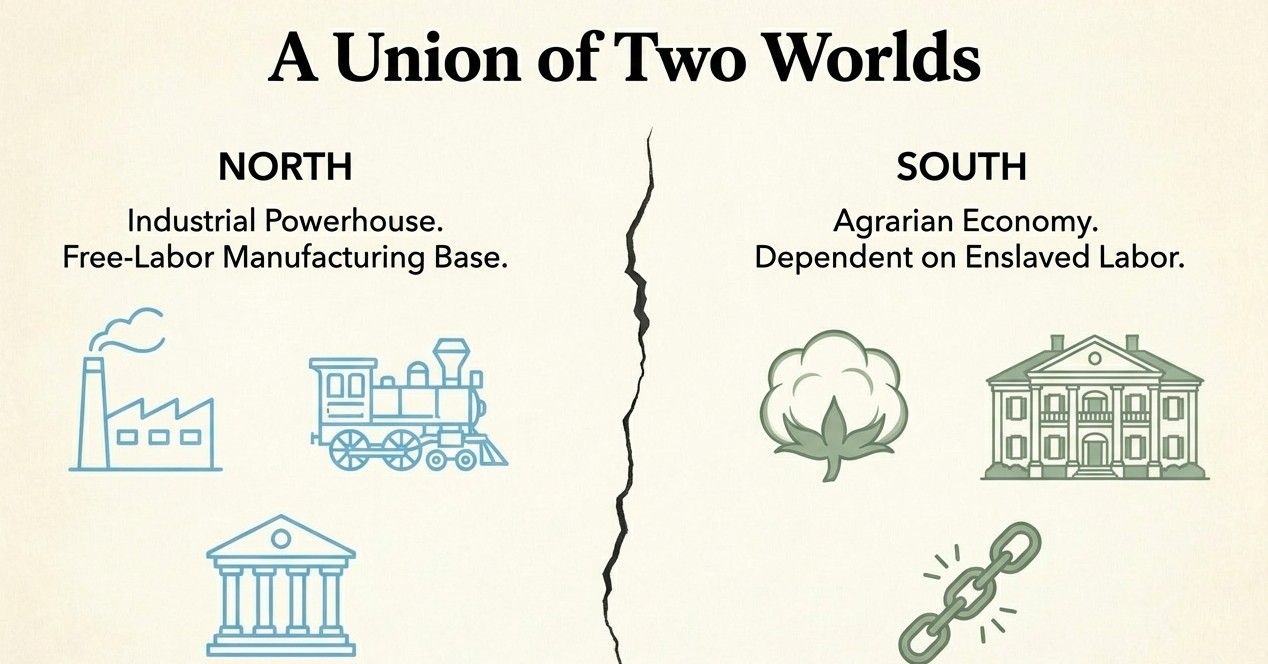
Economic: The two regions had developed distinct economies. The North was becoming an industrial powerhouse with a free-labor manufacturing base, while the South remained a largely agrarian economy dependent on enslaved labor to produce cash crops like cotton.
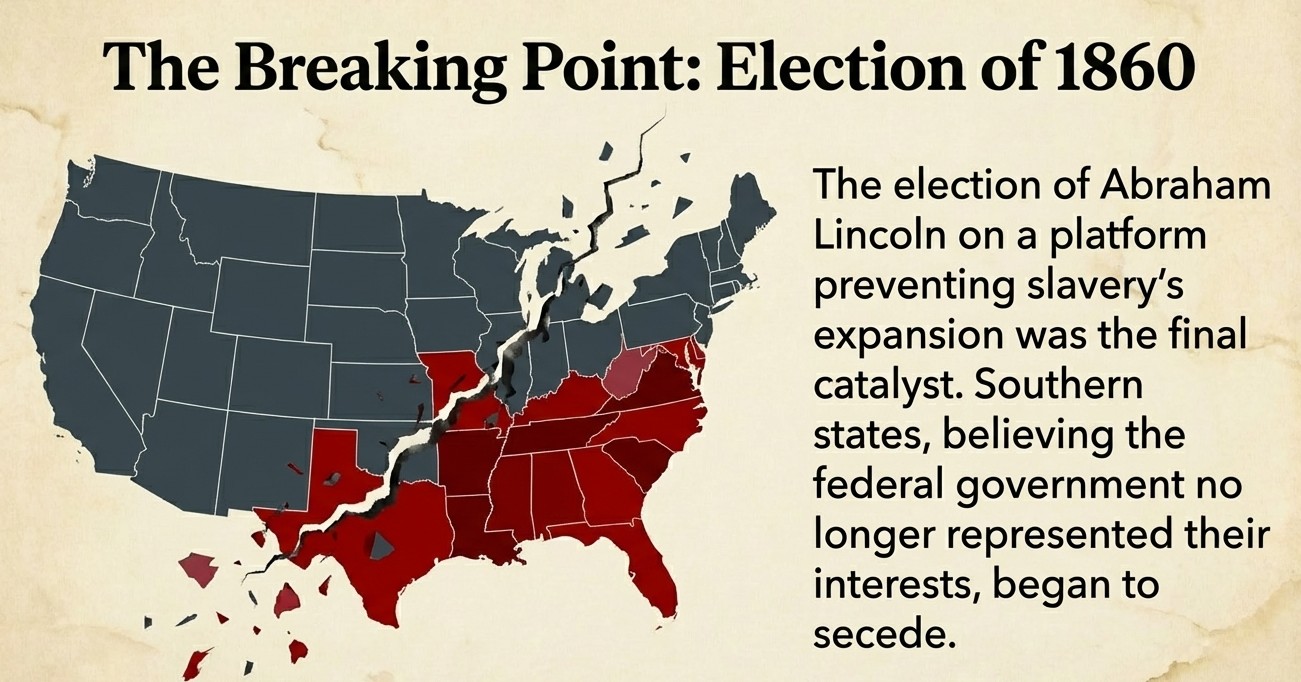
Political Breakdown: These divisions culminated in a bitter and fractured political landscape. The election of 1860, which brought Abraham Lincoln to power on a platform of preventing slavery's expansion, was the final catalyst. Believing the federal government no longer represented their interests, Southern states began the process of secession, or the formal withdrawal from the United States.
Effects & Impacts of the Conflict (1861–1877)
The secession of Southern states led directly to the Civil War, a conflict that reshaped the nation in fundamental ways.
Immediate Effects (The Civil War):
The Union military victory was the ultimate outcome. This victory was achieved through several key advantages: the North’s greater manpower, superior industrial resources, and the effective leadership of President Abraham Lincoln.
A critical turning point was the decision to pursue emancipation—the freeing of enslaved people. This changed the purpose of the war, adding a moral cause and undermining the Confederacy's labor force.
Long-Term Impacts (Reconstruction & Redefinition):
The war definitively settled the issues of slavery and secession. The institution of slavery was abolished, and the principle that states could not unilaterally leave the Union was firmly established.
The relationship between the states and the national government was fundamentally altered, with a significant increase in the power of the federal government.
The period of Reconstruction (1865–1877) began, during which the nation grappled with how to rebuild the South and integrate nearly four million newly freed African Americans into society.
This era led to intense debates over new definitions of citizenship and rights, particularly for African Americans but also for women and other minority groups. While Reconstruction ultimately ended without securing full equality, it laid the constitutional groundwork for future civil rights struggles.
Data & Organization Tools
The historical developments of this period can be understood as a direct causal chain, where each event triggered the next.
Causal Chain of Conflict: 1844–1877

Popular Enthusiasm for Expansion
↓
Acquisition of New Western Territories
↓
Intensified Debates Over Slavery's Extension
↓
Political Breakdown and the Election of 1860
↓
Secession of Southern States
↓
The Civil War (1861–1865)
↓
Union Victory and the End of Slavery
↓
Reconstruction and Debates over Citizenship & Federal Power
Evidence Bank
- Manifest Destiny: A widely held cultural belief in the 19th century that American settlers were destined to expand across North America. This ideology fueled popular enthusiasm for westward expansion and the acquisition of new territories.

Sectionalism: An intense loyalty to one's own region or section of the country, rather than to the country as a whole. Growing sectionalism, based on the diverging economies and cultures of the North and South, was a primary cause of the Civil War.
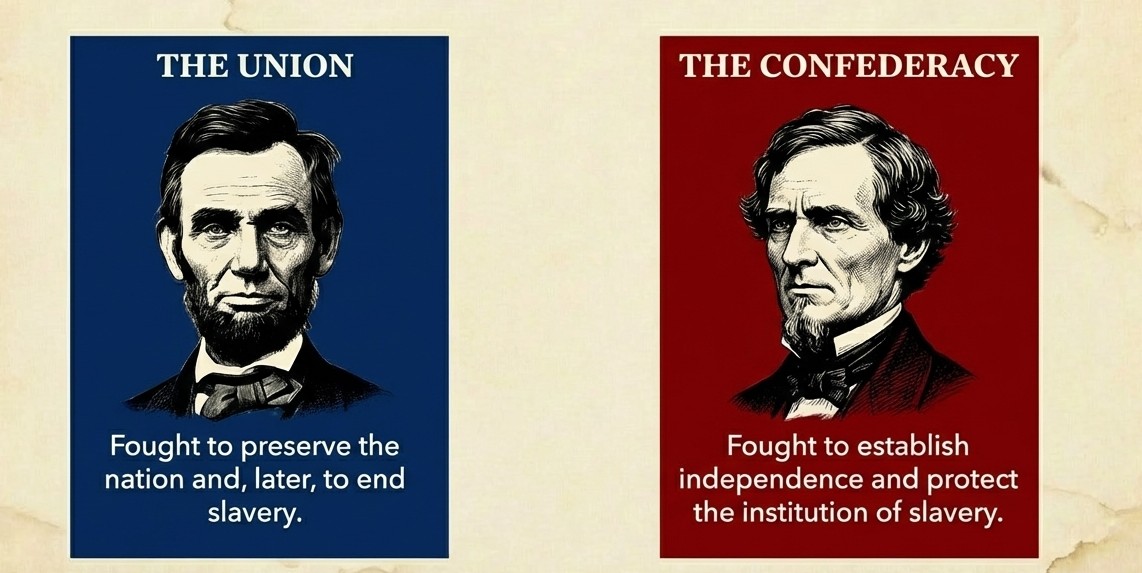
The Confederacy: The government formed from 1861 to 1865 by the eleven Southern states that seceded from the Union. Its primary goal was to preserve the institution of slavery and the principle of states' rights against federal interference.
The Union: The term used to refer to the United States government and the states that remained loyal to it during the Civil War. The Union's war aims evolved from preserving the nation to also ending slavery.
Abraham Lincoln: The 16th U.S. President, whose election in 1860 on an anti-slavery-expansion platform prompted the secession of Southern states. His leadership was a critical factor in the Union's eventual victory.
Emancipation Proclamation (1863): An executive order issued by Abraham Lincoln that declared all enslaved people in Confederate-held territory to be free. This decision transformed the purpose of the war and was a crucial step toward slavery's total abolition.
Reconstruction Amendments (13th, 14th, 15th): Three constitutional amendments passed after the Civil War. They abolished slavery, defined citizenship and guaranteed equal protection under the law, and prohibited the denial of voting rights based on race, respectively, fundamentally altering the Constitution.
Skill Snapshots
Causation:
The acquisition of new territories caused the debate over slavery to dominate national politics.
Deepening ideological and economic differences between the North and South caused the secession of Southern states.
The Union's superior industrial resources and manpower caused its military victory over the Confederacy.
Comparison:
The North's economy was primarily industrial and based on free labor, while the South's was agrarian and dependent on enslaved labor.
The Union fought to preserve the nation and later to end slavery, while the Confederacy fought to establish its independence and protect the institution of slavery.
Post-war debates pitted federal power to enforce citizenship rights against arguments for states' rights to control local affairs.
Continuity and Change Over Time (CCOT):
Baseline (c. 1844): The U.S. was a nation held together by political compromises over the issue of slavery.
Change: Westward expansion shattered these compromises, making sectional conflict unavoidable.
Change: The Civil War and Reconstruction ended slavery and dramatically increased the power of the federal government.
Continuity: Throughout the period, debates over rights and citizenship for various groups, including African Americans and women, remained a persistent feature of American life.
Common Misconceptions & Clarifications
Misconception: The Civil War was fought over states' rights, not slavery.
Clarification: The primary "state's right" that was debated and defended by seceding states was the right to own enslaved people and to extend the institution of slavery into new territories.
Misconception: The North was a land of racial equality.
Clarification: While the North did not have a slave-based economy, its society was marked by widespread racism and discrimination. Many Northerners opposed the expansion of slavery for economic or political reasons, not purely on moral grounds.
Misconception: The Emancipation Proclamation freed all enslaved people.
Clarification: The proclamation only applied to enslaved people in Confederate-held territories. Slavery was not fully and legally abolished nationwide until the ratification of the 13th Amendment in 1865.
Misconception: The end of the Civil War meant the end of the nation's racial problems.
Clarification: The war ended slavery, but it did not resolve the deep-seated issue of racism. The contested period of Reconstruction and its eventual end left many questions about the rights and status of African Americans unresolved, leading to a new era of struggle.
One-Paragraph Summary
The period from 1844 to 1877 was defined by a powerful chain of cause and effect, beginning with the nation's expansionist drive. This territorial growth directly fueled a political crisis over the extension of slavery, which exposed and deepened the profound economic, ideological, and cultural divisions between the North and South. The failure of political compromise led to the secession of Southern states and the outbreak of the Civil War. The Union's eventual victory, secured through industrial strength and Lincoln's leadership, settled the questions of secession and slavery but opened new, unresolved debates about the meaning of citizenship and the balance of power between the federal government and the states—issues that would shape the nation for decades to come.