
Getting Started
In the mid-1840s, the United States, driven by a powerful belief in westward expansion, entered a brief but transformative war with Mexico. This conflict fundamentally reshaped the map of North America, but its consequences extended far beyond new borders. The war and its outcome forced the nation to confront divisive questions about slavery, citizenship, and the fate of the diverse peoples living in the newly acquired western lands.
What You Should Be Able to Do
Explain the primary causes of the Mexican-American War.
Describe the immediate effects of the war, including major territorial changes.
Analyze the long-term consequences of the war for different groups, including Anglo-Americans, Mexicans, and American Indians.
Evaluate how the acquisition of new territory intensified debates over the expansion of slavery.
Key Developments & Analysis
Causes of the Mexican-American War
The Mexican-American War did not erupt from a single event but from a combination of long-term pressures and immediate triggers.
Manifest Destiny: This was the widely held 19th-century belief that the United States was divinely ordained to expand its democratic institutions and control the entire North American continent. This ideology provided a powerful justification for territorial acquisition.
U.S. Annexation of Texas: After winning its independence from Mexico in 1836, Texas existed as an independent republic. Its annexation by the United States in 1845 was viewed by the Mexican government as an act of aggression, as it had never formally recognized Texan independence.
Territorial and Boundary Disputes: The U.S. and Mexico disputed the southern border of the newly annexed Texas. The U.S. claimed the Rio Grande, while Mexico insisted on the Nueces River further north. This created a tense, contested zone between the two rivers.
American Expansionist Goals: The U.S. government, particularly under President James K. Polk, sought to acquire not just Texas but also the vast Mexican territories of California and New Mexico. When diplomatic efforts to purchase these lands failed, military force became a more likely option.
The Immediate Trigger: In 1846, President Polk ordered U.S. troops into the disputed territory between the Nueces River and the Rio Grande. A skirmish with Mexican forces ensued, which Polk used to declare that Mexico had "shed American blood upon the American soil," providing the justification to ask Congress for a declaration of war.
Effects of the Mexican-American War
The war's conclusion brought about a dramatic series of immediate and long-term changes for the United States and the people of the region.
Immediate Effects
U.S. Military Victory: The United States won a decisive military victory, occupying key Mexican cities, including its capital, Mexico City.
The Treaty of Guadalupe Hidalgo (1848): This treaty formally ended the war. In it, Mexico ceded a vast territory to the United States in exchange for $15 million.
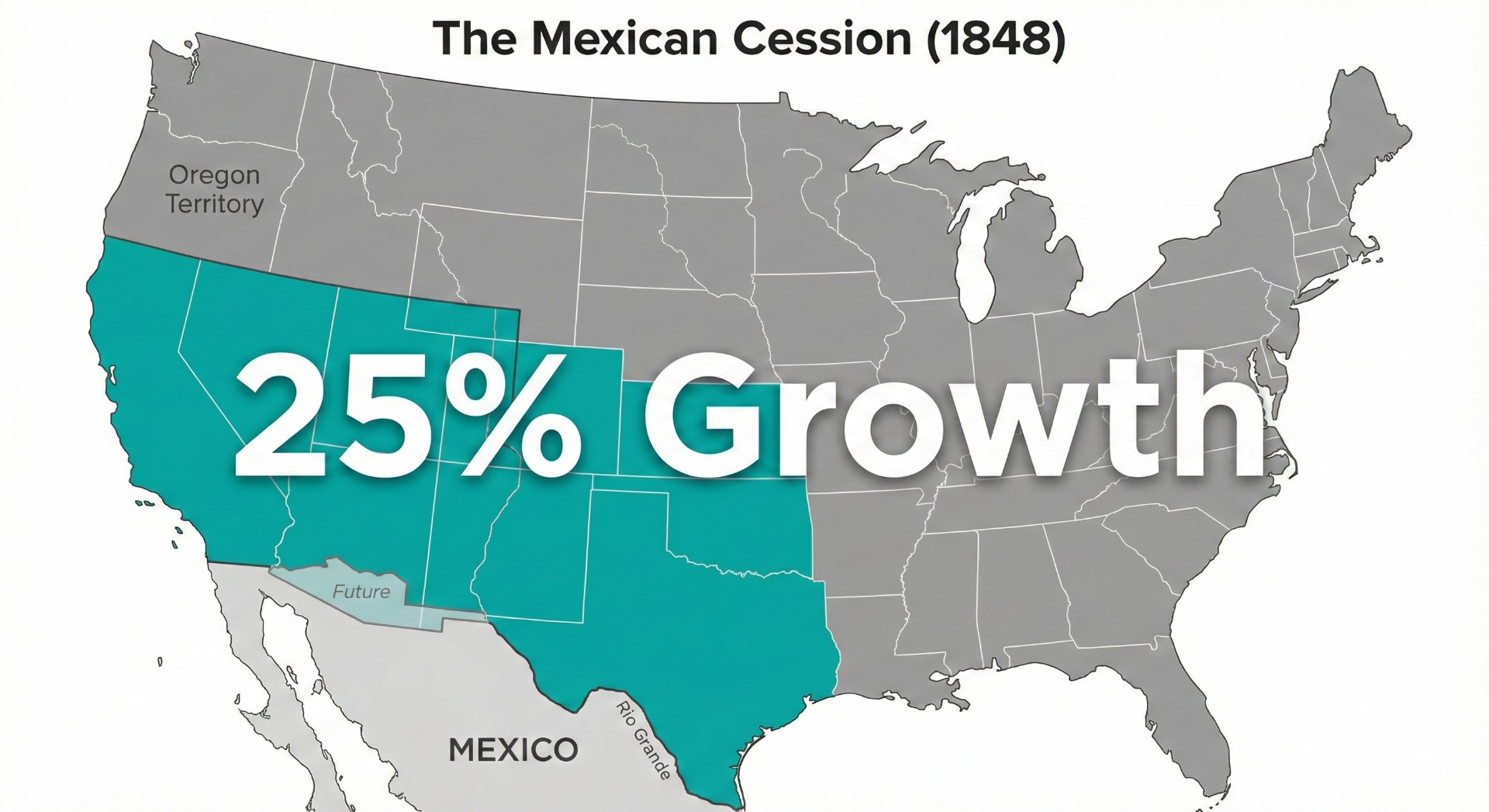
The Mexican Cession: This is the name for the enormous territory acquired through the treaty. It included all of present-day California, Nevada, and Utah, as well as parts of Arizona, New Mexico, Colorado, and Wyoming. This single acquisition increased the size of the United States by nearly 25 percent.
Long-Term Impacts
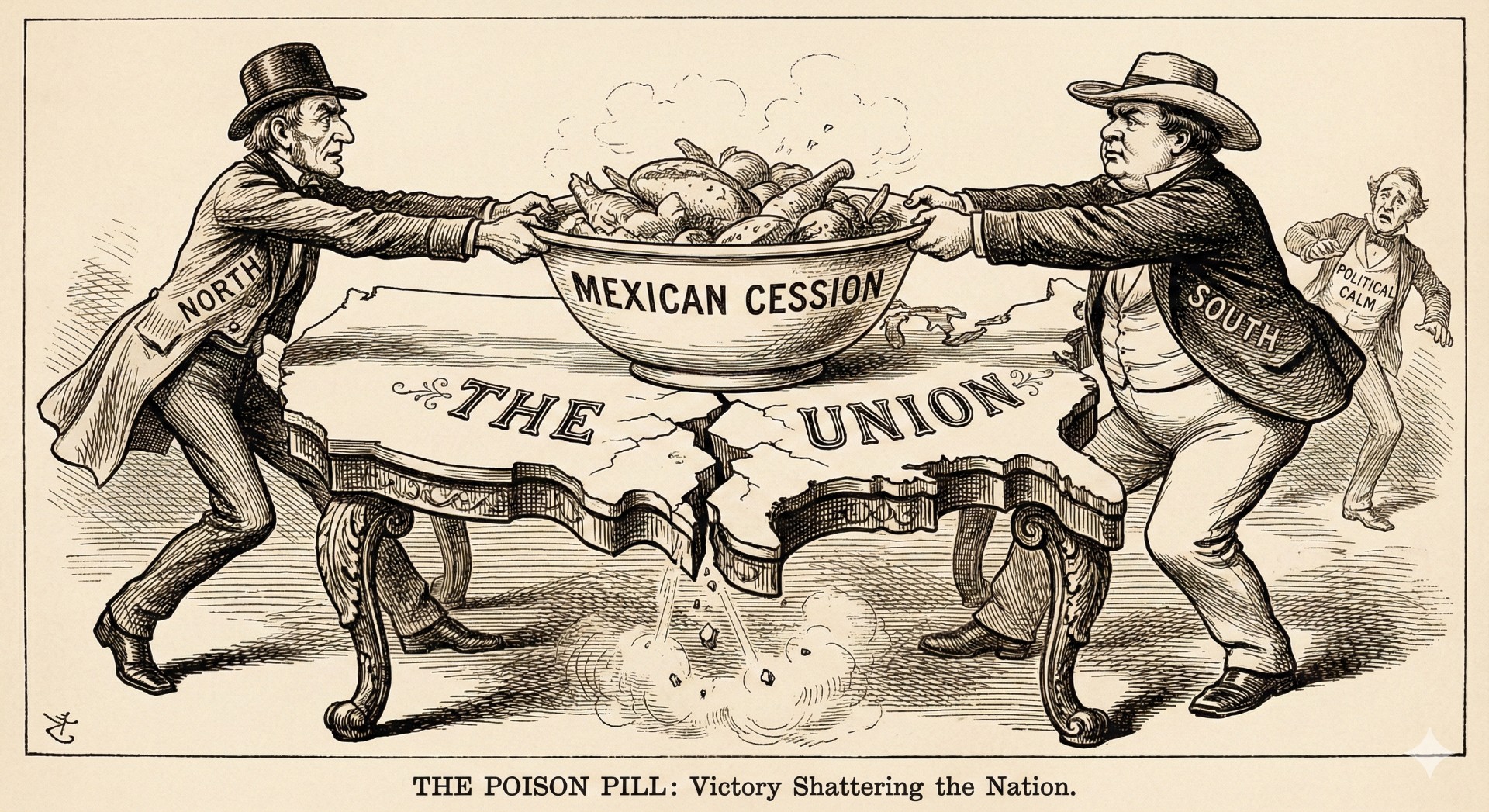
- Intensified Sectional Conflict over Slavery: The central question raised by the Mexican Cession was whether slavery would be permitted in the new territories. This issue shattered the political calm maintained by earlier compromises, leading to bitter debates in Congress and across the country that would ultimately set the stage for the Civil War.
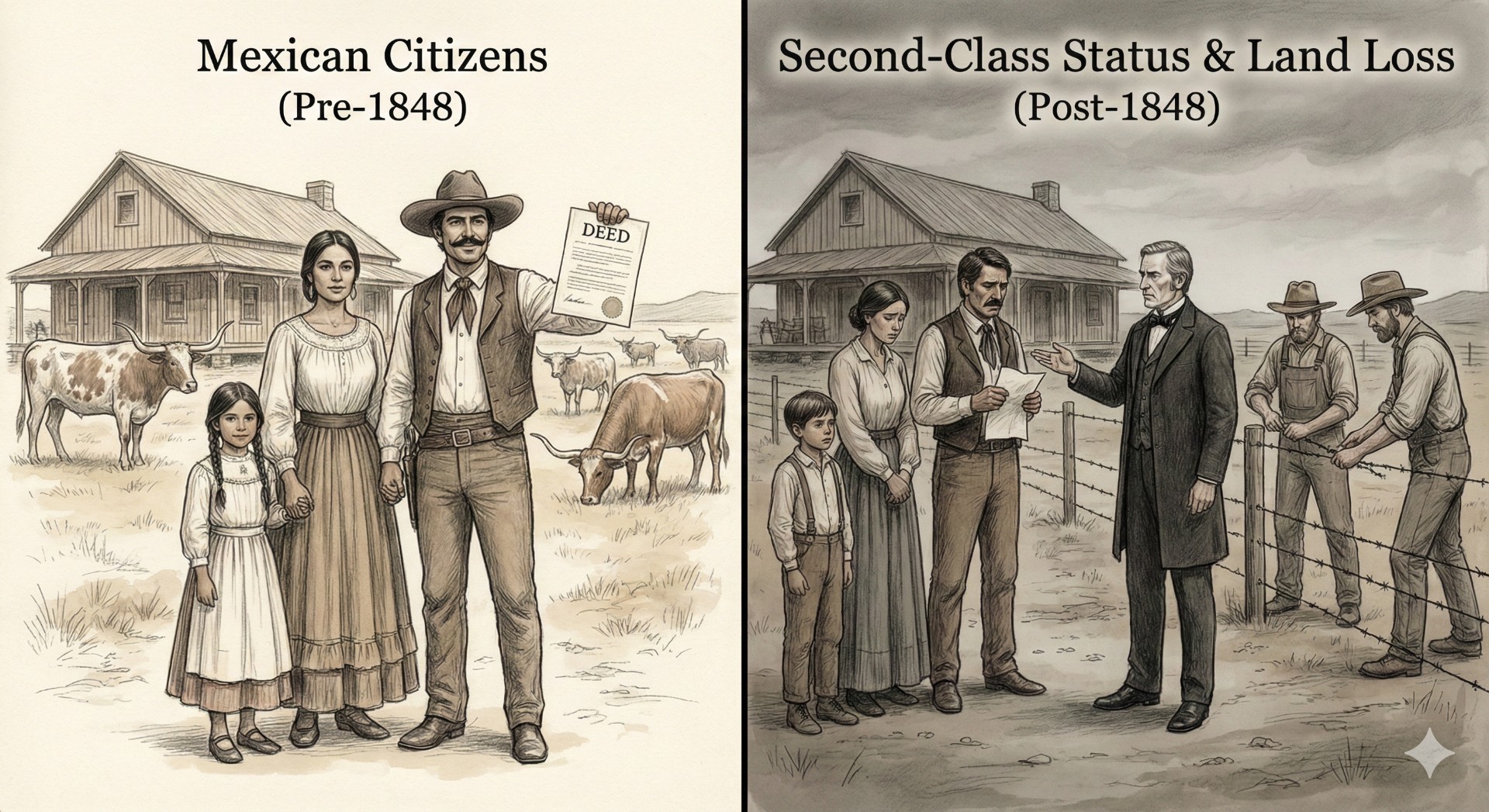
- Altered Status of Mexicans: The treaty granted citizenship to the thousands of Mexicans living in the ceded lands. However, these new Mexican Americans (former citizens of Mexico who became U.S. citizens after the war) found their status altered. U.S. government interaction and conflict with them increased, and many lost their land, political influence, and economic self-sufficiency in the face of Anglo-American settlement and legal systems.
- Increased Conflict with American Indians: U.S. expansion into the West brought settlers and the federal government into direct and sustained contact with the region's American Indians (the diverse indigenous peoples of North America). This interaction frequently led to violent conflict, the seizure of native lands, and policies that severely altered the economic and cultural autonomy of these groups.
Data & Organization Tools
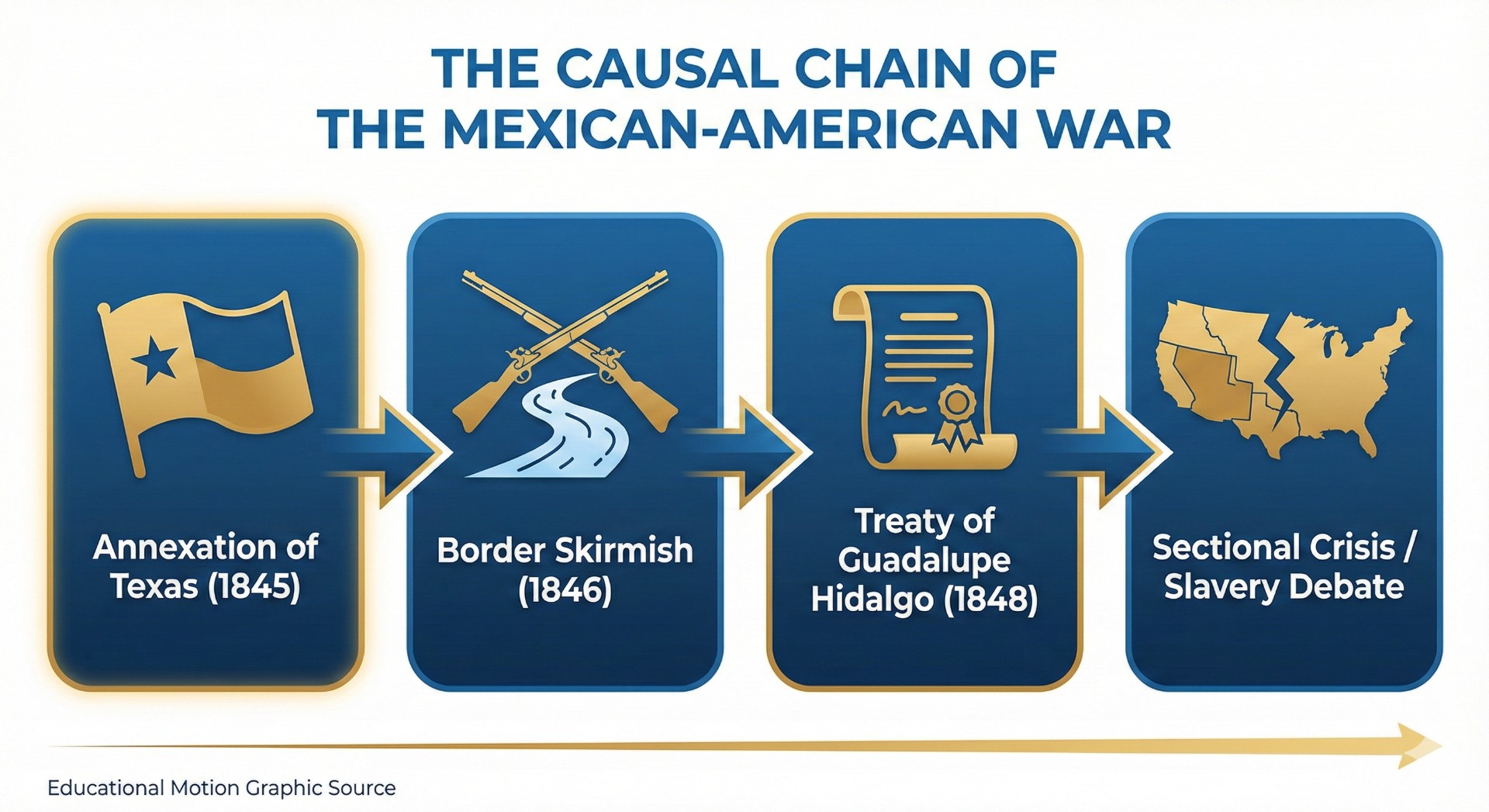
Causal Chain of the Mexican-American War
| Year | Event | Significance |
|---|---|---|
| 1845 | U.S. Annexation of Texas | Provoked a diplomatic crisis with Mexico, which still considered Texas its territory. |
| 1846 | Border Skirmish | U.S. and Mexican troops clashed in disputed territory, providing the trigger for war. |
| 1846-1848 | Mexican-American War | U.S. forces defeated Mexico and occupied its capital. |
| 1848 | Treaty of Guadalupe Hidalgo | Ended the war; U.S. acquired the Mexican Cession, a vast western territory. |
| Post-1848 | National Debate Intensifies | The question of slavery's status in the new territories dominated American politics. |
Evidence Bank
Manifest Destiny: The 19th-century belief that American expansion westward was both justified and inevitable. It served as the primary ideological engine for the war.
James K. Polk: The 11th U.S. President (1845–1849) who was a firm believer in Manifest Destiny and whose policies directly led to the war with Mexico to acquire western territory.
Treaty of Guadalupe Hidalgo (1848): The peace treaty that ended the war. It established the Rio Grande as the U.S.-Mexico border and formalized the transfer of the Mexican Cession to the United States.
Mexican Cession: The vast region ceded by Mexico, including lands that would become California, Nevada, Utah, and parts of four other states. Its acquisition was the war's main outcome.
Wilmot Proviso: A legislative proposal, ultimately defeated, that sought to ban slavery in all territories acquired from Mexico. Its introduction signaled the start of an intense and intractable political fight over slavery's expansion.
Mexican Americans: The group of former Mexican citizens who chose to remain in the ceded territories after 1848. They often faced legal, economic, and cultural discrimination as the U.S. asserted control.
American Indians of the Southwest: Diverse indigenous groups, such as the Navajo, Apache, and Pueblo peoples, whose societies were profoundly disrupted by the influx of American settlers and military forces into the newly acquired lands.
Skill Snapshots
Causation:
The U.S. annexation of Texas → led directly to a border dispute and diplomatic breakdown with Mexico.
The U.S. victory in the war → resulted in the acquisition of the Mexican Cession.
The acquisition of the Mexican Cession → raised the question of slavery's expansion, which destabilized national politics.
Comparison:
Before the war, Mexicans in California were citizens of a republic; after the war, they became a linguistic and ethnic minority within the United States.
The U.S. justified the war as a defense of its new border, while Mexico viewed it as an invasion and a war of conquest.
Northern Whigs largely opposed the war as an immoral land grab to expand slavery, while Southern Democrats strongly supported it for the same reason.
Continuity and Change Over Time:
Baseline (c. 1844): The U.S. was largely contained east of the Rocky Mountains, and the debate over slavery was managed by the Missouri Compromise of 1820.
Change: The war dramatically expanded U.S. territory to the Pacific Ocean and introduced new populations (Mexican Americans and Southwestern American Indians) for the federal government to interact with.
Continuity: The underlying belief in American exceptionalism and the sectional tension between North and South over the institution of slavery continued, but were greatly intensified by the war's outcome.
Common Misconceptions & Clarifications
Misconception: The war was a universally popular and patriotic effort in the United States.
- Clarification: The war was highly controversial. Many prominent Americans, including Abraham Lincoln and Henry David Thoreau, opposed it, viewing it as an unjust war of aggression designed to expand the power of slave states.
Misconception: The lands acquired from Mexico were empty and unsettled.
- Clarification: The Mexican Cession was home to well-established Mexican communities and hundreds of distinct and long-settled American Indian nations, whose lives and cultures were profoundly disrupted.
Misconception: The Treaty of Guadalupe Hidalgo solved the problems between the U.S. and Mexico.
- Clarification: While the treaty ended the fighting, it created new, long-term challenges. For the U.S., it ignited the sectional crisis over slavery. For the people in the ceded territories, it began a long period of cultural and economic adjustment and conflict.
One-Paragraph Summary
The Mexican-American War (1846–1848), a conflict fueled by the American ideology of Manifest Destiny and disputes over the Texas border, was a pivotal turning point in U.S. history. A decisive American victory resulted in the acquisition of the vast Mexican Cession through the Treaty of Guadalupe Hidalgo, expanding the nation to the Pacific Ocean. This territorial gain, however, came at a high cost. It immediately raised the explosive question of whether slavery would be allowed in the new lands, shattering political compromises and placing the nation on an irreversible path toward the Civil War. Furthermore, the expansion dramatically altered the lives of the region's existing inhabitants, as increased U.S. government interaction led to the cultural and economic displacement of Mexican Americans and more frequent and violent conflicts with American Indian nations.