
AP U.S. History Practice Quiz: The Mexican-American War
Written by AP Content Team, Verified for 2026 AP Exams, Last updated: August 2026
Test your understanding with short quizzes. This quiz has 9 questions to check your progress.
Question 1 of 9
All Questions (9)
A) acquire new territories in the West.
B) end conflicts with American Indians.
C) negotiate new trade agreements with Mexico.
D) decrease the influence of European powers in North America.
Correct Answer: A
The provided content states that 'The United States added large territories in the West through victory in the Mexican-American War,' indicating that territorial acquisition was a key motivation and outcome of the conflict.
A) An immediate end to sectional tensions between the North and South.
B) A national consensus on the cultural assimilation of American Indians.
C) Intensified debates over the extension of slavery into the new territories.
D) A long-term military alliance between the United States and Mexico.
Correct Answer: C
According to the text, the addition of western territories through the war was a direct cause for 'raising questions about the status of slavery... in the newly acquired lands,' which fueled the sectional crisis.
A) Mexican Americans and American Indians experienced increased political power and representation.
B) The U.S. government guaranteed the preservation of existing economic and cultural systems.
C) U.S. government interaction led to the disruption of economic self-sufficiency and traditional cultures.
D) Most Mexican residents voluntarily relocated to territory remaining under Mexican control.
Correct Answer: C
The content explicitly states that 'U.S. government interaction and conflict with Mexican Americans and American Indians increased... altering these groups’ economic self-sufficiency and cultures.'
A) resolved all border disputes with foreign powers in North America.
B) led to the acquisition of vast western territories and heightened sectional conflicts over slavery.
C) resulted in the peaceful assimilation of Mexican and American Indian populations into U.S. society.
D) caused the United States to abandon its policy of westward expansion.
Correct Answer: B
The provided text highlights two key effects: the U.S. 'added large territories in the West' and this victory was responsible for 'raising questions about the status of slavery' in those lands.
A) The purchase of Alaska from Russia.
B) The annexation of the Oregon Territory.
C) The addition of large territories in the American West.
D) The establishment of a protectorate over Cuba.
Correct Answer: C
The content directly states, 'The United States added large territories in the West through victory in the Mexican-American War.'
A) They were granted full U.S. citizenship and voting rights immediately.
B) Their economic independence and cultural practices were significantly disrupted.
C) They were relocated to lands east of the Mississippi River.
D) They formed successful political alliances with newly settled Mexican Americans.
Correct Answer: B
The text indicates that increased 'U.S. government interaction and conflict with... American Indians... alter[ed] these groups’ economic self-sufficiency and cultures.'
A) proper method for negotiating treaties with European powers.
B) constitutionality of a national bank.
C) status of slavery, American Indians, and Mexicans in these territories.
D) decision to pursue industrialization over an agrarian economy.
Correct Answer: C
The provided content specifies that the acquisition of new lands raised 'questions about the status of slavery, American Indians, and Mexicans in the newly acquired lands.'
A) a period of economic prosperity due to new trade opportunities.
B) guaranteed protection of all pre-existing land grants and property.
C) increased conflict with the U.S. government that challenged their economic autonomy.
D) immediate and equal integration into the U.S. political system.
Correct Answer: C
The text states that 'U.S. government interaction and conflict with Mexican Americans... increased,' which had the effect of 'altering these groups’ economic self-sufficiency and cultures.'
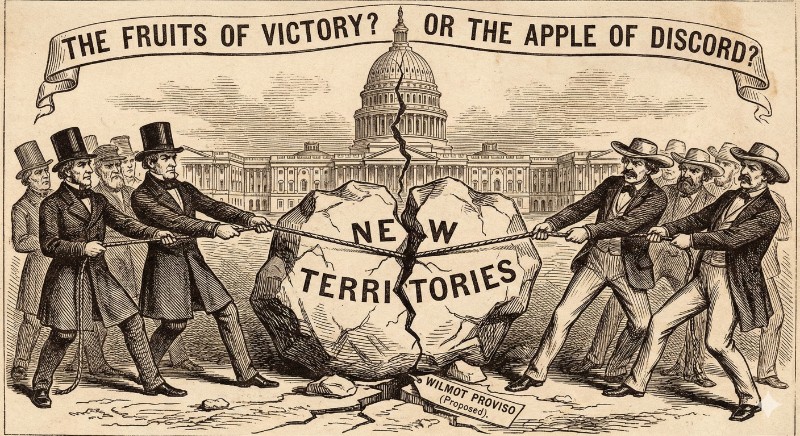
A) the route of the transcontinental railroad.
B) the future status of slavery.
C) the official language of the new territories.
D) the policy for admitting new states to the Union.
Correct Answer: B
The source material explicitly identifies that the victory and land acquisition were responsible for 'raising questions about the status of slavery... in the newly acquired lands,' which became a central and deeply divisive issue.