
Getting Started
The period following the Civil War, known as Reconstruction, was a tumultuous era filled with the promise of redefining American society. While constitutional amendments aimed to secure the rights of newly freed African Americans, powerful forces sought to reverse these gains. This chapter examines why Reconstruction ultimately failed to secure lasting equality, focusing on the economic, political, and social developments that reshaped the South and the nation's understanding of citizenship.
What You Should Be Able to Do
Explain the economic changes and continuities for formerly enslaved people and poor whites in the South.
Analyze the methods used to strip away African American political and social rights after the Civil War.
Evaluate how Reconstruction resulted in both continuity and change in American society.
Explain the long-term significance of the 14th and 15th Amendments, despite the failure of Reconstruction.
Key Developments & Analysis
Baseline & Context (c. 1865)
At the end of the Civil War, the nation faced two fundamental challenges: rebuilding the devastated South and integrating approximately four million formerly enslaved people into society as free citizens. The initial goals of Reconstruction included establishing new state governments and ensuring the rights of African Americans. For formerly enslaved people, freedom was inextricably linked to economic independence, primarily through the dream of land ownership, which would break their dependence on the white planter class.
Key Changes
- Constitutional Transformation: The most significant legal changes were the ratification of the 14th Amendment and the 15th Amendment. The 14th Amendment established that all persons born in the U.S. were citizens, guaranteeing them "equal protection of the laws." The 15th Amendment prohibited states from denying a citizen the right to vote based on "race, color, or previous condition of servitude." These amendments fundamentally changed the Constitution, creating a new, national standard for citizenship and voting rights.
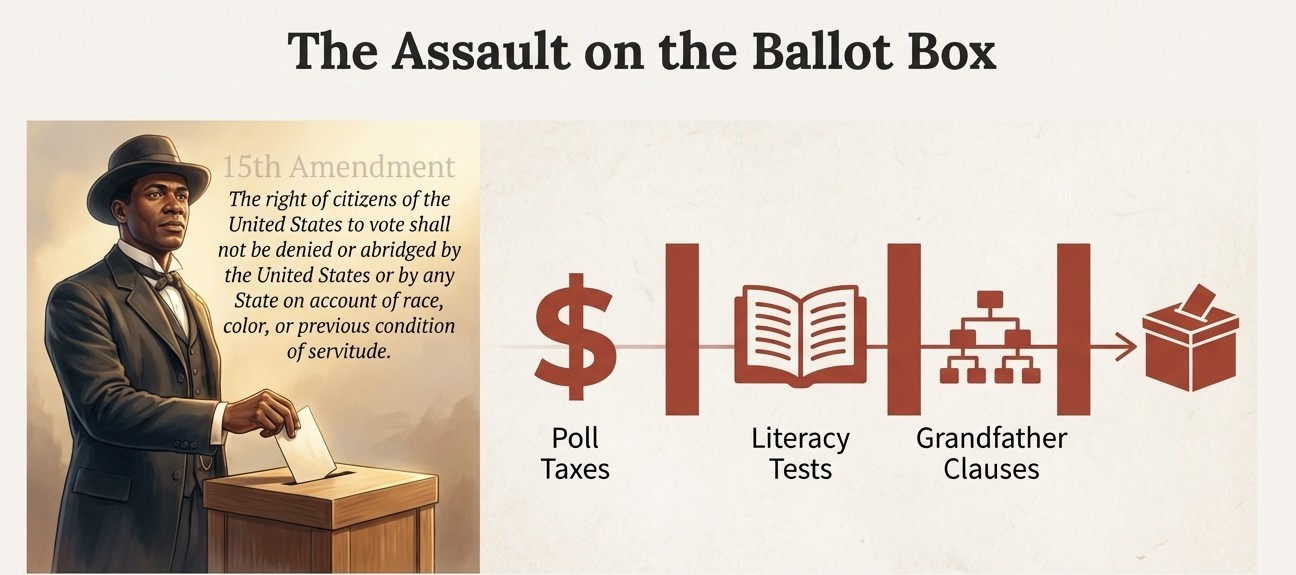
New Systems of Labor and Exploitation: With slavery abolished, the Southern economy required a new labor system. Instead of widespread land redistribution, a system of sharecropping emerged. Sharecropping was an agricultural system in which a landowner allowed a tenant to use the land in return for a share of the crops produced. This system, while different from slavery, trapped formerly enslaved people and many poor whites in a cycle of debt and poverty, preventing economic independence.
The Rise of Formal Segregation: As Reconstruction policies waned, Southern states implemented new measures to control and disenfranchise African Americans. Segregation, the enforced separation of different racial groups in a country, community, or institution, became a formal policy. This system, often referred to as Jim Crow, systematically denied African Americans access to public facilities, education, and political power.
Key Continuities
Concentration of Land Ownership: Despite the end of slavery, the fundamental economic structure of the South remained intact. Southern plantation owners, the same elite class that dominated the region before the war, continued to own the majority of the land. The failure to redistribute land meant that economic power remained concentrated in the hands of a small white minority.
Persistence of Racial Hierarchy: The core belief in white supremacy that underpinned slavery continued to dominate Southern society. Through violence, new laws, and social customs, white Southerners worked to maintain a racial hierarchy that limited the freedom and opportunities of African Americans. This continuity of racial ideology was the primary driver behind the efforts to dismantle the gains of Reconstruction.
Data & Organization Tools
Methods of Reversing Reconstruction
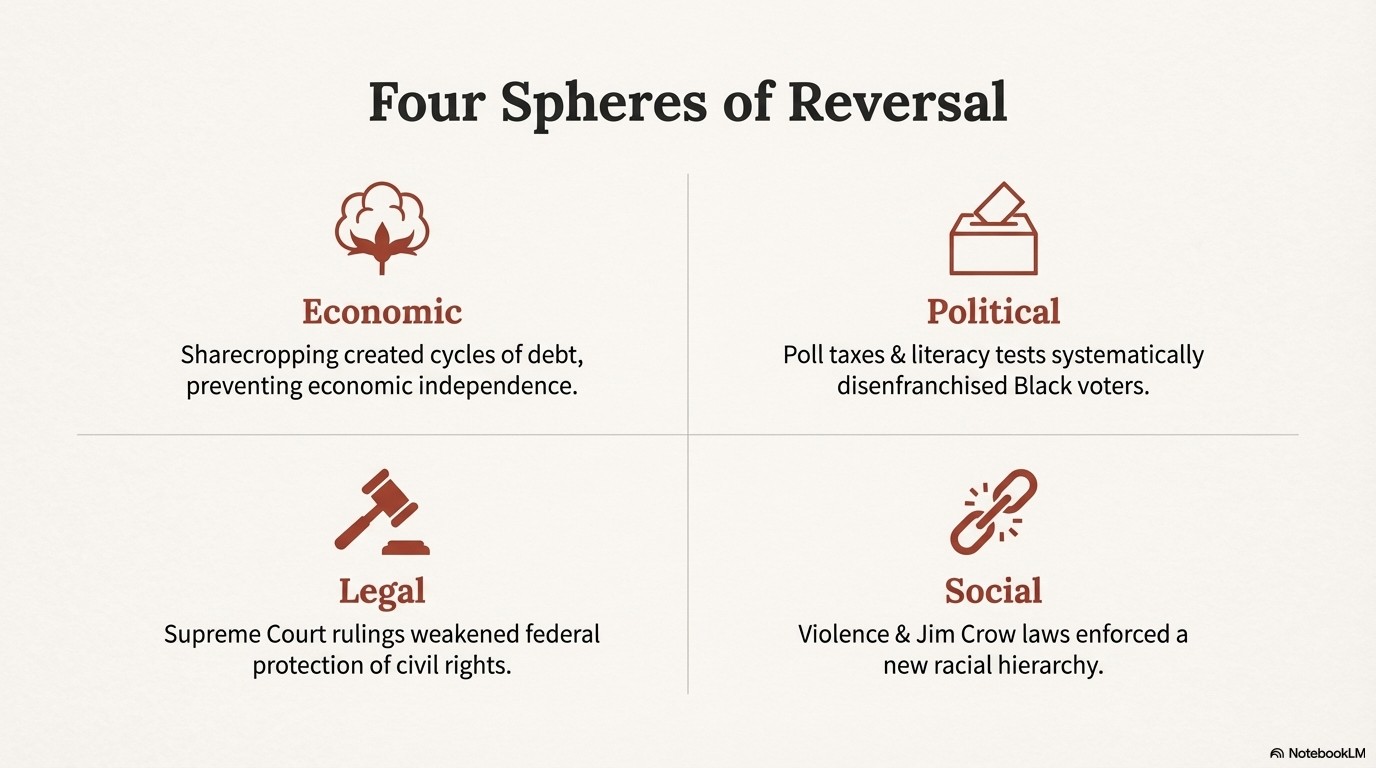
| Tactic Category | Description | Impact on African American Rights |
|---|---|---|
| Economic | The implementation of the sharecropping system. | Limited access to land ownership and created cycles of debt, preventing economic independence and ensuring a dependent labor force for white landowners. |
| Political | Local political tactics such as poll taxes, literacy tests, and grandfather clauses. | Systematically disenfranchised African American voters, effectively nullifying the 15th Amendment in the South for decades. |
| Legal | Narrow Supreme Court decisions that weakened the protections of the 14th and 15th Amendments. | Limited the federal government's ability to prosecute violations of civil rights, leaving enforcement to hostile state and local governments. |
| Social | Widespread violence and the establishment of formal segregation (Jim Crow laws). | Created a climate of terror, enforced social inferiority, and stripped away the rights to equal access to public spaces and services. |
Evidence Bank
Sharecropping: An agricultural labor system that emerged after the Civil War. It trapped tenants, including formerly enslaved people and poor whites, in a cycle of debt to landowners, preventing economic independence.
Plantation Owners: The pre-war Southern elite who largely managed to retain ownership of their land after the Civil War. Their continued economic dominance was a major obstacle to the advancement of formerly enslaved people.
14th Amendment (1868): A constitutional amendment that granted citizenship to all persons born or naturalized in the U.S., including formerly enslaved people, and guaranteed all citizens "equal protection of the laws."
15th Amendment (1870): A constitutional amendment that prohibited the federal and state governments from denying a citizen the right to vote based on that citizen's "race, color, or previous condition of servitude."
Segregation: The policy of enforced separation of racial groups. After Reconstruction, this became law in the South (Jim Crow), affecting public facilities, schools, and transportation.
Supreme Court Decisions: A series of rulings in the late 19th century that narrowly interpreted the 14th and 15th Amendments. These decisions weakened federal power to protect African American civil rights from state-level discrimination.
Local Political Tactics: Methods like poll taxes, literacy tests, and intimidation used by Southern Democrats to prevent African Americans from voting, effectively circumventing the 15th Amendment.
Violence: The use of force and intimidation by white supremacist groups and individuals to terrorize African Americans, suppress their political activity, and enforce the racial hierarchy.
Skill Snapshots
Causation:
Cause: The federal government failed to redistribute land → Effect: Formerly enslaved people were forced into the exploitative sharecropping system.
Cause: Southern Democrats regained political control of state governments → Effect: They enacted segregationist laws and tactics to disenfranchise Black voters.
Cause: The Supreme Court issued narrow interpretations of the 14th Amendment → Effect: The amendment's "equal protection" clause was rendered ineffective in protecting African Americans from discrimination for nearly a century.
Comparison:
The ideal of the 15th Amendment was universal male suffrage regardless of race; the reality in the post-Reconstruction South was widespread disenfranchisement through local political tactics.
Before the war, the planter elite controlled Black labor through slavery; after the war, they controlled it through the economic coercion of sharecropping.
The national understanding of citizenship expanded with the 14th Amendment, but the regional understanding in the South continued to be based on a rigid racial hierarchy.
CCOT:
Baseline: In 1865, Southern society was defined by a plantation economy based on enslaved labor.
Change: The 14th and 15th Amendments were passed, constitutionally redefining citizenship and voting rights.
Change: Sharecropping replaced slavery as the region's dominant, yet still exploitative, labor system.
Continuity: A small, white landowning class continued to dominate the Southern economy and political structure.
Common Misconceptions & Clarifications
Misconception: Sharecropping was simply "slavery by another name."
Clarification: While highly exploitative and designed to keep laborers in debt, sharecropping was a distinct system. It allowed families to live on their own plots of land and have a degree of personal autonomy and social structure (family, church) not possible under slavery.
Misconception: With the failure of Reconstruction, the 14th and 15th Amendments became irrelevant.
Clarification: Though largely unenforced for many decades, these amendments were not irrelevant. They remained part of the Constitution and provided the essential legal foundation for the Civil Rights Movement of the 20th century, which successfully challenged segregation and voting discrimination in federal courts.
Misconception: All Southerners were united in reversing Reconstruction.
Clarification: The sharecropping system also trapped many poor white farmers in a similar cycle of debt and poverty, limiting their economic opportunities. While racial hierarchy was a powerful unifier for whites, economic realities created complex class dynamics in the "New South."
One-Paragraph Summary
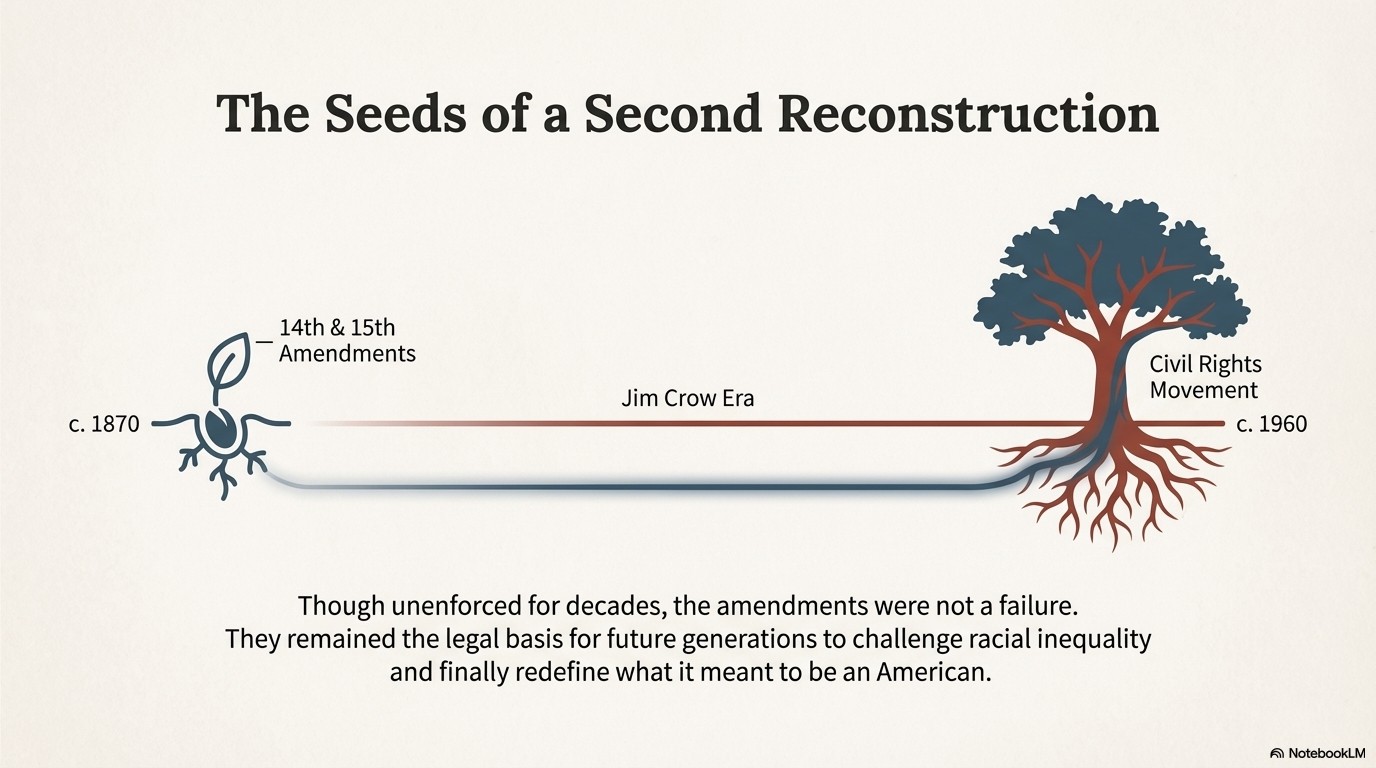
The failure of Reconstruction marked a pivotal moment of both continuity and change in the United States. While the 14th and 15th Amendments represented a profound, constitutional change in the national definition of citizenship and voting rights, their promise was left unfulfilled. In the South, continuity prevailed as the old plantation elite retained their land and economic power, trapping formerly enslaved people and poor whites in the exploitative sharecropping system. Through segregation, violence, and adverse Supreme Court decisions, African American rights were systematically stripped away, re-establishing a society based on racial hierarchy. However, the constitutional seeds planted during this era would lie dormant, eventually providing the legal basis for future generations to challenge racial inequality and redefine what it meant to be an American.