
Getting Started
The United States' victory in the Mexican-American War (1846–1848) dramatically expanded the nation's territory, but this success created a severe political crisis. The acquisition of vast new lands in the West, known as the Mexican Cession, forced a national confrontation over the most divisive issue of the era: whether slavery would be allowed to expand. This chapter examines the heated regional controversies that arose from this territorial gain and the complex, temporary political solution known as the Compromise of 1850.
What You Should Be Able to Do
Explain how the acquisition of new territory after the Mexican-American War intensified debates over slavery.
Describe the different regional attitudes toward the extension of slavery into the new territories.
Analyze the key provisions of the Compromise of 1850 as an attempt by national leaders to resolve sectional conflict.
Explain how the Compromise of 1850 ultimately failed to permanently settle the issue of slavery.
Key Developments & Analysis
Causes of the Sectional Crisis
The political crisis of the late 1840s did not emerge from a vacuum. It was the direct result of territorial expansion acting upon long-simmering regional tensions over the institution of slavery.
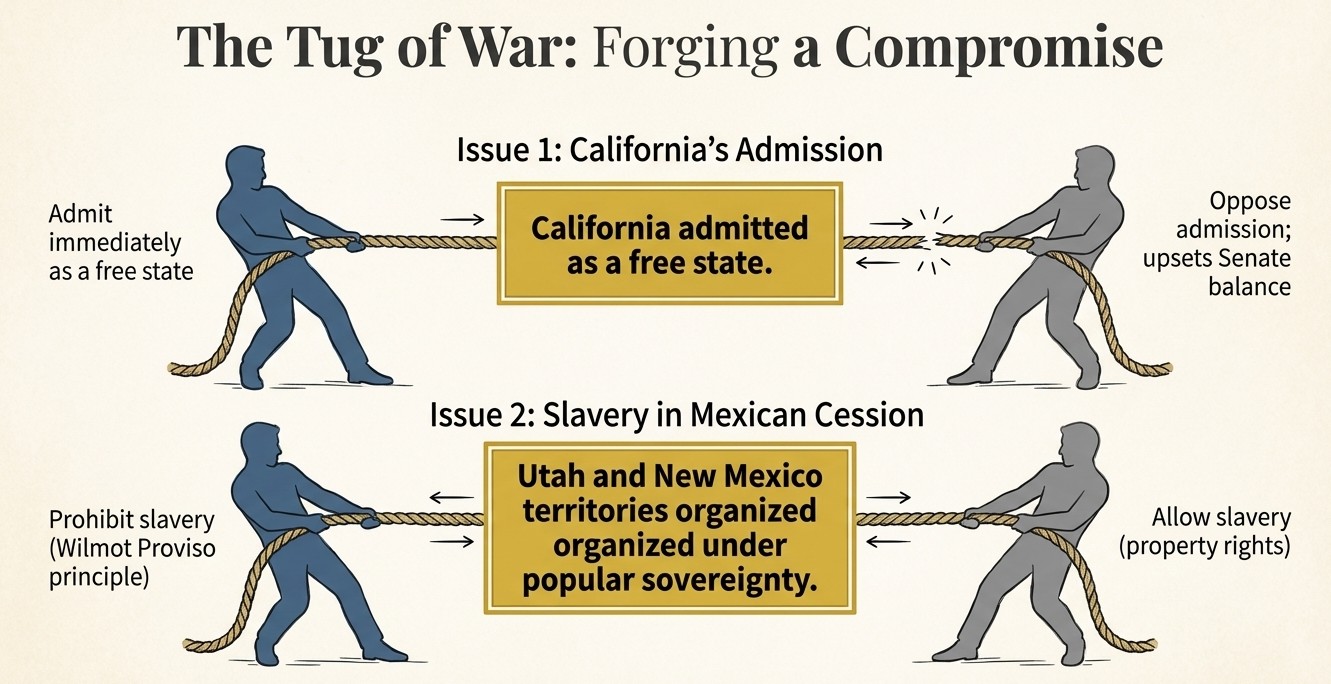
Territorial Expansion: The Mexican Cession—the vast territory ceded to the U.S. by Mexico in 1848, including modern-day California, Nevada, Utah, and Arizona—was the primary trigger. It immediately raised the question of whether these lands would be organized as free or slave territories, upsetting the delicate balance of power between North and South in the Senate.
Diverging Regional Economies: The industrializing North relied on free labor and viewed the expansion of slavery as a threat to the economic opportunities of free white workers. The agrarian South was economically dependent on enslaved labor and believed its survival required the ability to expand slavery into new territories.
Moral and Political Opposition to Slavery: A growing abolitionist movement in the North, while still a minority, framed slavery as a moral evil. More widespread was the "free-soil" position, which opposed the expansion of slavery on economic and political grounds, arguing it concentrated power in the hands of a small class of wealthy slaveholders.
Southern Defense of Slavery: In response, Southern leaders developed aggressive political and ideological defenses of slavery, arguing it was a "positive good" and a constitutionally protected property right that could not be restricted by the federal government in any territory.
The Compromise of 1850: An Attempted Solution
Faced with the possibility of Southern secession, national leaders crafted a complex legislative package to address the major points of contention. This was not one single bill, but a series of five separate laws.
Immediate Effects: The Compromise of 1850 successfully averted secession for the moment. California was admitted to the Union as a free state, a major victory for the North. To appease the South, the compromise included a much stricter Fugitive Slave Act, which required federal officials and citizens in free states to assist in the capture and return of escaped slaves.
Long-Term Impacts: The compromise proved to be an armistice, not a permanent peace. The Fugitive Slave Act was deeply unpopular in the North, leading to widespread resistance and further convincing many that a "Slave Power" conspiracy controlled the federal government. The principle of popular sovereignty—allowing settlers in the Utah and New Mexico territories to decide the slavery issue for themselves—created a new and volatile precedent for future territorial organization. Ultimately, the compromise exposed deep, irreconcilable differences between the regions.
Data & Organization Tools
Regional Positions and Compromise Solutions
This table breaks down the key issues, the opposing regional viewpoints, and the solution offered by the Compromise of 1850.
| Issue | Northern Position | Southern Position | Compromise of 1850 Solution |
|---|---|---|---|
| California's Admission | Admit immediately as a free state, as its constitution forbade slavery. | Oppose admission as a free state; it would upset the Senate balance. | California admitted as a free state. |
| Slavery in Mexican Cession | Prohibit slavery in all new territories (Wilmot Proviso principle). | Allow slavery in all territories, based on property rights. | Utah and New Mexico territories organized under popular sovereignty. |
| Slave Trade in D.C. | Abolish the slave trade in the nation's capital as a national embarrassment. | Protect the slave trade in Washington D.C. as a matter of principle. | The slave trade (but not slavery itself) was abolished in Washington D.C. |
| Fugitive Slaves | Weak enforcement of the existing 1793 law; some states passed "personal liberty laws." | Demand a strong, federally enforced law to return escaped slaves. | A new, much stricter Fugitive Slave Act was passed. |
| Texas Border Dispute | Settle the dispute in favor of New Mexico, limiting the size of a slave state. | Settle the dispute in favor of Texas, expanding its territory. | Texas gave up its land claims in exchange for $10 million in debt relief. |
Evidence Bank
Mexican Cession (1848): The vast territory acquired by the United States from Mexico following the Mexican-American War. This acquisition directly triggered the debate over the expansion of slavery.
Popular Sovereignty: The political principle that the people of a territory should decide for themselves whether to permit slavery. It was presented as a democratic solution but was ambiguous on when the decision could be made.
Compromise of 1850: A package of five separate bills passed by the U.S. Congress that defused a four-year political confrontation between slave and free states regarding the status of territories acquired during the Mexican-American War.
Fugitive Slave Act of 1850: A key part of the Compromise of 1850, this law compelled citizens and federal officials in free states to assist in the capture and return of alleged runaway slaves, denying the accused a jury trial.
Admission of California: The entry of California into the Union as a free state in 1850. This event was a major goal for the North and a key provision of the compromise, permanently ending the balance of free and slave states in the Senate.
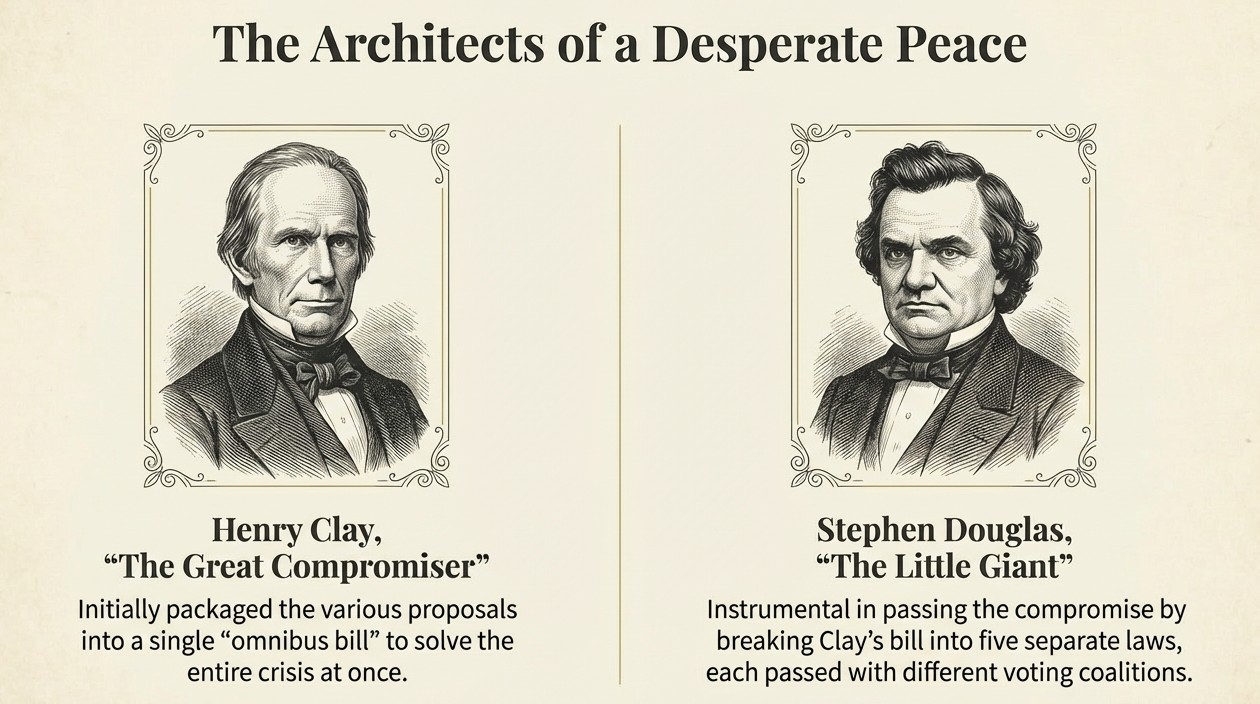
Henry Clay: A leading senator from Kentucky, known as the "Great Compromiser," who played a crucial role in initially packaging the various proposals that would become the Compromise of 1850.
Stephen Douglas: An Illinois senator who was instrumental in passing the Compromise of 1850 by breaking Clay's original "omnibus bill" into individual pieces of legislation that could be passed with different voting coalitions.
Skill Snapshots
Causation:
The Mexican Cession → created a crisis over the status of slavery in new territories.
Southern fears of losing political power → led to demands for a stronger fugitive slave law.
The Fugitive Slave Act → increased Northern opposition to slavery and sectional tensions.
Comparison:
The North sought to limit slavery's expansion into the territories, while the South insisted on the right to expand slavery based on property rights.
Northern states prioritized the admission of California as a free state, while Southern states prioritized the enforcement of fugitive slave laws.
Both North and South used the Constitution to justify their positions, with the North citing Congress's power to make rules for territories and the South citing the Fifth Amendment's protection of property.
Continuity and Change over Time:
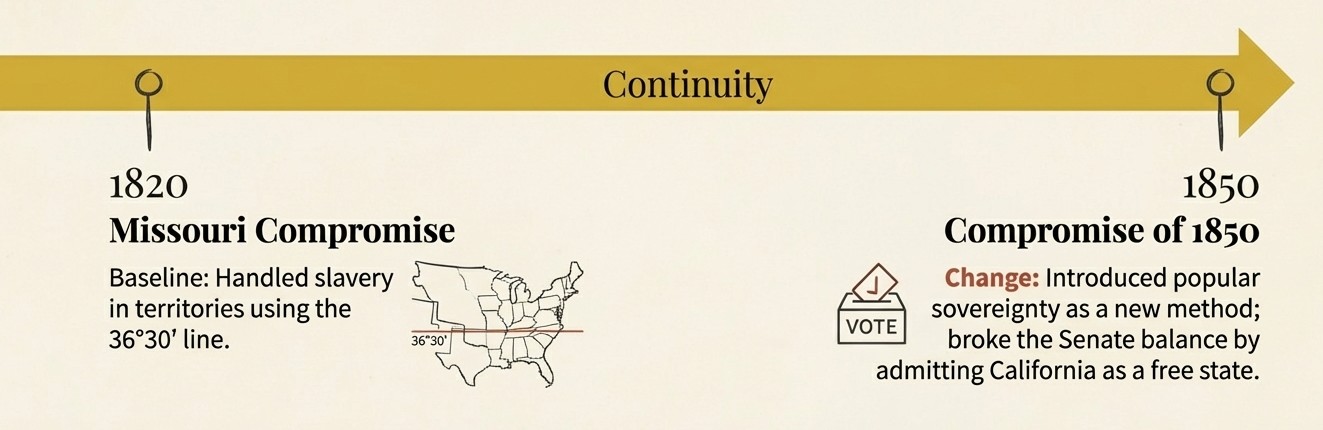
Baseline: Before 1848, the Missouri Compromise line of 36°30′ had been the primary mechanism for handling slavery in the territories.
Change: The Compromise of 1850 admitted California as a free state, breaking the Senate balance, and introduced popular sovereignty as a new method for deciding slavery's status.
Continuity: Despite the new legislation, the fundamental sectional conflict over the morality, economics, and politics of slavery continued to intensify.
Common Misconceptions & Clarifications
Misconception: The Compromise of 1850 was a single, unified bill that everyone agreed on.
Clarification: It was a package of five separate laws, each passed with different, fragile coalitions of votes. Few legislators supported all five parts.
Misconception: The Compromise of 1850 solved the slavery crisis.
Clarification: It only postponed a larger conflict. Key provisions, especially the Fugitive Slave Act, actively worsened sectional tensions and made future compromise more difficult.
Misconception: "Popular sovereignty" was a clear and simple solution.
Clarification: The doctrine was intentionally vague. It did not specify when settlers could decide on slavery (early on, or only at statehood?), leaving it open to conflicting interpretations by North and South.
One-Paragraph Summary
The acquisition of the Mexican Cession after 1848 forced a national reckoning over the expansion of slavery, creating a severe political crisis that threatened the Union. Regional attitudes, shaped by differing economic and social systems, clashed as Northerners sought to restrict slavery's spread while Southerners demanded its protection as a constitutional right. In an effort to resolve the issue, national leaders forged the Compromise of 1850. This complex set of laws admitted California as a free state, organized the remaining territories under the principle of popular sovereignty, and enacted a harsh new Fugitive Slave Act. While the compromise temporarily averted secession, it failed to resolve the underlying sectional conflict and, in the case of the Fugitive Slave Act, created new sources of bitterness that pushed the nation closer to civil war.