
AP U.S. History Practice Quiz: The Compromise of 1850
Written by AP Content Team, Verified for 2026 AP Exams, Last updated: August 2026
Test your understanding with short quizzes. This quiz has 9 questions to check your progress.
Question 1 of 9
All Questions (9)
A) The debate over whether to allow slavery in the Mexican Cession.
B) The financial cost of the war with Mexico.
C) The displacement of Native American populations from the new lands.
D) The establishment of new trade routes to the Pacific Ocean.
Correct Answer: A
The provided content explicitly states, 'The Mexican Cession led to heated controversies over whether to allow slavery in the newly acquired territories.'
A) Conflicting regional attitudes regarding the expansion of slavery.
B) Economic disputes over tariff rates between industrial and agricultural states.
C) Foreign policy challenges from European powers in the Western Hemisphere.
D) The need to organize a transcontinental railroad route.
Correct Answer: A
The content explains that 'regional attitudes affected federal policy' and that leaders made 'attempts to resolve the issue of slavery in the territories,' directly linking the need for policy to the conflicting regional views on slavery.
A) A successful and permanent resolution to sectional conflict.
B) A federal attempt to manage the conflict over slavery in new territories.
C) A judicial ruling that settled the question of slavery's expansion.
D) A military strategy to secure the lands of the Mexican Cession.
Correct Answer: B
The text identifies the Compromise of 1850 as one of the 'variety of attempts to resolve the issue of slavery in the territories' made by 'national leaders,' framing it as a federal policy effort, not a permanent solution or a court ruling.
A) The balance of power between the legislative and executive branches.
B) The debate over the constitutionality of a national bank.
C) The sectional divisions over the institution of slavery.
D) The question of voting rights for non-landowners.
Correct Answer: C
The content states that the Mexican Cession 'led to heated controversies over whether to allow slavery in the newly acquired territories,' which directly intensified the existing sectional conflict between regions with differing attitudes on slavery.
A) the desire for further territorial expansion into Canada.
B) the pressure from distinct and often opposing regional viewpoints.
C) the economic theories of international free trade.
D) the diplomatic relationship with the government of Mexico.
Correct Answer: B
The first point of the content explicitly states that 'regional attitudes affected federal policy in the period after the Mexican-American War,' indicating that these viewpoints were a major influence.
A) It was the first time Congress had addressed the issue of slavery.
B) It was a policy that permanently settled the debate over slavery in the territories.
C) It was one of several efforts that ultimately failed to prevent future conflict.
D) It was primarily a judicial, rather than a legislative, solution.
Correct Answer: C
The use of the word 'attempts' suggests that the solutions, including the Compromise of 1850, were not final or completely successful. It implies a series of efforts to manage a problem that persisted, eventually leading to further conflict.
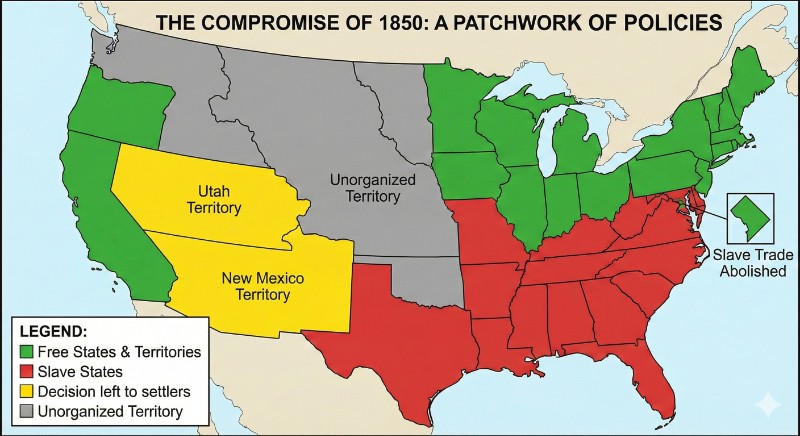
A) pay off the significant debt incurred during the Mexican-American War.
B) integrate a large, non-English-speaking population into the United States.
C) create a federal policy on slavery's status in new territories that could satisfy competing regional interests.
D) prevent European intervention in the newly acquired western lands.
Correct Answer: C
The content synthesizes this challenge: the Mexican Cession raised the question of slavery in the territories, which was contentious due to differing 'regional attitudes,' forcing federal leaders to make 'attempts to resolve the issue.'
A) A Supreme Court ruling that mandated the expansion of slavery.
B) The acquisition of new territory by the United States.
C) A sudden economic depression that affected the entire nation.
D) The election of a presidential candidate opposed to slavery.
Correct Answer: B
The provided text explicitly states that 'The Mexican Cession led to heated controversies,' identifying the acquisition of new territory as the direct cause of the political crisis.
A) the question of states' rights versus national authority.
B) the moral and economic implications of slavery's expansion.
C) the constitutional process for admitting new states to the Union.
D) the federal government's role in internal improvements.
Correct Answer: B
The core of the issue described is the 'controversies over whether to allow slavery in the newly acquired territories.' This question encompasses the fundamental economic and moral disagreements between regions that fueled the political crisis.