
Getting Started
In the decades before the Civil War (c. 1844–1860), the United States was not one unified nation but a collection of distinct regions with diverging paths. The industrializing North and the agrarian South developed different economic systems, social structures, and ideologies, while a new wave of international migration further reshaped American society. These growing regional differences, particularly over the institution of slavery, created deep-seated tensions that threatened to tear the country apart.
What You Should Be Able to Do
Explain how international immigration shaped American culture and politics in the mid-19th century.
Compare the economic and social systems of the North and the South.
Explain the competing ideologies regarding slavery, including abolitionism, the free-soil movement, and pro-slavery arguments.
Analyze how these regional differences fueled national tensions leading up to the Civil War.
Key Developments & Analysis
The growing divide between the North and South can be best understood by comparing their fundamental characteristics.
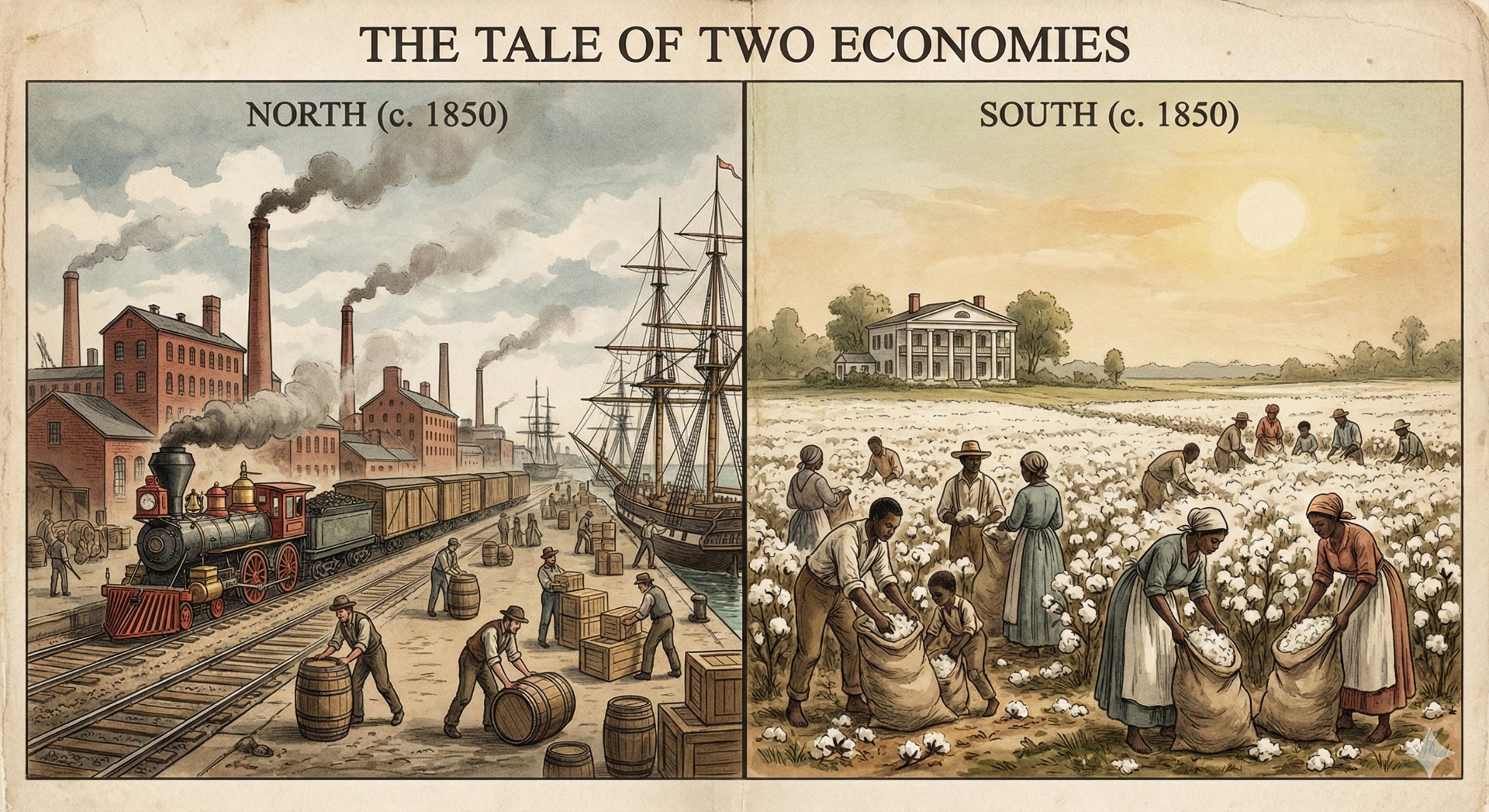
| Theme | The North | The South | Why This Difference Mattered |
|---|---|---|---|
| Economic System | An expanding manufacturing economy based on factories, trade, and finance. This system encouraged technological innovation and the growth of cities. | An agrarian economy dependent on cash crops like cotton, which were cultivated on large plantations. This system relied on a static labor model rather than industrial expansion. | The two economies were fundamentally incompatible. The North sought tariffs to protect industry, while the South opposed them. Their economic interests increasingly clashed at the national level. |
| Labor System | Relied on free labor, where workers were paid wages and could move between jobs. This system was supplemented by a substantial influx of international migrants. | Relied on enslaved labor, a system of forced, unpaid labor that was central to the region's economic output and social order. | This was the most significant source of conflict. The North's free-labor ideology saw slavery as a threat to the dignity of work and economic opportunity for white men, while the South saw it as essential to its prosperity and way of life. |
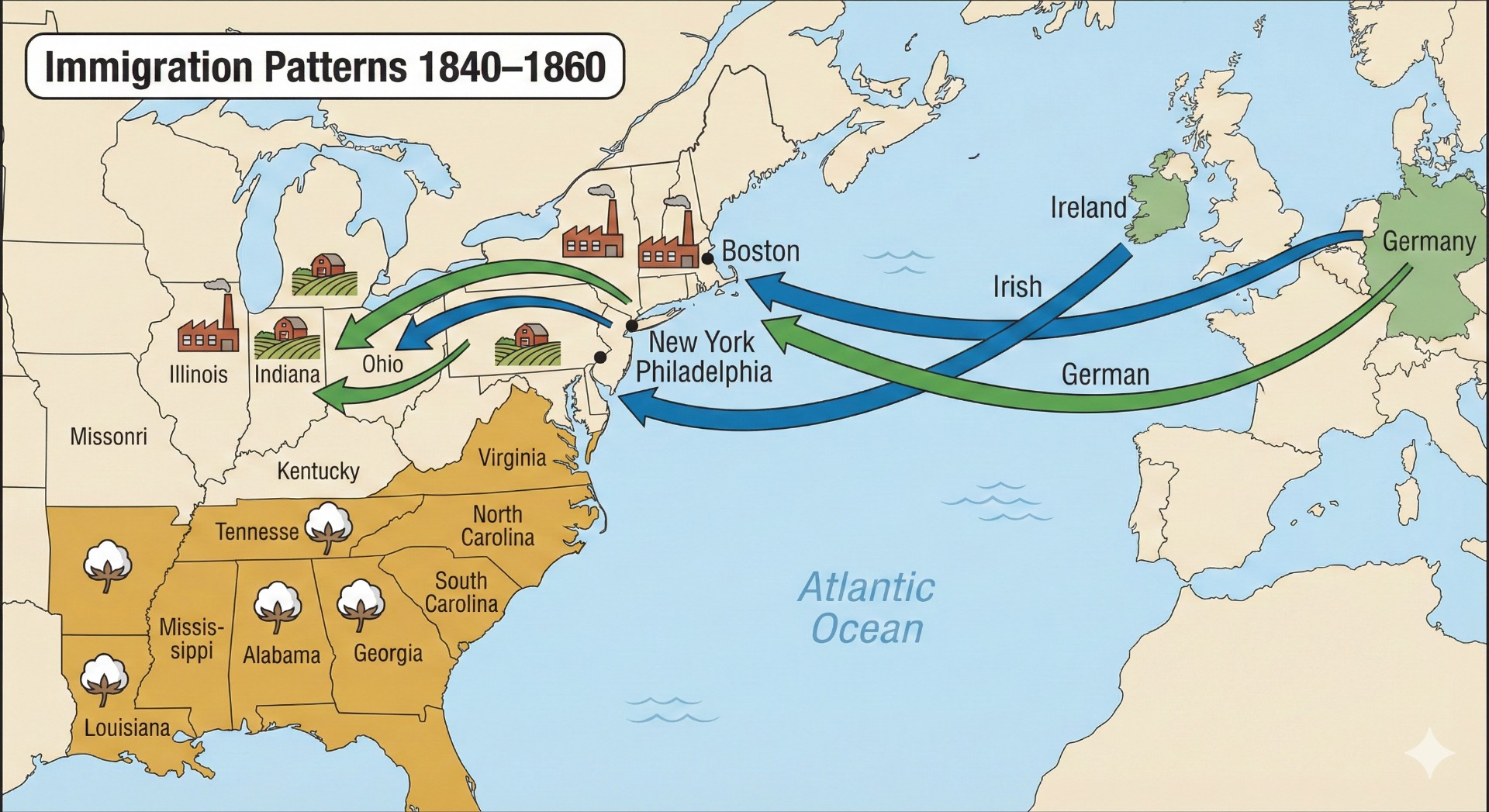
| Immigration & Demographics | Experienced substantial immigration from Europe, mainly Ireland and Germany, and some from Asia. Immigrants often settled in ethnic communities to preserve their culture. | Received very little international immigration. The population was less dense and diverse, with a rigid social hierarchy defined by race and land ownership. | Immigration fueled the North's population growth, increasing its political power in the House of Representatives. It also led to social tensions, such as the rise of a nativist movement. |
| Social & Political Movements | A free-soil movement arose, arguing that slavery's expansion threatened the economic model of free labor. A visible abolitionist movement also campaigned for slavery's end on moral grounds. | A powerful political class emerged to defend slavery. They developed arguments based on racial doctrines, constitutional protections (states' rights), and the idea that slavery was a "positive social good." | These opposing movements created a moral and political deadlock. Abolitionist efforts to assist escapes and pro-slavery arguments hardened regional identities and made compromise increasingly difficult. |
Data & Organization Tools
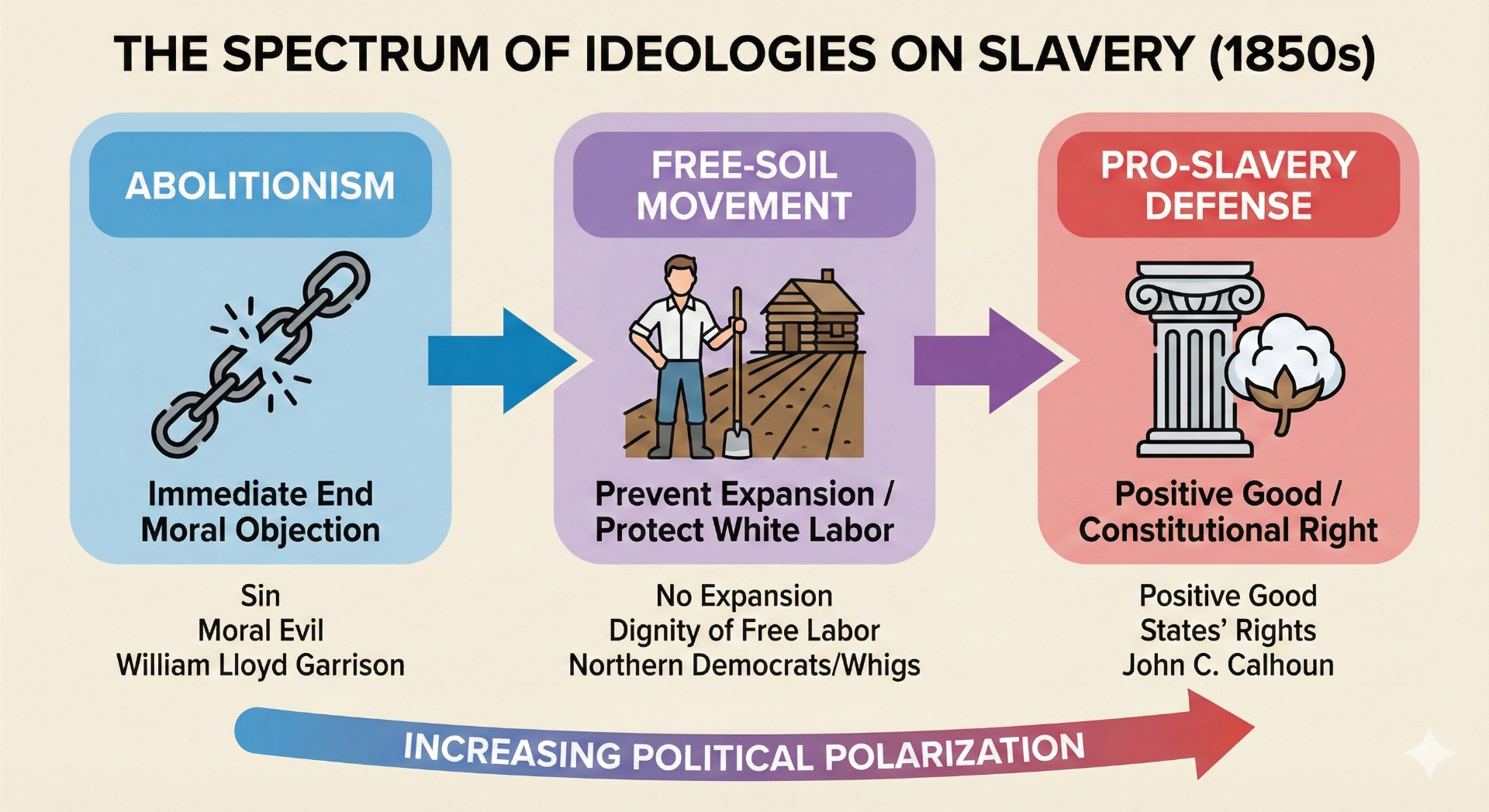
Competing Ideologies on Slavery
| Ideology | Core Beliefs | Key Arguments | Proponents |
|---|---|---|---|
| Abolitionism | Slavery is a moral evil that must be ended immediately and completely. | Presented moral arguments against the sin of human bondage; assisted in escapes; some expressed a willingness to use violence to achieve emancipation. | African American and white abolitionists. |
| Free-Soil Movement | Slavery should not be allowed to expand into new western territories. | Portrayed the expansion of slavery as incompatible with free labor; argued that enslaved labor degraded the value of work for free white men. | Northern Democrats and Whigs; later, Republicans. |
| Pro-Slavery Defense | Slavery is a necessary and beneficial institution for both enslavers and the enslaved. | Based on racial doctrines of white supremacy; claimed slavery was a "positive social good" that civilized African Americans; argued it was protected by the Constitution and states' rights. | Southern slaveholders, politicians, and intellectuals. |
Evidence Bank
German and Irish Immigrants: The two largest groups of international migrants arriving in the United States in the mid-19th century. Germans often settled in the Midwest to farm, while the Irish, fleeing famine, typically settled in Eastern cities.
Ethnic Communities: Urban or rural neighborhoods where immigrants from the same country of origin settled. These communities allowed migrants to preserve elements of their languages, customs, and religions.
Nativist Movement: A political movement that was strongly anti-immigrant and anti-Catholic. Nativists sought to limit the political power and cultural influence of new immigrants, whom they viewed as a threat to American values.
Free Labor: The Northern economic concept that workers should be free to choose their jobs, negotiate wages, and move up the social ladder. This ideology stood in direct opposition to the South's system of enslaved labor.
Free-Soil Movement: A political movement whose primary goal was to stop the expansion of slavery into the western territories. Its supporters believed that slavery undermined the dignity of labor and threatened the economic opportunities of free white men.
Abolitionists: Reformers who advocated for the complete and immediate end to slavery. They used moral arguments, published anti-slavery newspapers, helped enslaved people escape, and sometimes supported the use of violence.
"Positive Good" Argument: The claim made by defenders of slavery that the institution was beneficial. They argued it provided a stable social order, Christianized enslaved people, and was more humane than the "wage slavery" of the industrial North.
Racial Doctrines: A set of beliefs based on the idea that one race is inherently superior to another. In the South, these doctrines were used to justify the enslavement of African Americans as a natural and proper condition.
Skill Snapshots
Causation:
The arrival of substantial numbers of Catholic immigrants from Ireland and Germany caused the rise of a nativist movement aimed at limiting their influence.
The South’s economic dependence on enslaved labor caused its leaders to develop complex pro-slavery arguments based on race, religion, and the Constitution.
The North’s expanding manufacturing economy caused the development of a free-labor ideology that saw slavery as an economic and social threat.
Comparison:
The North’s economy was based on manufacturing and free labor, while the South’s was based on agriculture and enslaved labor.
Abolitionists sought to end slavery on moral grounds, whereas the free-soil movement sought only to prevent its expansion to protect opportunities for white workers.
Northern society was reshaped by mass immigration, in contrast to the South's more static, biracial social hierarchy.
Continuity and Change Over Time:
Baseline: In the early 19th century, sectional differences existed but were often managed through political compromise.
Change: The abolitionist movement grew from a small, radical group into a highly visible and influential campaign.
Change: Pro-slavery arguments shifted from defending slavery as a "necessary evil" to promoting it as a "positive good."
Continuity: The Southern economy remained fundamentally dependent on cash-crop agriculture and a coerced labor system throughout the period.
Common Misconceptions & Clarifications
"All Northerners were abolitionists." This is incorrect. While the abolitionist movement was centered in the North, it was a minority view. The more widespread Northern view was the free-soil position, which opposed the expansion of slavery but did not necessarily advocate for its immediate abolition everywhere.
"Immigration was universally welcomed in the North as a source of labor." While immigrants did provide essential labor for the expanding economy, their arrival also sparked significant backlash. The nativist movement was a powerful anti-immigrant and anti-Catholic force in Northern politics.
"The defense of slavery was purely economic." While protecting the wealth generated by enslaved labor was central, pro-slavery arguments were also deeply ideological. They were built on racial doctrines of white supremacy, constitutional arguments about states' rights, and the claim that slavery was a positive social good.
One-Paragraph Summary
During the mid-19th century, deep-seated regional differences pushed the United States toward crisis. The North developed a dynamic industrial economy reliant on free labor and shaped by waves of European immigration, which in turn sparked a nativist backlash. In stark contrast, the South’s agrarian economy and social structure were wholly dependent on the institution of slavery. This fundamental divide fueled competing ideologies: a Northern free-soil movement that sought to halt slavery’s expansion and a vocal abolitionist campaign that demanded its end, countered by a Southern defense of slavery as a "positive good" protected by the Constitution. These irreconcilable economic, social, and moral visions created escalating sectional tensions that made national unity increasingly fragile.