
AP U.S. History Practice Quiz: Sectional Conflict: Regional Differences
Written by AP Content Team, Verified for 2026 AP Exams, Last updated: August 2026
Test your understanding with short quizzes. This quiz has 16 questions to check your progress.
Question 1 of 16
All Questions (16)
A) To assimilate quickly into American society.
B) To preserve elements of their languages and customs.
C) To take advantage of government land grants for farming.
D) To establish new political parties based on European models.
Correct Answer: B
The provided content explicitly states that immigrants from Europe and Asia often settled in ethnic communities 'where they could preserve elements of their languages and customs.'
A) The expansion of slavery into western territories.
B) The economic dominance of the Southern planter class.
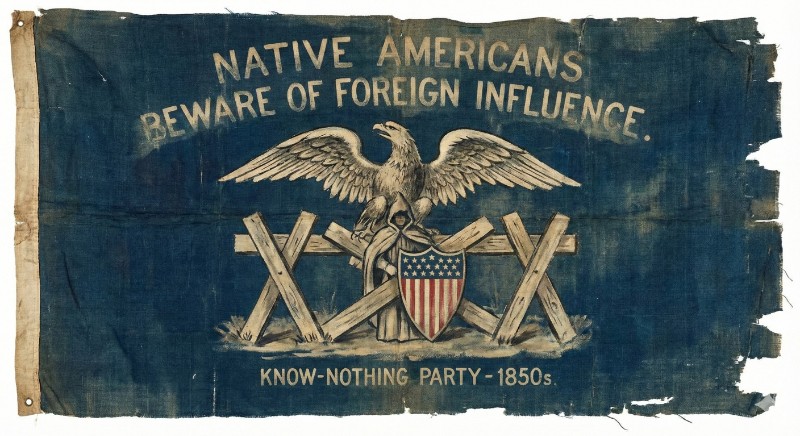
C) The perceived political and cultural influence of new immigrants.
D) The moral arguments presented by the abolitionist movement.
Correct Answer: C
The text describes the nativist movement as being 'aimed at limiting new immigrants’ political power and cultural influence,' indicating it was a direct reaction to the effects of immigration.
A) The North focused on international trade, while the South focused on domestic trade.
B) The North's economy was based on free labor and manufacturing, while the South's was dependent on enslaved labor.
C) The North was primarily agricultural, while the South was rapidly industrializing.
D) The North's economy relied on federal subsidies, while the South's was based on states' rights.
Correct Answer: B
The content explicitly contrasts the North’s 'expanding manufacturing economy relied on free labor' with the 'Southern economy’s dependence on enslaved labor.'
A) was a moral evil that violated Christian principles.
B) was incompatible with the system of free labor.
C) violated the constitutional principle of states’ rights.
D) would lead to an increase in anti-Catholic sentiment.
Correct Answer: B
The text states that the free-soil movement 'portrayed the expansion of slavery as incompatible with free labor,' making this the core of their argument.
A) Presenting moral arguments against the institution.
B) Assisting enslaved people in their escapes.
C) Lobbying for federal legislation to compensate slaveholders.
D) Expressing a willingness to use violence.
Correct Answer: C
The text mentions that abolitionists used moral arguments, assisted escapes, and were sometimes willing to use violence. It does not mention any effort to compensate slaveholders.
A) the belief that slavery was a 'positive social good.'
B) the idea that slavery was protected by the Constitution and states’ rights.
C) the argument that slavery promoted economic equality among whites.
D) the use of racial doctrines to assert white superiority.
Correct Answer: C
The text lists racial doctrines, the 'positive social good' argument, and constitutional/states' rights protections as justifications for slavery. It makes no mention of slavery promoting economic equality among whites.
A) The rise of a strongly anti-Catholic nativist movement.
B) The rapid expansion of the Southern plantation economy.
C) The formation of the Free-Soil movement.
D) An alliance between new immigrants and abolitionists.
Correct Answer: A
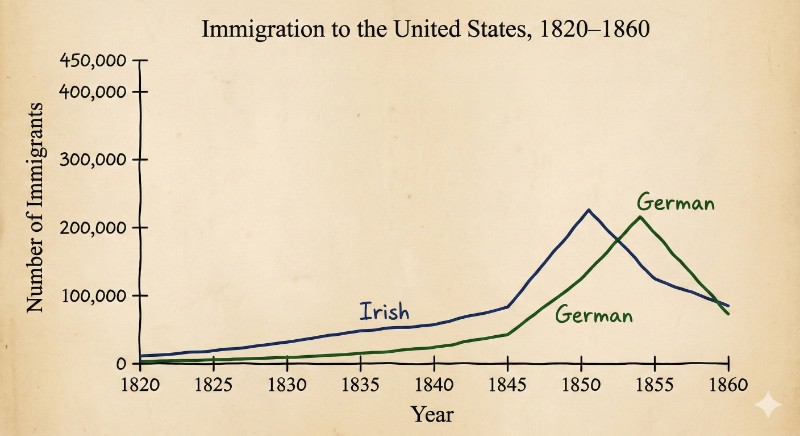
The text links the arrival of international migrants (Point 3) to the rise of 'a strongly anti-Catholic nativist movement' aimed at limiting their influence (Point 4).
A) disagreements over immigration policy and cultural preservation.
B) differing interpretations of federal tariff laws.
C) fundamentally different labor systems and their economic implications.
D) competition for international trade with Europe and Asia.
Correct Answer: C
The text states that 'regional differences related to slavery caused tension' and elaborates by contrasting the North's 'free labor' economy with the South's 'enslaved labor' economy. This points to the labor systems as the core issue.
A) Protestantism.
B) Catholicism.
C) The Free-Soil movement.
D) Southern slaveholders.
Correct Answer: B
The text explicitly identifies the movement as a 'strongly anti-Catholic nativist movement.'
A) That it was an efficient system of free labor.
B) That it was a positive social good.
C) That it promoted cultural assimilation for immigrants.
D) That it was a temporary solution to a labor shortage.
Correct Answer: B
The text directly states that defenders of slavery based their arguments on 'the view that slavery was a positive social good.'
A) exclusively comprised of white Northerners.
B) unified in its commitment to nonviolent resistance.
C) diverse in its participants and methods, which sometimes included the potential for violence.
D) primarily focused on political solutions through the existing party system.
Correct Answer: C
The text states that 'African American and white abolitionists' were involved and that they used various methods, including 'assisting escapes' and 'sometimes expressing a willingness to use violence,' showing diversity in both participants and tactics.
A) By arguing that the Bill of Rights applied to all individuals, including the enslaved.
B) By citing the 'necessary and proper' clause to justify the expansion of slavery.
C) By asserting that slavery was a right reserved to the states.
D) By claiming the Constitution mandated a manufacturing-based economy.
Correct Answer: C
The text states that defenders of slavery based their arguments on 'the belief that slavery and states’ rights were protected by the Constitution.'
A) It led to the complete and rapid assimilation of new groups.
B) It resulted in the preservation of diverse languages and customs within the U.S.
C) It caused the federal government to ban all further immigration from Europe and Asia.
D) It created a uniform national culture free of regional differences.
Correct Answer: B
The content states that immigrants settled in ethnic communities 'where they could preserve elements of their languages and customs,' which directly contributed to cultural diversity rather than a uniform culture or rapid assimilation.
A) the moral injustice of slavery and the humanity of enslaved people.
B) the threat that the expansion of slavery posed to the economic opportunities of free white laborers.
C) the immediate and uncompensated emancipation of all enslaved people.
D) using violence to overthrow the institution of slavery in the South.
Correct Answer: B
The text describes the Free-Soil movement as portraying 'the expansion of slavery as incompatible with free labor,' an economic argument focused on white workers. In contrast, it describes abolitionists as presenting 'moral arguments' and assisting escapes, focusing on the injustice of the institution itself.
A) Northern and Southern states disagreed over the cultural influence of Asian immigrants.
B) The North's reliance on free labor for manufacturing clashed with the South's economic and social dependence on enslaved labor.
C) The abolitionist movement in the South threatened the North's growing industrial power.
D) Nativist movements in the South sought to limit the political power of Northern factory owners.
Correct Answer: B
This question synthesizes the core conflict. The text states 'regional differences related to slavery caused tension' and then details the North's 'free labor' manufacturing economy versus the South's 'dependence on enslaved labor.' This economic and social clash was the central cause of tension.
A) the movement was exclusively a Northern phenomenon.
B) the campaign against slavery was a biracial effort.
C) all Northerners were united in their opposition to slavery.
D) the movement's primary goal was to gain political power.
Correct Answer: B
The text specifies that 'African American and white abolitionists mounted a highly visible campaign against slavery,' indicating that it was a biracial or interracial movement.