
AP U.S. History Flashcards: Sectional Conflict: Regional Differences
Written by AP Content Team, Verified for 2026 AP Exams, Last updated: August 2026
Review key ideas with interactive flashcards. This set includes 14 cards to help you master important concepts.
What was the fundamental economic difference between the North and the South?
The North’s expanding manufacturing economy relied on free labor, while the Southern economy was dependent on enslaved labor.
Card 1 of 14
All Flashcards (14)
What was the fundamental economic difference between the North and the South?
The North’s expanding manufacturing economy relied on free labor, while the Southern economy was dependent on enslaved labor.
Besides moral arguments, what other forms of resistance did abolitionists support?
Abolitionists also assisted with escapes of enslaved people and, in some cases, expressed a willingness to use violence to end slavery.
How did defenders of slavery use the Constitution to justify their position?
They argued that the institution of slavery and the principle of states' rights were protected by the Constitution.
What was the nativist movement of the mid-19th century?
It was a strongly anti-Catholic movement aimed at limiting the political power and cultural influence of new immigrants.
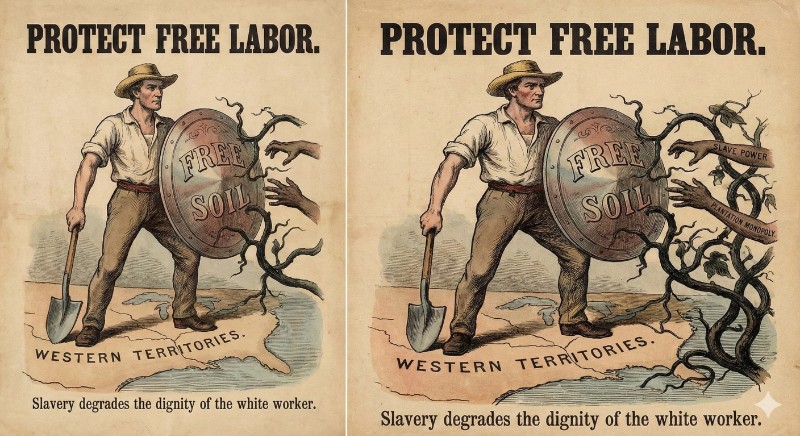
What was the free-soil movement?
A movement that portrayed the expansion of slavery as incompatible with free labor, arguing against its spread into new territories.
What methods did African American and white abolitionists use in their campaign against slavery?
They mounted a highly visible campaign presenting moral arguments, assisting escapes, and sometimes expressing a willingness to use violence.
How did immigrants from Europe and Asia preserve their culture in America?
They often settled in ethnic communities where they could preserve elements of their languages and customs.
What is meant by the pro-slavery argument of a 'positive social good'?
This was the view used by defenders of slavery to argue that the institution was beneficial for society and for the enslaved people themselves, a claim based on racial doctrines.
From which two European countries did a substantial number of migrants arrive between 1844 and 1877?
Substantial numbers of international migrants arrived from Ireland and Germany.
How did regional economic systems contribute to tensions over slavery?
The North's reliance on a free-labor manufacturing economy clashed with the South's dependence on an enslaved-labor agricultural economy, creating opposing viewpoints on the expansion of slavery.
Who was the primary target of the mid-19th century nativist movement?
The strongly anti-Catholic nativist movement was primarily aimed at new immigrants, such as the Irish, to limit their influence.
What were the three main arguments used by defenders of slavery?
They based their arguments on racial doctrines, the view that slavery was a positive social good, and the belief that slavery and states' rights were protected by the Constitution.
A German immigrant family moves to a city in the 1850s and settles in a neighborhood with German-language newspapers and cultural clubs. What does this behavior demonstrate?
This demonstrates the tendency of immigrants to settle in ethnic communities to preserve elements of their languages and customs.
A politician argues that allowing slavery into Kansas would hurt the economic prospects of white farmers. This argument aligns with which movement?
This aligns with the free-soil movement, which saw the expansion of slavery as incompatible with free labor.