
Getting Started
The American Civil War (1861–1865) was a defining crisis in U.S. history, forcing the nation to confront fundamental questions about its own identity. This chapter focuses on the leadership of President Abraham Lincoln and how federal government policies, particularly regarding slavery and the purpose of the war, evolved. We will trace how the conflict transformed from a war to preserve a nation into a revolutionary struggle to redefine it.
What You Should Be Able to Do
Explain the Union's initial war aims in 1861.
Analyze how and why the purpose of the Civil War changed over time.
Explain the multiple impacts of the Emancipation Proclamation on the war effort.
Evaluate how Lincoln’s speeches connected the war to America’s founding ideals.
Key Developments & Analysis
Baseline & Context (c. 1861)
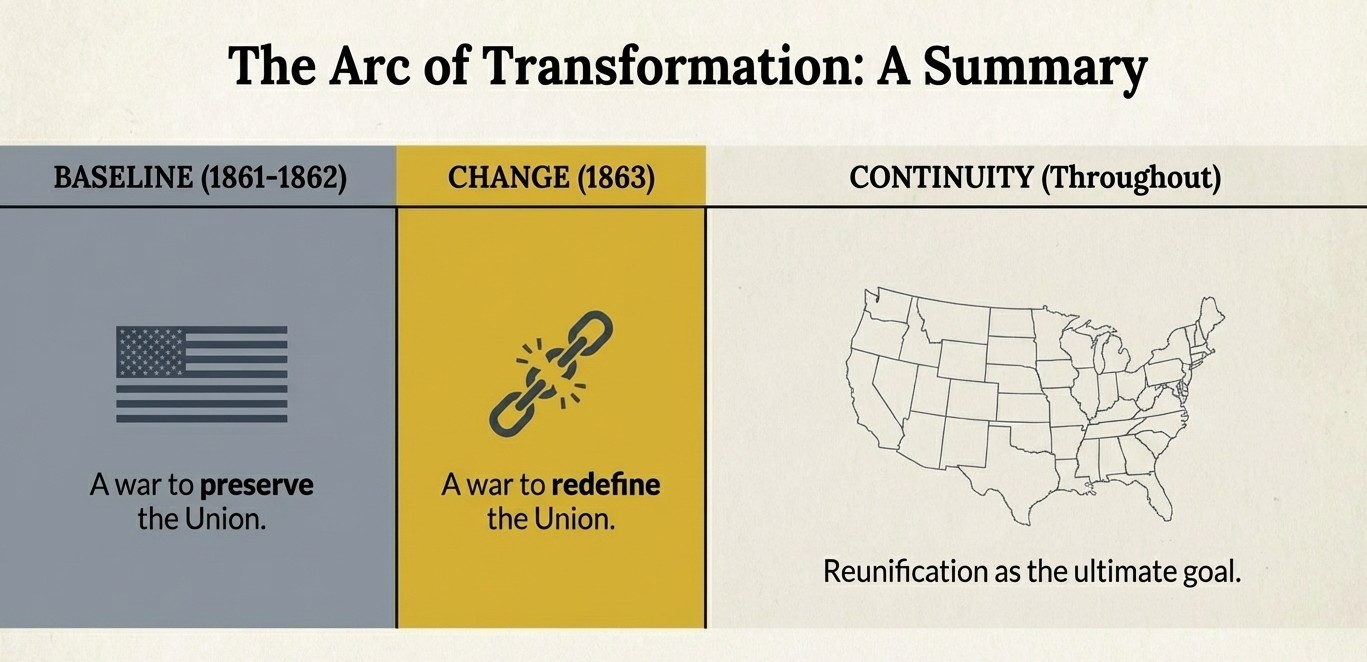
When the Civil War began, President Abraham Lincoln’s stated objective was clear and singular: to preserve the Union, a term for the United States as a single, indivisible nation. He argued that the secession of Southern states was an illegal rebellion that threatened the world's great democratic experiment. To maintain national unity and, crucially, to keep the slave-holding border states from joining the Confederacy (the government formed by the 11 seceded Southern states), Lincoln initially insisted the war was not about abolishing slavery. The primary goal was to restore federal authority and reunify the country.
Key Changes
The Emancipation Proclamation: As the war progressed, Lincoln’s strategy shifted. In 1863, he issued the Emancipation Proclamation, a presidential order that declared all enslaved people in Confederate-held territory to be "thenceforward, and forever free." This was a pivotal change. It reframed the war's purpose, transforming it from a conflict solely about union into a struggle for human freedom. This move also had a significant diplomatic effect, making it politically difficult for anti-slavery European nations like Great Britain to offer diplomatic support to the Confederacy.
African American Enlistment: The Proclamation also authorized the enlistment of African American men in the Union Army. In response, many African Americans fled Southern plantations and joined the fight. Their service provided a crucial source of manpower for the Union and demonstrated a profound commitment to securing their own liberation, fundamentally altering the character of the armed conflict.
Redefining American Ideals: Lincoln used his powerful rhetoric to articulate this new, higher purpose for the war. In his 1863 Gettysburg Address, a short speech dedicating a military cemetery, he portrayed the brutal struggle as a test of the nation's founding principles. By connecting the Union cause to the ideals of the Declaration of Independence—that all men are created equal—Lincoln argued that the war against slavery was necessary to fulfill America's original democratic promise and ensure a "new birth of freedom."
Key Continuities
- Reunification as the Ultimate Goal: Despite the profound shift toward emancipation, Lincoln's ultimate objective remained the reunification of the country. He saw the destruction of slavery not as a separate crusade but as an essential condition for creating a stronger, more just, and lasting Union. The goal of preserving the nation never vanished; rather, the meaning of what that nation stood for was deepened and expanded.
Data & Organization Tools
Timeline of Evolving War Aims
| Date | Event | Significance for Government Policy & War Aims |
|---|---|---|
| April 1861 | Civil War Begins | Lincoln's stated goal is exclusively to preserve the Union. |
| Sept. 1862 | Preliminary Emancipation Proclamation | Lincoln signals a shift in policy, warning the Confederacy he will free enslaved people in their territory. |
| Jan. 1, 1863 | Emancipation Proclamation Takes Effect | The war officially becomes a fight for both Union and freedom; African American enlistment is authorized. |
| Nov. 19, 1863 | Gettysburg Address | Lincoln rhetorically frames the war as a struggle to fulfill America's founding democratic ideals. |
Evidence Bank
Abraham Lincoln: The 16th U.S. President, whose leadership during the Civil War was defined by his evolving policies on slavery and his goal of preserving the nation while giving it a "new birth of freedom."
The Union: The term used to refer to the United States government and the states that remained loyal to it during the Civil War. Its primary war aim at the outset was to prevent the permanent separation of the seceded states.
The Confederacy: The government established by the 11 Southern states that seceded from the Union. Its primary goal was to secure independence and preserve the institution of slavery.
Emancipation Proclamation (1863): The executive order issued by Lincoln that freed enslaved people in Confederate-controlled territories. It fundamentally changed the Union's war aims and helped prevent foreign intervention.
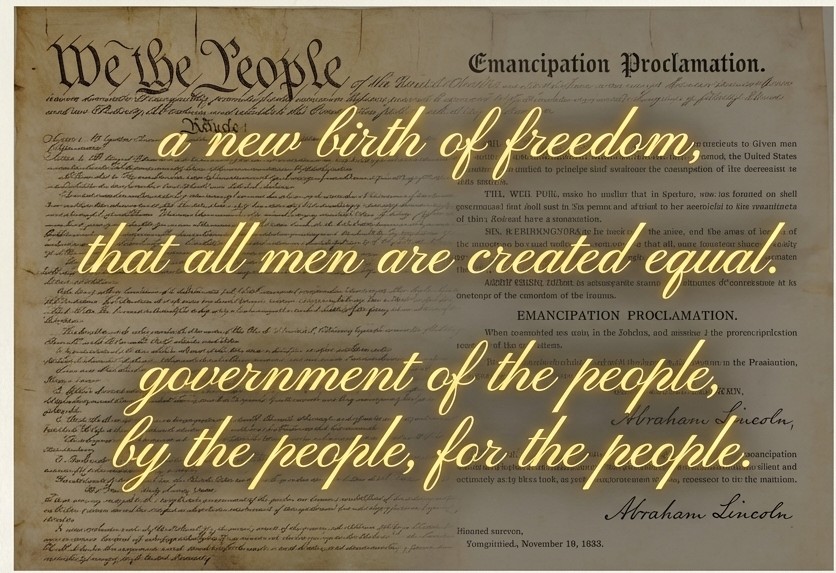
Gettysburg Address (1863): A brief but powerful speech by Lincoln that framed the Civil War as a struggle to uphold the principles of human equality and self-government laid out in the Declaration of Independence.
Union Army: The land-based military force of the United States during the Civil War. The enlistment of nearly 200,000 African American soldiers after the Emancipation Proclamation was critical to its victory.
Founding Democratic Ideals: Core principles from the American Revolution, such as liberty, equality, and government by the people, which Lincoln referenced in his speeches to give the war a moral and historical purpose.
Skill Snapshots
Causation: The Emancipation Proclamation caused a shift in the war's purpose and helped prevent European diplomatic support for the Confederacy. Lincoln's Gettysburg Address was caused by the need to articulate a moral vision for the immense sacrifice of the war.
Comparison: Lincoln's initial war aim of simple Union preservation differed from his later goal of creating a "new birth of freedom." The Union's purpose contrasted with the Confederacy's goal of preserving a society founded on slavery.
CCOT: The war began as a conflict to preserve the Union (Baseline). It changed into a war to end slavery and redefine the nation's commitment to its founding ideals (Change). Throughout the conflict, the goal of national reunification remained a continuity (Continuity).
Common Misconceptions & Clarifications
Misconception: The Civil War was always about ending slavery.
Clarification: Lincoln’s initial and official goal was to preserve the Union. The abolition of slavery became a central war aim only after the Emancipation Proclamation in 1863.
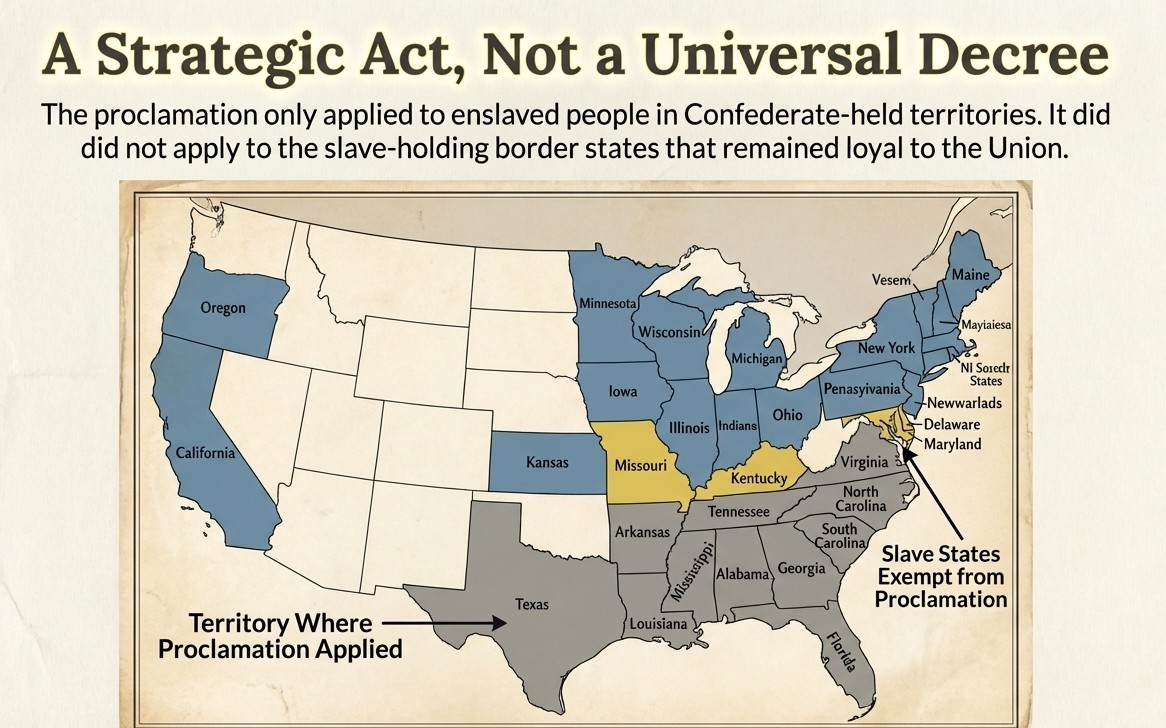
Misconception: The Emancipation Proclamation freed all enslaved people in the United States.
Clarification: The proclamation only applied to enslaved people in Confederate-held territories. It did not apply to the slave-holding border states that remained loyal to the Union.
Misconception: Lincoln was a radical abolitionist from the start.
Clarification: While Lincoln personally opposed slavery, his policies were driven by the political and military necessities of preserving the Union. His public stance and actions evolved significantly over the course of the war.
One-Paragraph Summary
President Abraham Lincoln’s leadership during the Civil War fundamentally reshaped American ideals by transforming the conflict’s purpose. Initially, Lincoln waged the war solely to preserve the Union, a goal designed to maintain national unity. However, the issuance of the Emancipation Proclamation in 1863 marked a decisive turning point, reframing the war as a struggle for freedom, preventing potential European support for the Confederacy, and enabling the enlistment of African American soldiers. Through powerful rhetoric like the Gettysburg Address, Lincoln articulated this new purpose, portraying the war as a necessary fight to fulfill the nation's founding democratic ideals. In doing so, he ensured that the restored Union would not be the same one that had fractured, but one dedicated to a "new birth of freedom."