Getting Started
Between 1844 and 1877, the United States underwent a dramatic territorial and demographic transformation. Fueled by a powerful belief in a coast-to-coast destiny, Americans migrated west in massive numbers. This movement was not a simple story of settlement but a complex process driven by diverse motivations, justified by a new ideology, and resulting in significant conflict, economic change, and a reorientation of the nation's role in the world.
What You Should Be Able to Do
After reviewing this material, you should be able to:
Explain the economic, social, and ideological causes of westward expansion.
Analyze how the concept of Manifest Destiny was used to justify American expansion.
Describe the effects of westward migration, including new conflicts and economic developments.
Explain how government legislation after the Civil War accelerated western settlement.
Connect westward expansion to the growth of U.S. interest in Asia.
Key Developments & Analysis
This section explores the primary causes and effects of the massive westward expansion that reshaped the United States in the mid-19th century.
Causes of Westward Expansion
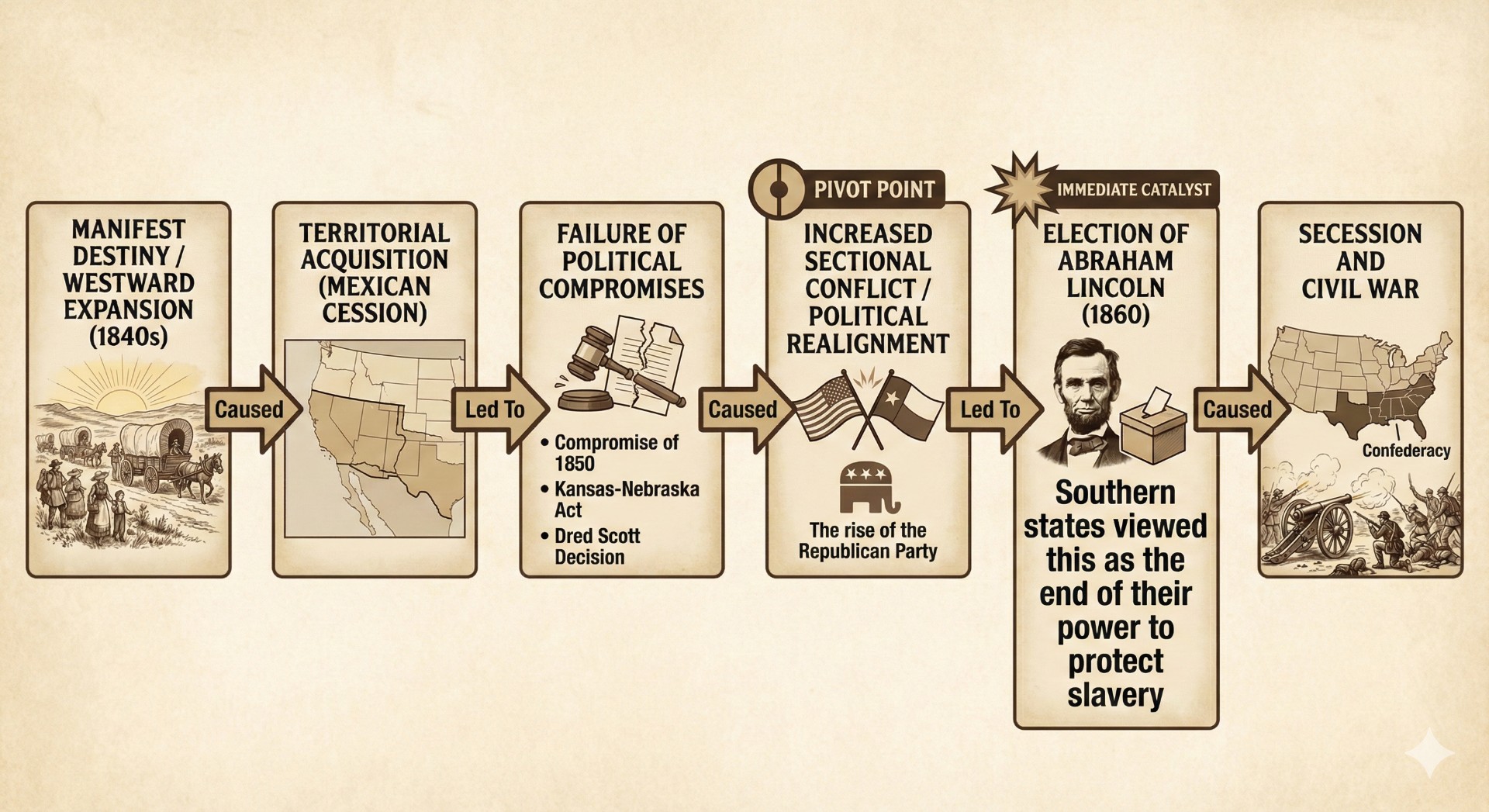
A combination of powerful forces—economic, social, and ideological—propelled millions of Americans and new immigrants toward the western frontier.
Economic and Resource Opportunities: The most tangible driver for many migrants was the promise of economic betterment. The West offered access to vast natural and mineral resources, such as fertile farmland for agriculture, valuable timber, and, most famously, gold and silver. The hope of acquiring land and achieving economic independence was a powerful lure for those facing limited opportunities in the more settled eastern states.
Religious Refuge: Some groups moved west not for wealth but for freedom from persecution. For these settlers, the West represented a sanctuary where they could establish communities based on their unique beliefs. The migration of the Mormons to Utah is a prime example of a large-scale movement undertaken to find a religious refuge.
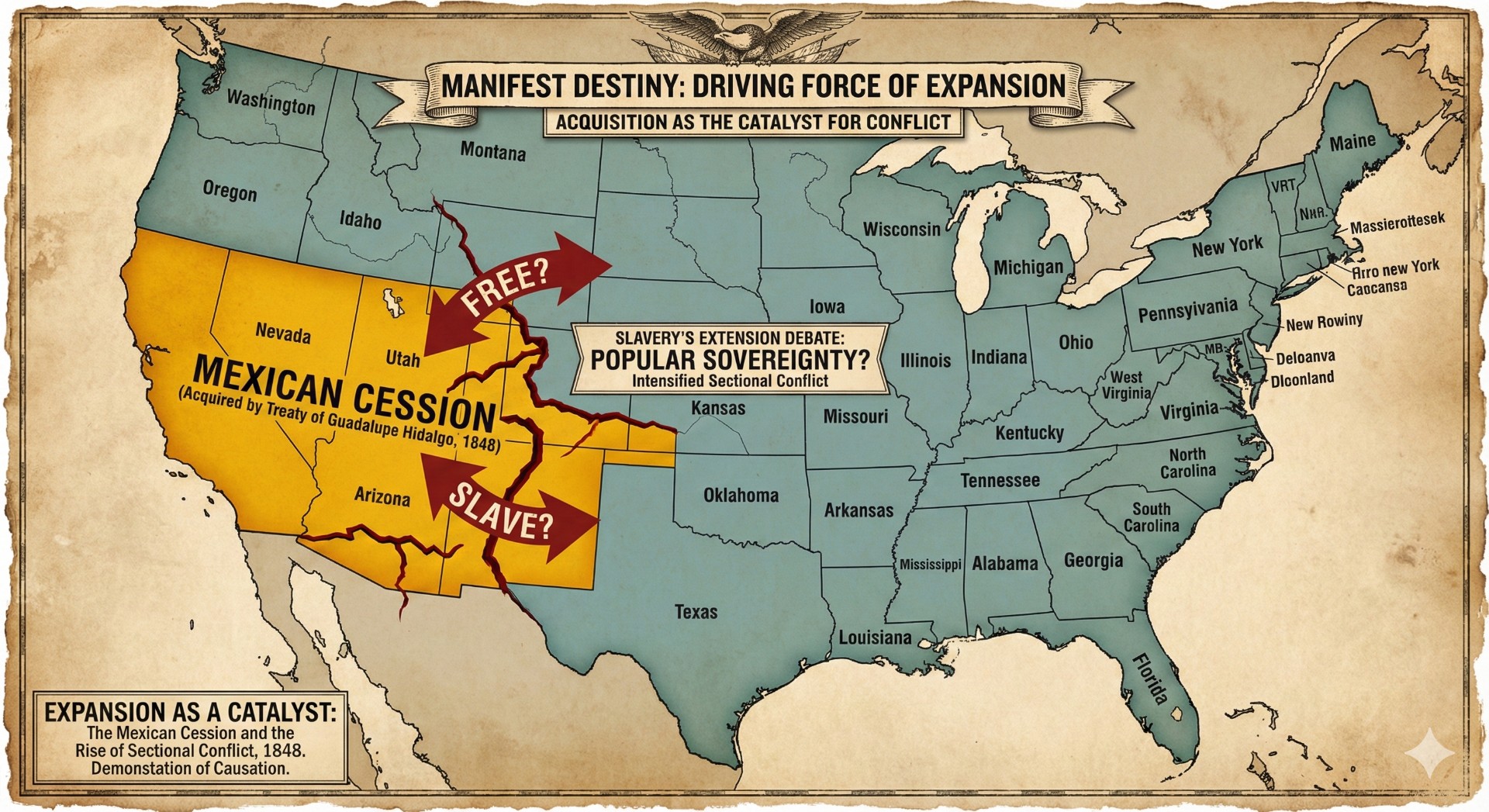
Ideological Justification: The expansion was underpinned by a powerful belief system known as Manifest Destiny. This was the widely held 19th-century doctrine that the United States was divinely ordained to expand its democratic institutions and control across the North American continent, from the Atlantic to the Pacific. Advocates of this idea argued that the superiority of American institutions (such as representative democracy and Protestant Christianity) gave the nation a right and a duty to spread its influence. This ideology provided a powerful moral and political justification for territorial acquisition.
Effects of Westward Expansion
The drive west had profound and often disruptive consequences for the nation's geography, economy, and relationships with other peoples and nations.
Territorial Growth and Violent Conflict: The most direct effect of Manifest Destiny was the physical expansion of U.S. borders to the Pacific Ocean. This process, however, was not peaceful. It frequently provoked competition and violent conflict with Native Americans and other nations, particularly Mexico, who already inhabited these lands. The push westward led to wars, displacement, and the disruption of existing societies.
Accelerated Post-War Development: Westward migration was significantly boosted during and after the Civil War. With southern opposition removed from Congress, the federal government passed new legislation promoting western transportation and economic development. Laws providing for the construction of transcontinental railroads and offering free or cheap land to settlers encouraged a new wave of migration and integrated the western economy with the industrializing North.
Expansion of Foreign Trade: The acquisition of a Pacific coastline fundamentally altered U.S. foreign policy. U.S. interest in expanding trade led to economic, diplomatic, and cultural initiatives to create more ties with Asia. Ports on the West Coast, such as San Francisco, became vital gateways for commerce with nations like China and Japan, positioning the United States as a Pacific power.
Data & Organization Tools
The motivations for westward expansion can be organized into several distinct but overlapping categories.
Motivations for Westward Expansion (1844–1877)
| Motivation Category | Description | Examples & Manifestations |
|---|---|---|
| Economic | The desire for personal financial gain, access to land, and control of valuable resources. | Seeking gold and silver in the West; acquiring cheap farmland for commercial agriculture; trapping for furs. |
| Ideological / Cultural | The belief in the cultural and political superiority of the U.S. and its mission to spread its institutions. | The concept of Manifest Destiny; the belief in American exceptionalism and the "civilizing" of the continent. |
| Social / Religious | The search for new opportunities, social mobility, or a safe haven from persecution. | Farmers seeking a new start; immigrants pursuing the "American Dream"; groups like the Mormons seeking religious freedom. |
| Political / Governmental | Federal policies designed to encourage settlement, secure national borders, and promote economic growth. | Legislation promoting railroad construction; laws offering land to settlers (e.g., the Homestead Act). |
Evidence Bank
Manifest Destiny: A term coined in 1845 to describe the belief that the United States was destined to expand across the continent. This ideology asserted that American expansion was not only good but also obvious ("manifest") and inevitable.
Migration for Mineral Resources: The California Gold Rush (1848–1855) is a key example of migration driven by the desire for mineral resources. It drew hundreds of thousands of people to the West Coast, rapidly accelerating settlement in the region.
Migration for Religious Refuge: The Mormon Exodus, led by Brigham Young to the Great Salt Lake Valley in Utah beginning in the 1840s, is the most prominent example of a group seeking a safe haven from religious persecution.
Pacific Railway Acts (1862, 1864): Post-Civil War legislation that provided federal government support for the building of the first transcontinental railroad. These acts are prime examples of government action promoting western transportation and economic integration.
Homestead Act (1862): A law that provided 160 acres of federal land to any household head who agreed to farm the land for five years. This act dramatically encouraged settlement by individuals and families who might not otherwise have been able to afford land.
U.S. Diplomatic Initiatives in Asia: The 1854 expedition of Commodore Matthew Perry to Japan, which opened the country to American trade, exemplifies the new U.S. interest in creating economic and diplomatic ties with Asia that was spurred by access to the Pacific.
Skill Snapshots
Causation:
The discovery of gold in California → A massive and rapid migration to the West Coast.
The belief in Manifest Destiny → Justification for territorial expansion and the resulting conflicts.
The passage of the Pacific Railway Acts → The rapid construction of railroads that connected the West to the rest of the nation.
Comparison:
Economic motivations for migration (seeking land/gold) differed from religious motivations (seeking refuge), though both led people to the same regions.
Pre-Civil War expansion was often driven by sectional debates over slavery, while post-Civil War expansion was promoted by a stronger federal government focused on national economic development.
U.S. goals in North America focused on territorial acquisition and settlement, whereas its goals in Asia focused on establishing trade and diplomatic ties.
Continuity and Change Over Time:
Baseline (c. 1844): The U.S. was largely contained east of the Rocky Mountains, and the idea of a coast-to-coast nation was still a political goal, not a reality.
Changes: By 1877, the U.S. had acquired all of its contiguous territory, and federal legislation was actively populating the West with a network of farms, ranches, and railroads. The nation's economic focus had expanded to include the Pacific.
Continuity: The underlying belief in American exceptionalism and the pursuit of economic opportunity as a core part of the national identity remained a constant driver of policy and migration.
Common Misconceptions & Clarifications
Misconception: Manifest Destiny was a universally beloved, official government policy.
Clarification: Manifest Destiny was a popular ideology, but it was also controversial. Many prominent Americans, particularly in the North, opposed it, fearing it would lead to the expansion of slavery and war.
Misconception: The American West was an empty, unsettled land before Americans arrived.
Clarification: The West was home to hundreds of distinct and long-standing Native American societies, as well as established Hispanic communities in the Southwest. Westward expansion was an invasion and displacement, not the settlement of a void.
Misconception: Westward expansion was primarily a pre-Civil War event.
Clarification: While significant territory was acquired before 1860, the pace of settlement and economic development of the West greatly accelerated after the Civil War, thanks to new federal laws like the Homestead Act and the Pacific Railway Acts.
Misconception: The goal of expansion was solely about acquiring land for farming.
Clarification: While land was a primary driver, expansion was also motivated by the desire for natural resources (minerals, timber) and, critically, access to the Pacific Ocean to open up lucrative trade routes with Asia.
One-Paragraph Summary
From 1844 to 1877, the United States expanded to the Pacific Ocean, driven by a powerful combination of forces. The ideology of Manifest Destiny, which proclaimed a divine right to spread American institutions, provided a moral justification for this continental ambition. Migrants were drawn west by the promise of economic opportunities, including access to natural and mineral resources, while some groups sought religious refuge from persecution. This expansion led to violent conflicts with Native Americans and Mexico. Following the Civil War, the federal government actively promoted settlement through legislation that funded transportation and provided land, further integrating the West into the national economy and fueling new diplomatic and commercial initiatives with Asia.