
AP U.S. History Practice Quiz: Election of 1860 and Secession
Written by AP Content Team, Verified for 2026 AP Exams, Last updated: August 2026
Test your understanding with short quizzes. This quiz has 7 questions to check your progress.
Question 1 of 7
All Questions (7)
A) The immediate start of the Civil War.
B) The secession of most slave states from the Union.
C) The implementation of the Republicans' free-soil platform.
D) The unanimous support for Lincoln from all states.
Correct Answer: B
The text explicitly states that Lincoln's victory 'led most slave states to secede from the Union,' which was the direct effect that then precipitated the Civil War.
A) Pro-slavery stance.
B) Desire to acquire new territories.
C) Free-soil platform.
D) Alliance with Southern politicians.
Correct Answer: C
The content specifies that Lincoln's victory was 'on the Republicans’ free-soil platform,' and this victory is directly linked to the decision of slave states to secede.
A) He won a majority of votes in the slave states.
B) His victory was achieved without any Southern electoral votes.
C) The election result was disputed for several months.
D) He had to form a coalition government with Southern leaders.
Correct Answer: B
The text clearly states that Lincoln won the election 'without any Southern electoral votes,' emphasizing the deep sectional divide in the country.
A) The American Revolution
B) The Missouri Compromise
C) The Civil War
D) The Era of Good Feelings
Correct Answer: C
The provided content directly links the secession of slave states to 'precipitating the Civil War.'
A) Eastern merchants and Western farmers
B) The Republican Party and the slave states
C) The federal government and state governments
D) Immigrant and native-born populations
Correct Answer: B
The text establishes a clear opposition: Lincoln, a Republican, won without any electoral votes from the South, and in response, 'most slave states' seceded. This points to a direct political division between the Republican party and the slave-holding states.
A) The Civil War caused the election of Abraham Lincoln, which led to the secession of slave states.
B) Abraham Lincoln's election on a free-soil platform, without Southern support, prompted most slave states to secede, leading to the Civil War.
C) Southern states seceded from the Union to protest the free-soil platform, allowing Abraham Lincoln to win the election of 1860.
D) The Republican party's platform was universally accepted, but Lincoln's election still precipitated the Civil War.
Correct Answer: B
This option correctly follows the cause-and-effect chain presented in the text: Lincoln's victory on a specific platform -> secession of a specific group of states -> the outbreak of war.
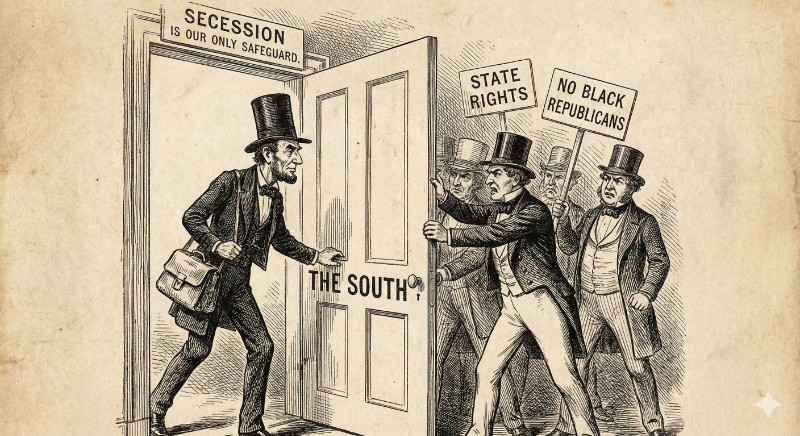
A) The outcome of the Civil War.
B) The establishment of the Republican Party.
C) The victory of a candidate whose platform was perceived as a threat to the institution of slavery.
D) A dispute over the collection of federal tariffs.
Correct Answer: C
The text links the secession directly to Lincoln's victory 'on the Republicans’ free-soil platform.' A free-soil platform opposed the expansion of slavery, which would be perceived as a threat by slave states, making this the most accurate interpretation.