
AP U.S. History Flashcards: Failure of Compromise
Written by AP Content Team, Verified for 2026 AP Exams, Last updated: August 2026
Review key ideas with interactive flashcards. This set includes 10 cards to help you master important concepts.
What was the Dred Scott decision?
A Supreme Court ruling that attempted to settle the issue of slavery in the territories but failed, further inflaming sectional tensions.
Card 1 of 10
All Flashcards (10)
What was the Dred Scott decision?
A Supreme Court ruling that attempted to settle the issue of slavery in the territories but failed, further inflaming sectional tensions.
How does the rise of the Republican Party illustrate a political cause of the Civil War?
Its emergence as a purely Northern, sectional party showed that national political compromise was failing, as parties began to represent regional interests over national unity.
What was the ultimate outcome of the Kansas-Nebraska Act and the Dred Scott decision?
These attempts to resolve the issue of slavery in the territories ultimately failed to reduce sectional conflict and instead intensified it.
What caused the end of the Second Party System?
The system ended when divisive issues, particularly slavery and anti-immigrant nativism, weakened loyalties to the existing national parties.
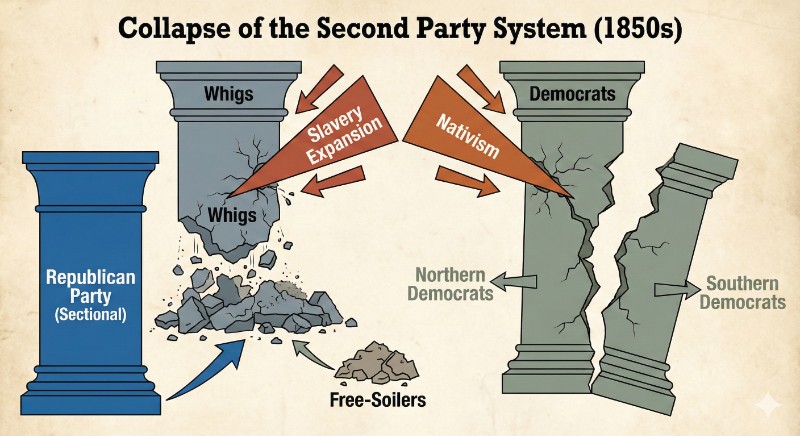
What was the most notable sectional party to emerge in the North after the Second Party System collapsed?
The Republican Party emerged in the North as the most prominent new sectional party, fostered by the weakening of the old party system.
According to the text, what was the central political failure leading towards the Civil War?
The central failure was the inability of political compromises, such as the Kansas-Nebraska Act, to resolve the issue of slavery in the territories and reduce conflict.
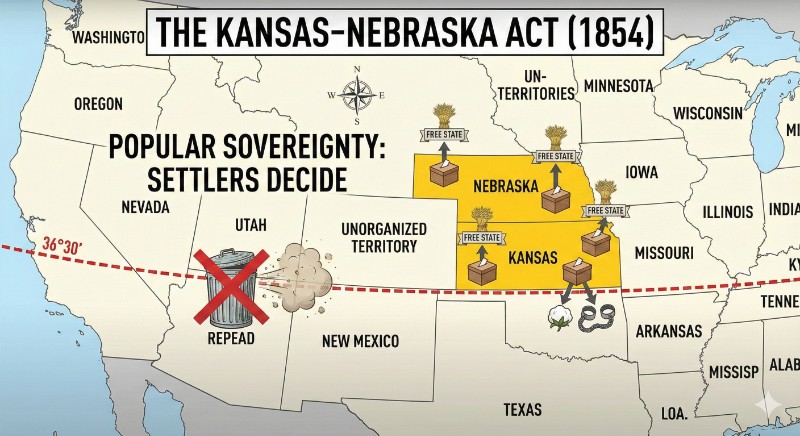
What was the Kansas-Nebraska Act?
An attempt to resolve the issue of slavery in the territories by allowing settlers there to decide whether to permit slavery, a principle known as popular sovereignty.
What are sectional parties?
Political parties that emerge when loyalties are weakened, drawing their support from a specific region or section of the country rather than the nation as a whole.
Identify two specific government actions that, instead of solving the slavery issue, failed to reduce conflict.
The Kansas-Nebraska Act (legislative branch) and the Dred Scott decision (judicial branch) were two attempts that ultimately failed to reduce conflict over slavery.
What were the two main issues that fractured the Second Party System?
The two primary issues that weakened party loyalties and led to the system's end were the expansion of slavery and anti-immigrant nativism.