
AP U.S. History Practice Quiz: Military Conflict in the Civil War
Written by AP Content Team, Verified for 2026 AP Exams, Last updated: August 2026
Test your understanding with short quizzes. This quiz has 9 questions to check your progress.
Question 1 of 9
All Questions (9)
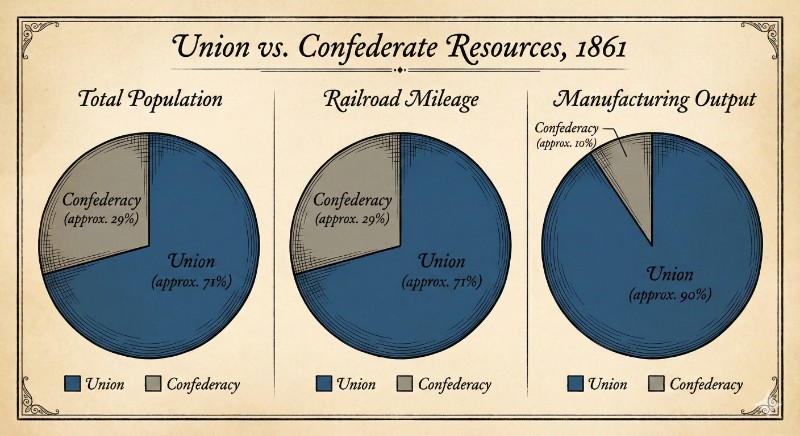
A) Superior resources
B) Early military initiative
C) Unwavering support from the home front
D) The immediate effectiveness of its military leadership
Correct Answer: A
The text explicitly states the Union ultimately succeeded due to factors including 'greater resources,' which was a key long-term advantage over the Confederacy.
A) It was hampered from the start by poor military leadership.
B) It was successful in its early stages due to military effectiveness.
C) It failed primarily because of widespread home front opposition.
D) It possessed greater resources than the Union throughout the war.
Correct Answer: B
The text states, 'the Confederacy showed military initiative early in the war,' indicating it was effective in the initial phase of the conflict.
A) A lack of early military initiative.
B) The destruction of their primary infrastructure.
C) Significant internal dissent and opposition.
D) A failure to mobilize their economies for war.
Correct Answer: C
The text mentions that both sides waged the war 'even while facing considerable home front opposition,' indicating that internal dissent was a shared problem.
A) the destruction of the Southern infrastructure.
B) improvements in military leadership and strategy.
C) a lack of home front opposition.
D) the achievement of key military victories.
Correct Answer: C
The text explicitly states that the Union, like the Confederacy, faced 'considerable home front opposition,' so a lack of it was not a factor in its victory. The other options are all directly mentioned as reasons for Union success.
A) were superior to the Confederacy's from the outset of the war.
B) were a consistent weakness that was overcome by economic strength.
C) developed and became more effective as the war progressed.
D) were less important to the final outcome than home front morale.
Correct Answer: C
The text cites 'improvements in leadership and strategy' as a reason for the Union's ultimate success, which implies that they were not as effective at the beginning but became a key factor over time.
A) maintaining the strategic advantages it held from the very beginning of the conflict.
B) overcoming early Confederate military effectiveness through strategic and leadership development.
C) resolving all home front opposition before achieving key victories.
D) the Confederacy's failure to mobilize its society for war.
Correct Answer: B
The text contrasts the Confederacy's 'military initiative early in the war' with the Union's ultimate success due to 'improvements in leadership and strategy,' implying the Union had to develop these aspects to turn the tide of the war.
A) a limited conflict fought only by professional armies.
B) a total war requiring the full commitment of national resources and population.
C) a war that was primarily resolved through economic sanctions rather than battle.
D) a conflict that had little impact on civilians on the home front.
Correct Answer: B
The concept of mobilizing entire economies and societies is a key characteristic of total war, where all national resources are directed towards the war effort, a direct contrast to a limited conflict.
A) The Union won because it faced no significant challenges on the battlefield or at home.
B) The Confederacy's early advantages were eventually overcome by the Union's superior resources, improved strategy, and destructive capacity.
C) The primary factor in the Union victory was the unanimous support of its civilian population.
D) The Confederacy lost solely because its economy and society failed to mobilize for the war effort.
Correct Answer: B
This statement accurately combines the key points from the text: the Confederacy's early initiative, and the multiple factors (resources, leadership/strategy, destruction of infrastructure) that ultimately led to the Union's success.
A) improving the Union's military leadership.
B) increasing home front opposition in the Confederacy.
C) undermining the Confederacy's ability to utilize its resources and wage war.
D) demonstrating the Union's early military initiative.
Correct Answer: C
The destruction of infrastructure is listed alongside 'greater resources' as a reason for Union victory. Damaging infrastructure directly impacts a nation's ability to supply its army and sustain its economy, thus crippling its war-waging capabilities.